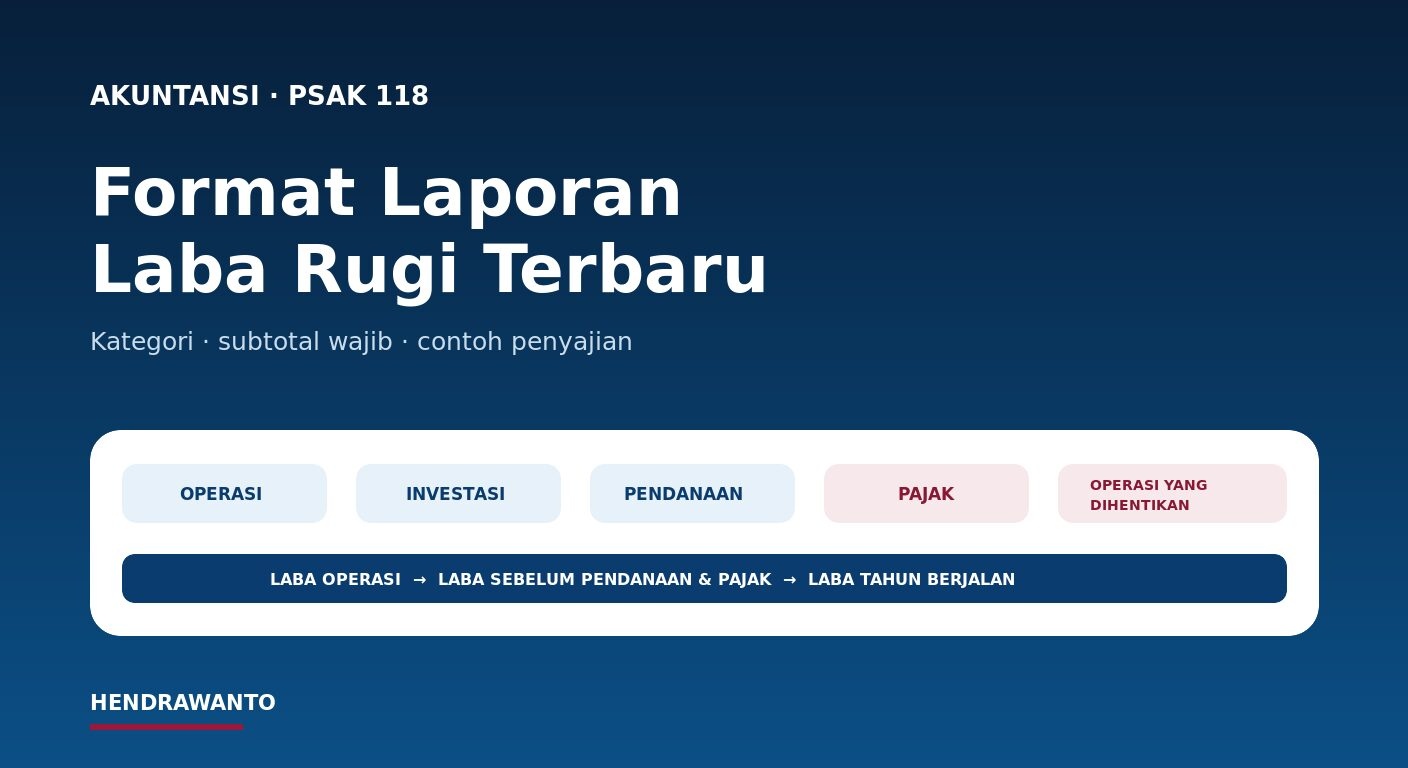
PSAK 118 changes the structure of the statement of profit or loss through defined categories and subtotals. The change is significant, but it does not prescribe one rigid form that every company can copy.
On 28 May 2025, DSAK IAI approved PSAK 118 Presentation and Disclosure in Financial Statements. Based on IFRS 18, it replaces PSAK 201 and is effective from 1 January 2027. It primarily changes how financial performance is presented and explained rather than recognition or measurement.
Important limitation: the format below is designed for a general non-financial entity. Banks, finance companies, insurers and entities whose main business activity is investing in assets or providing financing to customers require a separate classification analysis.
Five categories in profit or loss
Income and expenses are classified into operating, investing, financing, income taxes and discontinued operations. Operating is the default category: an item that does not meet the requirements of the other four categories is classified as operating. It is therefore not limited to recurring items; volatile or unusual items may remain operating.
Operating
This category includes all income and expenses not classified in investing, financing, income taxes or discontinued operations. It provides a complete picture of an entity's operations during the period.
Investing
Investing generally includes returns from assets that generate returns individually and largely independently of other resources, as well as investments in associates and joint ventures.
Financing
Financing includes income and expenses from liabilities arising from financing transactions and interest or changes in interest rates on other liabilities.
Required subtotals
For a general non-financial entity, PSAK 118 results in three key totals or subtotals: operating profit or loss, profit or loss before financing and income taxes, and profit or loss for the year.
Gross profit, totals for investing or financing, profit before tax and profit from continuing operations may be presented when required by another standard or needed to provide a useful structured summary. Additional subtotals must be consistent, not misleading and no more prominent than required subtotals.
Illustrative PSAK 118 format
The following example is adapted from the working format supporting this article. Expenses are shown in parentheses and 2026 comparative information is assumed to have been restated.
| Profit or loss item | Note | 2027 | 2026 restated |
|---|---|---|---|
| OPERATING CATEGORY | |||
| Revenue | xx | xxx | xxx |
| Cost of revenue | xx | (xxx) | (xxx) |
| Gross profit | xxx | xxx | |
| Other operating income | xx | xxx | xxx |
| Selling and marketing expenses | xx | (xxx) | (xxx) |
| General and administrative expenses | xx | (xxx) | (xxx) |
| OPERATING PROFIT/(LOSS) | xxx | xxx | |
| INVESTING CATEGORY | |||
| Income from assets generating individual returns | xx | xxx | xxx |
| Share of profit/(loss) of associates and joint ventures | xx | xxx/(xxx) | xxx/(xxx) |
| PROFIT/(LOSS) BEFORE FINANCING AND INCOME TAXES | xxx | xxx | |
| FINANCING CATEGORY | |||
| Interest expense on financing liabilities | xx | (xxx) | (xxx) |
| Interest expense on other liabilities | xx | (xxx) | (xxx) |
| Profit/(loss) before income taxes | xxx | xxx | |
| Income tax expense | xx | (xxx) | (xxx) |
| Discontinued operations, net of tax | xx | xxx/(xxx) | xxx/(xxx) |
| PROFIT/(LOSS) FOR THE YEAR | xxx | xxx | |
Not all interest income is investing
Automatically classifying all interest income as investing and all interest expense as financing is too simplistic. Classification changes when investing in assets or providing financing to customers is a main business activity.
For some entities, the profit before financing and income taxes subtotal may not be presented when the specified main-business-activity requirements make it irrelevant.
Expenses by nature, function or both
An entity presents operating expenses by nature, function or a mixture, selecting the approach that provides the most useful structured summary. Nature-based examples include raw materials, employee benefits, depreciation and advertising. Function-based examples include cost of sales, distribution, marketing and administration.
If one or more expense line items are presented by function, specified information about expenses by nature must still be disclosed in the notes. The format change can therefore require changes to the chart of accounts and supporting data.
Management-defined measures are not a sixth category
Adjusted EBITDA, core profit or normalised profit are not automatically required subtotals. If a subtotal used in public communications meets the definition of a management-defined performance measure, PSAK 118 requires disclosure in a single note, including calculation and reconciliation.
Transition to 2027
Calendar-year entities need the new structure for 2027 financial statements. Comparative 2026 information must be restated when PSAK 118 is first applied. Preparation should cover account mapping, assessment of main business activities, required and additional subtotals, disaggregation of “other” accounts, identification of management-defined measures, and changes to systems and controls.
Good implementation is more than relabelling rows. It requires understanding the source of each income and expense item and connecting primary statements to the notes.
Official references
This article provides general information and an illustrative format for a general non-financial entity. Application requires the full PSAK 118 text, entity-specific facts, materiality, main business activities and other applicable standards.