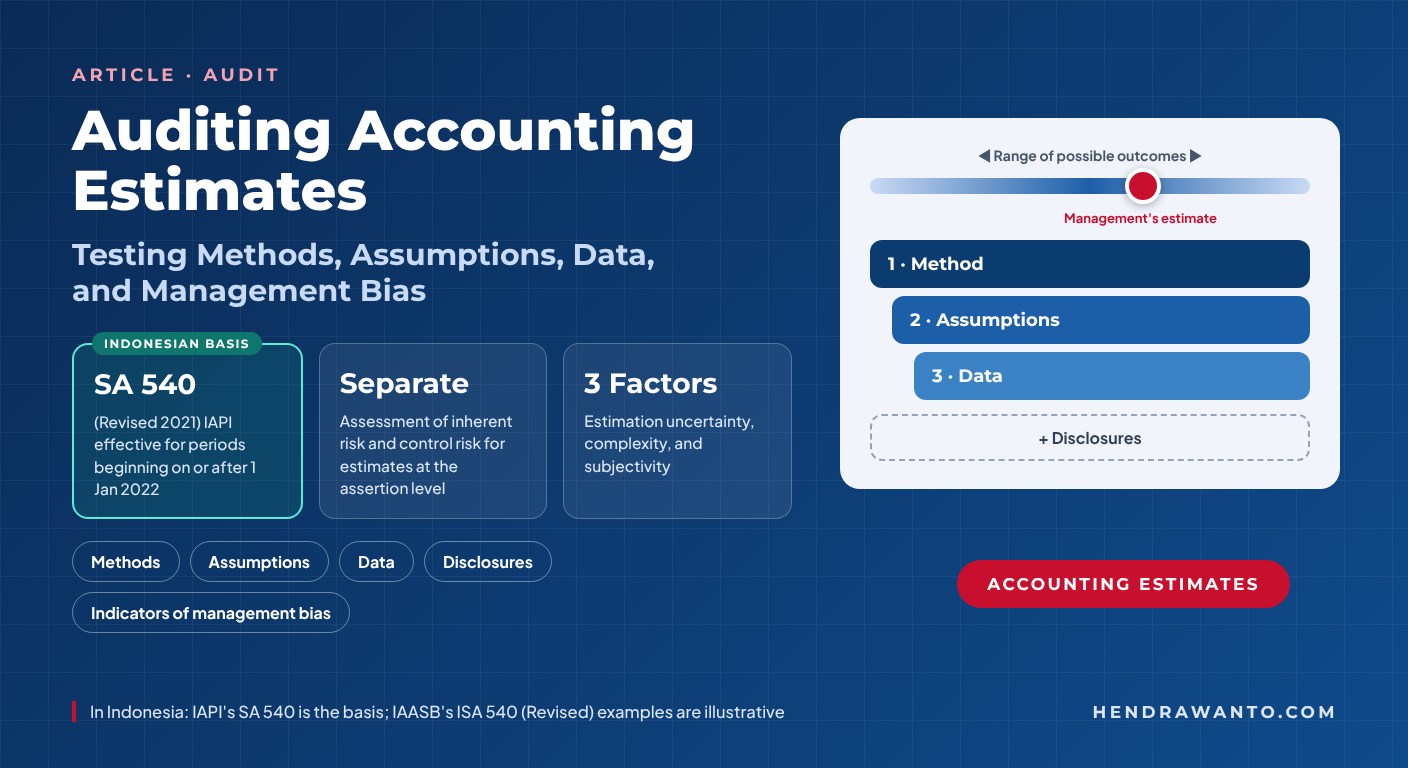
An accounting estimate often appears in the financial statements as a single, precise figure. Behind it, management may have chosen a method, used incomplete data, and made assumptions about circumstances that have not yet occurred. The figure can be prepared carefully and still carry uncertainty. For the auditor, the question is not whether the final outcome will one day equal today's estimate exactly, but whether the estimate and its disclosures are reasonable under the applicable financial reporting framework and supported by sufficient appropriate audit evidence.
In Indonesia, IAPI's professional standards page lists SA 540 (Revised 2021) "Audit of Accounting Estimates and Related Disclosures", effective for audits of financial statements for periods beginning on or after 1 January 2022. IAPI's summary states that the standard requires a separate assessment of inherent risk and of control risk for accounting estimates at the assertion level. The same page also includes SA 540 in the Standar Audit 2025 set, so confirm which edition applies to the period being audited.
Why Estimates Need to Be Read Differently
Some financial statement items can be determined from completed transactions and fairly direct documents. Estimates require additional judgement: how to measure a value when the outcome is uncertain, which information is relevant, and when a change in circumstances should be reflected. Illustrative examples include a provision for inventory impairment or an impairment of property, plant and equipment that uses a model. These examples do not imply that every entity uses the same model or faces the same level of risk.
According to the IAASB, ISA 540 (Revised) — effective for audits of periods beginning on or after 15 December 2019 — asks auditors to look beyond estimation uncertainty to complexity, subjectivity, and other inherent risk factors. Uncertainty relates to the range of possible outcomes. Complexity may arise from a model or from many inputs. Subjectivity appears when the choice of assumptions depends heavily on management's judgement. These factors can interact. A complex model is not automatically wrong, but the auditor needs to understand how it works and why particular inputs were chosen.
Estimation uncertainty
How wide the range of possible outcomes is.
Which assumption moves the outcome most if it changes?
Complexity
Models, many inputs, or diverse data sources.
Is the model applied in line with the measurement objective, and is the data complete?
Subjectivity
Choices that depend heavily on management's judgement.
What supports the choice, and is there a pattern leaning one way?
It is also important to distinguish uncertainty from misstatement. A wide range of outcomes does not by itself prove that the reported figure is wrong. Conversely, a figure that looks precise does not guarantee that its method, assumptions, and data are sensible. The auditor's assessment focuses on how the estimate was formed, the evidence available, and its consistency with the applicable reporting requirements.
Start with How Management Builds the Figure
A useful examination begins by understanding the objective of the estimate and the accounting requirements that govern it. The auditor traces who prepared the calculation, who reviewed it, where the data came from, and why the method was chosen. If the entity changed its method or assumptions from the previous period, the reason for the change needs to be understood. A change may reflect legitimate new information, but it may also change the outcome materially.
Risk assessment cannot be replaced by the same list of procedures for every estimate. The auditor needs to consider which part is most sensitive to error: the integrity of source data, the application of the model, economic assumptions, or the completeness of disclosures. IAPI's summary links SA 540 to the relevant requirements of SA 315 (Revised 2021) and SA 330 (Revised 2021) for identifying risks and designing responses. In other words, audit procedures follow the assessed risks, including decisions about relevant controls.
- 1Management preparesThe measurement objective, method, assumptions, and data are selected and reviewed.
- 2Auditor assesses riskInherent risk and control risk are assessed separately at the assertion level (SA 315).
- 3Response & testingMethod, assumptions, data, and disclosures are tested according to risk (SA 330).
- 4EvaluationReasonableness of estimates and disclosures, misstatements, and indicators of management bias.
As an illustration, when a calculation depends on data from many systems, the completeness and accuracy of that data become important. When the outcome is highly sensitive to a single assumption, the auditor needs to assess the basis for that assumption and the effect of reasonable alternatives. This is an example of a way of thinking, not a recipe of required procedures for every engagement. The evidence needed always follows the entity's facts, materiality, and reporting framework.
Test Methods, Assumptions, and Data Together
The method explains how information is turned into an estimate. The auditor needs to understand whether the method suits the measurement objective and is applied consistently with the applicable framework. Recalculation can find arithmetic errors, but it does not answer whether the method is appropriate. A model that calculates correctly can still produce a misleading figure if its structure or application is unsuitable.
Assumptions are choices about circumstances that affect the outcome. The auditor can compare them with relevant internal and external information, check consistency across parts of the calculation, and consider whether management's choices have an explainable basis. The auditor is not required to make a precise forecast; what is assessed is the reasonableness of the choices at the time the statements were prepared and the quality of the supporting evidence.
Data is the foundation of both. The auditor needs to question the source of the data, the completeness of the population, the correctness of the period, and any changes made before the data enters the model. Data generated by the entity's systems is not automatically reliable just because it comes as a digital report. External data, too, must be read for its relevance to what is being measured. Testing the method without assessing the data, or assessing assumptions without understanding the model, easily leads to an incomplete conclusion.
The IAASB's illustrative examples, published on 29 May 2020, cover one simple estimate (a provision on inventory impairment) and one complex estimate (a provision on property, plant and equipment impairment). The IAASB stresses that each example illustrates only a selection of the requirements of ISA 540 (Revised) and is not meant to be exhaustive. They should therefore not be treated as a checklist that replaces the auditor's judgement or the text of the SA applicable in Indonesia.
Management Bias Does Not Always Look Like a Calculation Error
Management may choose a point within a range of estimates that favours a particular result. Each decision may still have a legitimate reason, so the auditor needs to look at the pattern and the basis of those choices rather than jump to a conclusion of fraud. According to IAPI's summary, SA 540 specifically includes requirements on indicators of possible management bias and on evaluating misstatements in accounting estimates.
Indicators may arise when optimistic assumptions are used repeatedly without comparable support, when changes in method are not adequately explained, or when disclosures obscure important sources of uncertainty. The auditor then weighs contradictory evidence and asks for explanations that can be tested. Professional skepticism means staying open to evidence that both supports and undermines management's estimate; it is not a presumption that every management judgement is wrong. Where indications point towards fraud, the discussion overlaps with the auditor's fraud responsibilities; see Revised ISA 240: The Auditor's Responsibilities Relating to Fraud.
Actual outcomes after the reporting date also need careful reading. A difference between the actual outcome and an earlier estimate can help in understanding the estimation process, but it does not always prove the earlier estimate was wrong. Conditions may have changed after the estimate was made. A fair assessment distinguishes information available at the time of preparation from information that emerged later.
Disclosures Are Part of What Is Audited
Users of financial statements need more than a single final amount. They also need the explanations required by the reporting framework about policies, key assumptions, and relevant uncertainty. Adequate disclosure helps users understand why a figure could change when assumptions change. However, a long narrative is not automatically adequate if the key information is vague or inconsistent with the recognised amount.
The auditor therefore evaluates estimates together with the related disclosures. A figure may fall within an acceptable range while the explanation of its uncertainty still needs improvement. Conversely, detailed disclosure does not justify an unsupported measurement. The auditor's objective, as summarised by IAPI, is to obtain sufficient appropriate audit evidence about whether accounting estimates and related disclosures are reasonable in the context of the applicable financial reporting framework. The effect on the auditor's report is discussed in Understanding Audit Opinions on Financial Statements.
Conclusion
Auditing accounting estimates requires a clear link between risk and evidence. The auditor understands how management builds the figure, assesses uncertainty, complexity, and subjectivity, and then tests methods, assumptions, data, and disclosures as circumstances require. A good conclusion does not promise that the future outcome will exactly equal the estimate. It states whether sufficient appropriate audit evidence supports the reasonableness of the estimate at the time the statements were prepared, including whether there are indications of bias that need follow-up.
Need a discussion of auditing estimates in line with the applicable standards? See our Financial Statement Audit service.
Official References
- IAPI: Public Accountant Professional Standards — SA 540 (Revised 2021) Audit of Accounting Estimates and Related Disclosures
- IAASB: Auditing Accounting Estimates (ISA 540 Revised)
- IAASB: ISA 540 (Revised) Implementation — Illustrative Examples (29 May 2020)
This article is general information and does not replace a full reading of the auditing standards, the applicable financial reporting framework, or professional judgement for specific circumstances. Check official IAPI and IAASB publications before making decisions. The Indonesian version is the original text.