The transaction price can be negotiated, but risks that are not found before signing often turn into losses after the deal closes. Due diligence is needed to test whether earnings really recur, cash is available, liabilities have been recorded, ownership and licences are valid, and the growth plan can be justified. The result is not just a list of findings but the basis for proceeding, changing the structure and price, asking for contractual protection, or stopping the transaction.
The most common mistake is to run due diligence as a document-collection exercise. It looks busy but produces no decision. Robust work starts from the deal thesis, identifies the risks that could destroy value, connects evidence across functions, and turns findings into numbers or deal terms that can be acted on.
Due Diligence at a Glance
| Aspect | Meaning |
|---|---|
| Purpose | Validate deal assumptions and identify risks before the decision becomes hard to reverse |
| Core questions | What is really being bought, what is its economic value, which liabilities transfer, and what could destroy value after the deal |
| Output | Quantified findings, normalised earnings, net debt position, working capital target, legal and tax risks, price recommendations and deal protections |
| Limits | Does not guarantee that every risk is found and is not automatically an audit, a business valuation, or a legal opinion |
| Decision | Proceed, proceed with conditions, renegotiate, restructure, or stop the transaction |
Not an Audit, and Not Just a Valuation
The term due diligence is often used too loosely, so users expect a level of assurance that was never promised in the engagement letter. Scope, the standards applied, data access, intended users, report format, and limits of responsibility must be agreed before the work starts.
| Work | Focus | Output | Basis |
|---|---|---|---|
| Financial statement audit | Whether the financial statements are free from material misstatement | Auditor's opinion with reasonable assurance | Standards on Auditing (SA) in the SPAP |
| Financial due diligence | Deal risks, quality of earnings, cash, debt, and working capital | Findings, adjustments, red flags, and deal implications | Deal thesis and the scope agreed in the engagement |
| Valuation | Estimating the value of a business or instrument | A value conclusion or range | Valuation standards, methods, projections, discount rates, and market assumptions |
| Agreed-upon procedures | Performing specific procedures agreed by the parties | Factual findings without an opinion or assurance conclusion | SJT 4400 (Revised) where the engagement has those characteristics |
| Legal due diligence | Legal status, authority, ownership, contracts, and disputes | Legal findings and protection recommendations | Applicable regulations and the scope of the legal profession |
According to IAPI, SJT 4400 (Revised) Agreed-Upon Procedures Engagements was adopted on 16 July 2025, is based on ISRS 4400 (Revised), and applies to engagements agreed on or after 31 December 2025, with early application permitted. It governs performing agreed procedures and reporting factual findings. Calling all due diligence work "agreed-upon procedures" is therefore also inaccurate. Classification must follow the substance of the engagement, not a marketing label.
Mapping the Scope
| Area | Key questions |
|---|---|
| Financial | Quality of revenue and EBITDA, cash flow, net debt, working capital, assets, capital expenditure, related-party transactions, and projections |
| Tax | Tax return compliance, fiscal reconciliation, audits and disputes, withholding and collection, VAT, transfer pricing, tax incentives, and historical exposure |
| Legal | Incorporation and changes, authority, ownership, licences, material contracts, assets, security, litigation, and sector compliance |
| Commercial | Market size, competitive position, customer concentration, churn, pricing, pipeline, distribution channels, and demand resilience |
| Operational | Capacity, productivity, suppliers, inventory, quality, safety, maintenance, locations, and business continuity |
| People | Key employees, pay structure, employee benefit obligations, disputes, culture, incentives, and talent-loss risk |
| Technology and data | System ownership, licences, cybersecurity, incidents, vendor dependence, privacy, data quality, and modernisation costs |
| Integrity and ESG | Beneficial owners, affiliates, anti-bribery, sanctions, reputation, environment, social, governance, and supply chain |
Not every transaction needs the same depth. Acquiring a family company with manual records needs sharper testing of data and related parties. Investing in a technology company needs focus on intellectual property ownership, data security, churn, and unit economics. Public company or licensed-sector deals need broader regulatory mapping. Using the same scope for every target is a weak approach.
Eight Questions That Must Be Answered
- Are the rights, assets, licences, contracts, customers, and resources considered important really held by the entity being bought?
- Is revenue recognised fairly, collectible, recurring, and not dependent on unusual transactions?
- Can EBITDA and profit be sustained after the former owner leaves and all normal costs are included?
- Why does profit differ from cash flow, and what normal working capital does the business need?
- Which obligations are not yet included as net debt, provisions, commitments, guarantees, tax, or claims?
- Are projections based on realistic capacity, contracts, prices, and capital expenditure?
- Does the transaction require regulatory approval, a competition notification, a change of control, or counterparty consent?
- What must happen from day one so that customers, employees, systems, cash, and controls are not disrupted?
Core Analyses in Financial Due Diligence
Quality of revenue and earnings
Sales growth is not enough. The team must test the basis for revenue recognition, cut-off patterns, returns, discounts, rebates, cancellable contracts, one-off revenue, related-party transactions, customer concentration, and how sales correlate with cash receipts. Revenue that jumps near period end but is followed by returns or long-dated receivables is a red flag, not evidence of growth.
Normalised EBITDA aims to estimate recurring performance after the deal. Adjustments must be symmetrical and evidenced: if one-off costs are added back, one-off income must also be removed. Adjustments that only raise EBITDA without testing under-recorded costs are bias, not analysis.
Cash flow and working capital
Profit can rise while cash weakens because receivables build up, inventory moves slowly, supplier payments are delayed, or costs are capitalised. The analysis must reconcile EBITDA to operating cash flow, measure cash conversion, test receivable and inventory ageing, and set normal working capital based on seasonality and growth. A working capital target that is too low shifts the cash shortfall to the buyer.
Net debt and debt-like items
Net debt should not stop at bank loans less cash. Lease liabilities, accrued interest, overdue tax, bonuses that have become obligations, severance or employee benefits, capital expenditure payables, factoring with recourse, guarantees, purchase commitments, disputes, and related-party balances all need assessing. Conversely, restricted cash should not be treated like free cash.
Assets, capital expenditure, and projections
Assets must be tested for existence, ownership, condition, utilisation, and replacement needs. Profit can look high when maintenance is deferred or operating costs are capitalised. Projections must be linked to capacity, prices, pipeline, headcount, working capital, and capital expenditure. Growth without an operational bridge is only a target, not a basis for value.
Bridging Enterprise Value to Equity Value
Financial due diligence is not a valuation, but its findings often change the inputs and the pricing mechanism. This simple form helps connect the analysis to the deal:
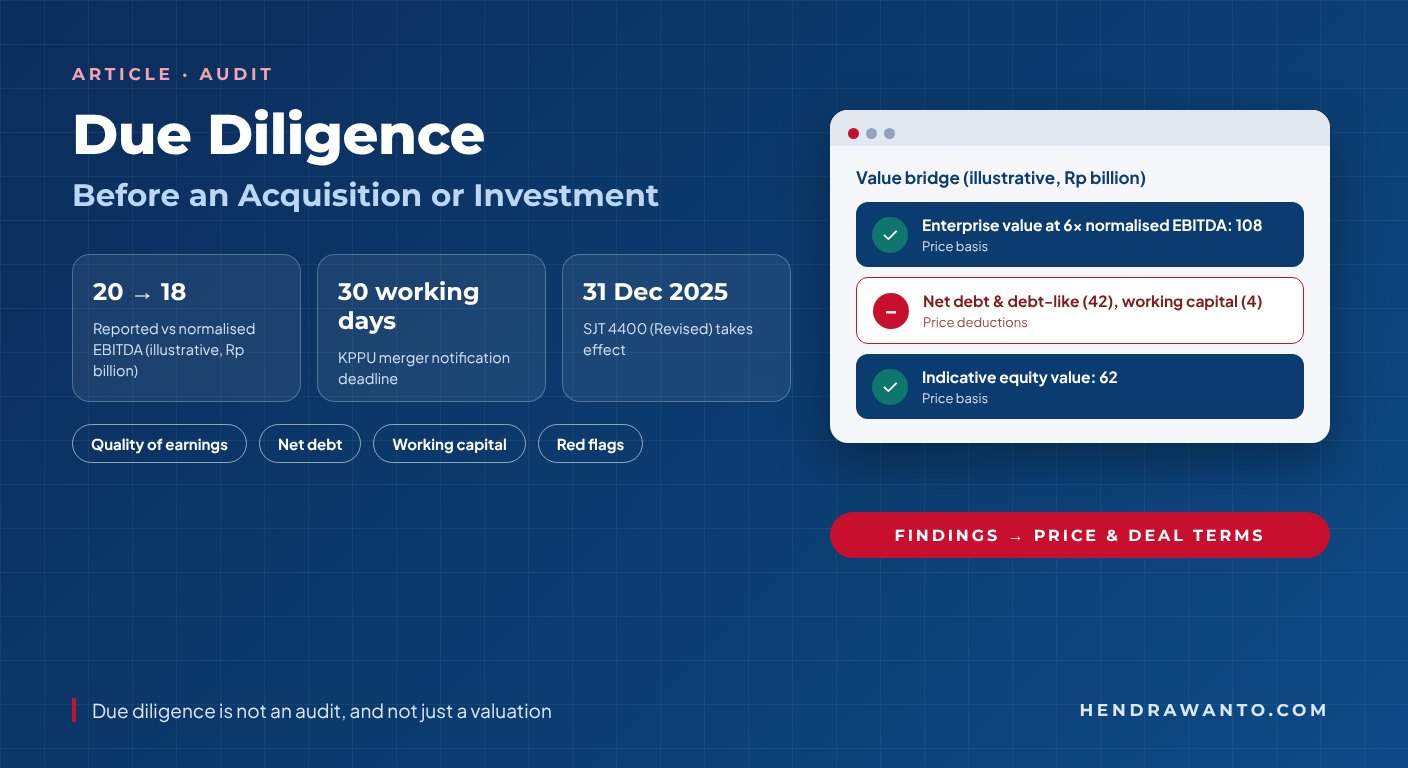
Indicative equity value = Enterprise value − Net debt − Debt-like items ± Working capital adjustment
The formula is not a single standard. Definitions of cash, debt, debt-like items, working capital, leakage, and the measurement date must be written into the transaction documents. Differences in definitions often matter more than small differences in valuation multiples.
Illustration of how findings affect price
| Component | Rp billion | Explanation |
|---|---|---|
| Reported EBITDA | 20.0 | Management figure |
| Less one-off claim settlement income | (3.0) | Non-recurring |
| Less under-accrued employee bonuses | (1.0) | Normal operating cost |
| Add back owner's personal expenses | 1.5 | Will not continue after the deal |
| Add back branch closure costs | 0.5 | Evidenced and non-recurring |
| Normalised EBITDA | 18.0 | Basis for deal analysis |
| Enterprise value at 6× EBITDA | 108.0 | Not Rp120.0 billion from reported EBITDA |
| Less net debt and debt-like items | (42.0) | Including obligations agreed as debt-like |
| Equity value before working capital | 66.0 | Enterprise value less related obligations |
| Working capital shortfall against target | (4.0) | Adjustment at completion |
| Indicative equity value | 62.0 | Illustration before other terms |
The illustration shows why an enterprise value of Rp120 billion implied by reported EBITDA can end at an indicative equity value of Rp62 billion. The gap does not automatically mean the target is flawed; it shows that the multiple, quality of earnings, debt definitions, and working capital must be read together. Every adjustment still has to be evidenced and negotiated.
Red Flags That Must Not Stay as Notes
| Indicator | Testing | Deal implication |
|---|---|---|
| Sales spike at period end | Test cut-off, delivery documents, customer acceptance, returns, and cash receipts | Normalise revenue, adjust price, or protect against returns |
| EBITDA up but operating cash down | Reconcile EBITDA to cash and analyse receivables, inventory, suppliers, and capitalisation | Working capital target, quality-of-earnings adjustment, or extra funding |
| Largest customer dominates revenue | Confirm contract, term, pricing, churn, and change-of-control clauses | Risk discount, measurable earn-out, or customer consent condition |
| Old receivables and high credit notes | Test ageing, payment history, disputes, returns, and receipts after the reporting date | Allowance, working capital reduction, or exclusion of impaired assets |
| High inventory with low turnover | Test ageing, utilisation, condition, selling price, and scrap | Write-down, working capital adjustment, or disposal plan |
| Routine costs recorded as assets | Review asset additions, invoices, capitalisation policy, and useful life | Correct EBITDA, assets, tax, and capex needs |
| Material related-party balances | Map beneficial owners, transaction substance, pricing, settlement, and dependence | Settlement before closing, transition agreement, or debt-like adjustment |
| Unresolved tax or employee obligations | Reconciliation, tax audits, disputes, actuarial calculations, and proof of payment | Indemnity, escrow, price retention, or closing condition |
| Licences, contracts, or assets not held by the target | Verify legal title, validity, transferability, security, and change-of-control clauses | Carve-out, consent, remediation, or stopping the deal |
| Undisclosed data security incidents | Test logs, incident response, vendor contracts, access, backups, and personal data protection compliance | Remediation before closing, cyber insurance, indemnity, or price adjustment |
A Process That Produces a Decision
- 1Set the deal thesisReasons to buy, sources of value, risk limits, and deal-breaking conditions.
- 2Scope & materialityFocus procedures on value risks, structure, sector, country, and data access.
- 3Confidentiality & accessNDA, data room, access rights, clean team if needed, and personal data protocols.
- 4Test data integrityReconcile the data room to financial statements, ledger, tax, bank, contracts, and operating data.
- 5Analyse & challengeAnalytics, sampling, walkthroughs, interviews, site visits, and follow-up evidence requests.
- 6Connect functionsBring together finance, tax, legal, commercial, operations, technology, and integrity.
- 7Quantify & prioritiseSeparate deal breakers, price adjustments, protection items, integration items, and accepted risks.
- 8Close into documentsMake sure findings reach the share purchase agreement, completion accounts, escrow, indemnities, covenants, and the 100-day plan.
Minimum Data Request
The request list must be tailored to risk. As a starting point, the team usually needs:
- monthly and annual financial statements, trial balance, general ledger, accounting policies, and reconciliation to audited reports;
- sales by customer, product, location, channel, and month; key contracts; pipeline; returns; discounts; and evidence of cash receipts;
- receivable and payable ageing, inventory details, fixed asset movements, capex, bank accounts, loans, security, and covenants;
- tax returns, fiscal reconciliations, tax audit correspondence, objections or appeals, transfer pricing documentation, tax incentives, and proof of payment;
- deeds and amendments, shareholder and beneficial owner data, licences, a list of material contracts, assets, security, litigation, and minutes of corporate organs;
- employee data, remuneration, bonuses, employee benefit obligations, employment agreements, key employees, and labour disputes;
- application architecture, licences, vendors, intellectual property, access lists, cyber incidents, backups, disaster recovery, and data policies;
- budgets and projections with assumptions for volume, price, margin, capacity, headcount, working capital, capex, and sensitivities.
Available documents are not automatically reliable. Data must be reconciled, traced to source, tested for consistency across periods, and compared with cash and operating behaviour. A full data room can still hide problems if the data structure does not allow testing.
Turning Findings into Deal Mechanisms
| Instrument | When to use | Examples |
|---|---|---|
| Price adjustment | The finding is measurable and economically falls on the buyer | Net debt, working capital, or assets that have lost value |
| Condition precedent | The issue must be resolved before closing | Regulatory approval, release of security, licence renewal, or counterparty consent |
| Representations and warranties | The seller states key facts and bears the consequences if they are untrue | Ownership, tax, compliance, disputes, or data |
| Specific indemnity | A particular risk is known but not yet final | Tax audit, lawsuit, environmental claim, or employee obligation |
| Escrow or holdback | Part of the price is held back to support claim settlement | Measurable risk with uncertain timing of resolution |
| Earn-out | Part of the price depends on future performance | Valuation expectation gaps; requires strict definitions and governance |
| Integration plan | The risk is accepted but must be controlled after closing | System migration, customer retention, cash controls, or governance improvements |
Not every risk has to reduce the price. Some are better handled through closing conditions, indemnities, escrow, or integration actions. However, putting every risk on the integration list just postpones the problem. Risks that could undermine legality, core revenue, cash, or licences must be resolved before the buyer loses bargaining power.
Indonesian Regulatory Context
Transactions do not happen in a vacuum. Law Number 40 of 2007 on Limited Liability Companies—amended, among others, by Law Number 6 of 2023—governs mergers, consolidations, acquisitions, and separations. A share acquisition must take into account the interests of the company, minority shareholders, employees, creditors and business partners, the public, and fair competition, and must follow the corporate procedures set out in that law. Acquisitions of public companies have a specific regime under OJK Regulation Number 9/POJK.04/2018. For certain transactions, the analysis must also cover sector approvals, creditor rights, employment, environment, and contracts with change-of-control clauses.
Competition. KPPU Regulation Number 3 of 2023 governs the assessment of mergers, consolidations, and acquisitions of shares and/or assets that may affect competition. In its press release of 16 October 2026, KPPU stated that 78 of the 82 merger and acquisition cases it had handled concerned late notification. KPPU reminded businesses that notification must be filed no later than 30 working days after the transaction becomes legally effective where combined assets exceed Rp2.5 trillion or combined sales exceed Rp5 trillion—for banking, combined assets above Rp20 trillion. KPPU also stressed that debt-settlement transactions are not automatically exempt. Although the mechanism is post-transaction, mapping the obligation and preparing documents should not start only after closing.
Beneficial ownership. The identity of the beneficial owner must be tested, not only the name of the direct shareholder. Presidential Regulation Number 13 of 2018 governs the principle of knowing the beneficial owners of corporations to prevent and combat money laundering and terrorism financing. IFC also treats integrity due diligence as an important part of choosing reputable partners.
Personal data protection. Data rooms often contain personal financial data and data on employees, customers, and others. Law Number 27 of 2022 governs personal data processing, controller and processor obligations, data transfers, sanctions, and data subject rights. Due diligence is not a reason to open all data without control.
Accounting after the acquisition. Where the transaction gives control, the buyer applies PSAK 103 Business Combinations: it identifies the acquirer, measures identifiable assets acquired and liabilities assumed at fair value under PSAK 113 Fair Value Measurement, and recognises goodwill or a bargain purchase gain. Due diligence findings on intangible assets, contingencies, and hidden liabilities therefore also feed the purchase price allocation.
The Broader Responsibility Framework
The OECD sees due diligence as a risk-based process to identify and address actual and potential impacts in operations, supply chains, and business relationships. Its framework has six steps: embedding policies and management systems, identifying impacts, ceasing or mitigating impacts, tracking results, communicating how impacts are addressed, and providing for or cooperating in remediation when appropriate. For transactions, the framework is a reminder that risk does not stop at the financial statements.
The Most Common Failures
- The scope is built from a standard checklist without linking it to the deal rationale and sector risks.
- The team accepts management explanations without tying them to the ledger, bank, contracts, tax, and operating data.
- EBITDA adjustments are asymmetrical and lean too heavily on claimed synergies or future savings.
- The report lists many findings but does not state their size, probability, action owner, and deal consequence.
- Financial, legal, tax, commercial, technology, and integrity due diligence run separately, so cross-functional red flags are missed.
- The work stops at the report; findings do not reach the price, the purchase agreement, the closing checklist, or the 100-day plan.
Weak due diligence creates false comfort. Complete documents and a tidy presentation are not enough if the work does not test the sources of earnings, cash availability, asset ownership, hidden liabilities, compliance, and operational resilience. The measure of success is simple: did the work change or strengthen the deal decision with traceable evidence?
Decision Checklist for Investors and Directors
| Area | Approval question |
|---|---|
| Value validation | Have normalised EBITDA, cash, net debt, working capital, capex, and projections been tested? |
| Completeness of risks | Are financial, tax, legal, commercial, operational, people, technology, data, integrity, and ESG risks connected? |
| Quality of evidence | Are findings based on primary documents, reconciliations, interviews, observation, and data after the reporting date? |
| Deal mechanisms | Has every material finding been placed in the price, conditions, warranties, indemnities, escrow, earn-out, or integration? |
| Authority and regulation | Have corporate, regulatory, creditor, customer, KPPU notification, and other approvals been mapped with their deadlines? |
| Day-one readiness | Can cash, authorisations, systems, customers, key employees, vendors, and reporting run after closing? |
| Final decision | Does the case for proceeding remain strong after all adjustments and downside scenarios? |
Conclusion
Good due diligence does not promise a risk-free deal. Its purpose is to make risks visible, measurable, allocated, and manageable before the decision becomes expensive to undo. Financial due diligence sits at the centre because it links quality of earnings, cash, debt, working capital, and projections to deal value, but its results are only complete when read together with legal, tax, commercial, operational, technology, people, and integrity aspects.
A strong decision is not the one with the thickest report but the one that clearly answers three things: what is really being bought, which risks come with it, and how those risks are reflected in the price, the transaction documents, and the integration plan.
Need support with financial due diligence before an acquisition or investment? See the Financial Statement Audit and Corporate Tax Advisory services, or request a proposal on the Proposal page.
Official References
- IAPI: Adoption of SA 600 and SJT 4400 (Revised)
- KPPU: 78 of 82 merger and acquisition cases concerned late notification (16 October 2026)
- KPPU legal database: KPPU Regulation Number 3 of 2023
- Law Number 40 of 2007 on Limited Liability Companies
- OJK: POJK Number 9/POJK.04/2018 on Acquisitions of Public Companies
- Presidential Regulation Number 13 of 2018 on Corporate Beneficial Owners
- Law Number 27 of 2022 on Personal Data Protection
- OECD: Due Diligence Guidance for Responsible Business Conduct
- IFC: Integrity Due Diligence
- PSAK 103 Business Combinations and PSAK 113 Fair Value Measurement (Indonesian SAK, IAI).
This article is general information and is not an audit opinion, a due diligence report, a business valuation, tax advice, or a legal opinion for any specific transaction. Scope and regulations must be tailored to the transaction structure, sector, jurisdiction, materiality, available data, and the form of professional engagement. The Indonesian version is the original text.