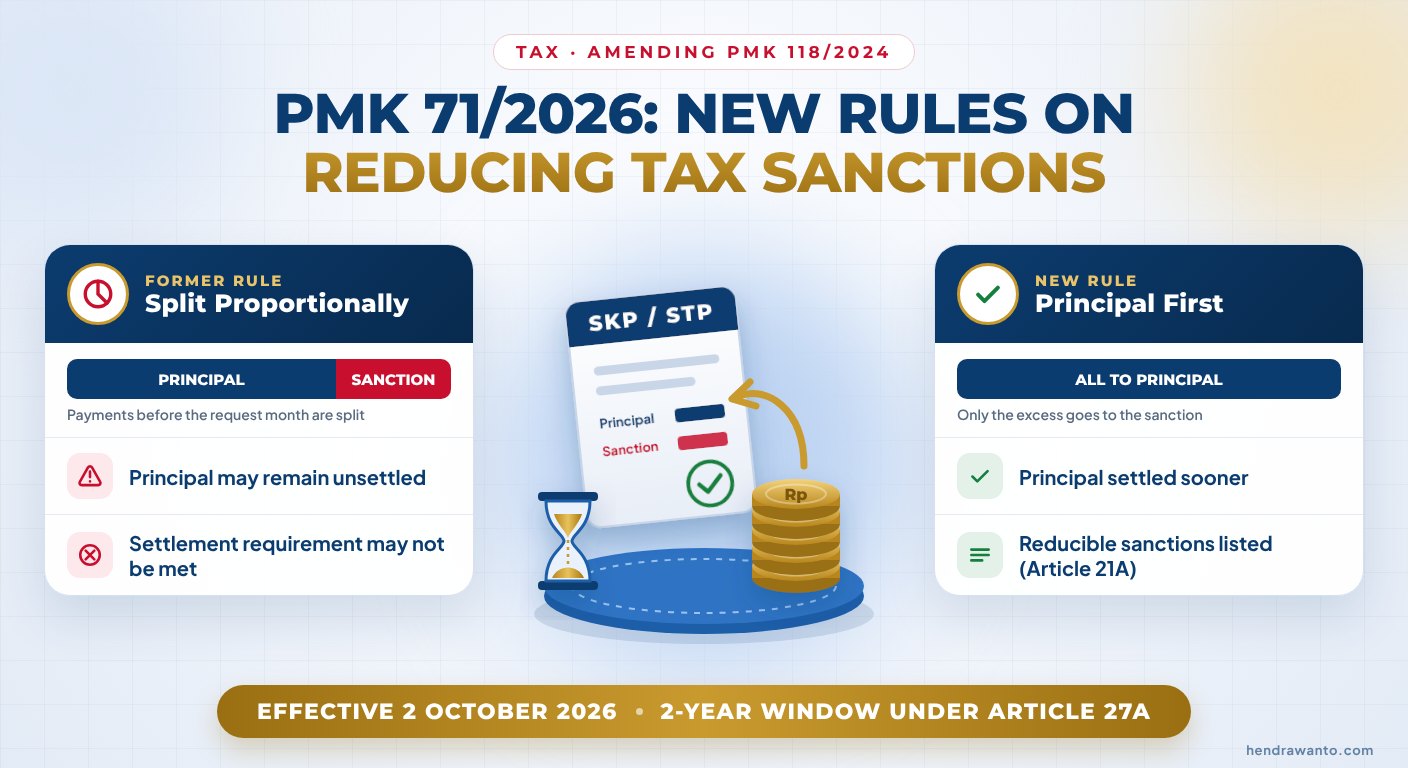
The Minister of Finance issued Minister of Finance Regulation (PMK) Number 71 of 2026 on 29 September 2026. It amends PMK 118 of 2024 on Procedures for Correction, Objection, Reduction, Removal, and Cancellation in the Field of Taxation, was promulgated on 2 October 2026, and took effect on that date. The amendments are few, but they touch very practical matters: how payments are counted when a taxpayer requests a reduction of sanctions, which sanctions can be reduced, and a two-year window to apply for sanction relief.
This article summarises those changes, what they mean for taxpayers holding a tax assessment letter (SKP) or tax collection letter (STP), and the steps to prepare.
What PMK 118/2024 Covers and Why It Was Amended
PMK 118/2024, in force since 1 January 2025, is the main implementing regulation for a taxpayer's administrative remedies outside appeals and lawsuits: correcting assessments with clerical or calculation errors, objections, reducing or removing administrative sanctions, reducing or cancelling incorrect assessments, and cancelling audit results produced without the proper procedure.
PMK 71/2026 does not replace that framework. It refines several articles: Articles 14 and 16 on the objection process, inserts Articles 21A and 27A, amends Articles 23 and 32, and replaces Appendix C, which contains letter formats and calculation examples. The rest of PMK 118/2024 remains in force.
Key Change: Payments Now Go to the Tax Principal First
One requirement for a request to reduce or remove sanctions is that the underpaid tax principal in the SKP or STP has been settled. The difficulty is that many taxpayers have already paid part of the bill before applying, and those payments were not necessarily booked as settlement of the principal.
Under the former wording of Article 23(6) of PMK 118/2024, payments made before the month in which the request was filed were allocated proportionally between the tax principal and the sanction. Only payments made in the same month as the request were treated entirely as settlement of the principal.
PMK 71/2026 amends paragraphs (6) and (7): payments on an SKP, STP, Land and Building Tax (PBB) SKP, or PBB STP are credited first to the unpaid tax principal. Only if the payment exceeds the principal is the excess credited to the administrative sanction or PBB administrative fine.
A simple illustration (hypothetical figures): an STP contains a principal of IDR 80 million and a sanction of IDR 20 million. The taxpayer pays IDR 80 million in the month before filing a request. Under proportional allocation, only IDR 64 million counts as principal, leaving an IDR 16 million shortfall, so the settlement requirement is not yet met. Under the new rule, the full IDR 80 million settles the principal, so a request to reduce the IDR 20 million sanction can be filed without further payment. Official calculation examples are set out in Appendix C of PMK 71/2026.
The Sanctions That Can Be Reduced Are Now Listed
The new Article 21A specifies the administrative sanctions and PBB administrative fines that may be reduced or removed, namely sanctions in:
- tax assessment letters (SKP);
- STPs relating to the issuance of an SKP, except STPs issued under Article 25(9), Article 27(5d), and Article 27(5f) of the General Tax Provisions and Procedures Law (UU KUP), i.e. the sanction provisions within the articles on objections and appeals;
- other STPs;
- PBB tax assessment letters; and
- PBB tax collection letters.
For STPs under those three excluded provisions, Article II of PMK 71/2026 sets a transitional rule: requests received before this PMK took effect and not yet decided are still settled under PMK 118/2024.
Article 23 also sets out formal requirements, including one request per assessment or collection letter, filed in writing in Indonesian with the taxpayer's reasons and amount, signed by the taxpayer, representative, or proxy, and submitted before an auction is requested or before the transfer relating to seized goods. For PBB fines on tax objects affected by natural, non-natural, or social disasters, some of the requirements relating to objection status and other requests do not apply.
Article 27A: A Two-Year Window
The inserted Article 27A states that, to support the national economy, the Director General of Taxes may reduce or remove administrative sanctions or PBB administrative fines on assessments or collection letters that meet the requirements of Article 23. This applies to requests filed no later than two years after PMK 71/2026 took effect, that is, from 2 October 2026.
It should be read carefully: Article 27A does not remove sanctions automatically. A request is still required, the Article 23 requirements (including settlement of the principal) still apply, and the decision remains within the Director General's authority. The term "amnesty" used in some media reports should therefore not be read as removal of sanctions without a process.
- 23 Dec 2024PMK 118/2024 issued
- 1 Jan 2025PMK 118/2024 takes effect
- 29 Sep 2026PMK 71/2026 issued
- 2 Oct 2026PMK 71/2026 promulgated and effective
- +2 yearsDeadline for Article 27A sanction relief requests, counted from 2 Oct 2026
Refinements to the Objection Process
For objections, PMK 71/2026 refines Articles 14 and 16. In reviewing an objection, the Director General of Taxes may exchange information for tax purposes with the tax authorities of partner countries or jurisdictions. Taxpayers must comply with a request to lend documents or provide information within 15 working days, and within 10 working days for a second request. If a request is not met, the objection is still processed on the basis of the available data.
The Notice to Attend is accompanied by a notice of the list of review findings together with a response form. That list is expressly not final and is not a decision on the objection. A written response must be submitted within 10 working days of the date the notice was sent. If the taxpayer does not attend, the absence is recorded in minutes and the objection is still decided. These deadlines are short, so supporting documents should be ready from the moment the objection is filed.
Reducing or Cancelling Incorrect Assessments
The amended Article 32 sets the requirements for requesting a reduction or cancellation of an incorrect SKP, SPPT, or PBB SKP, including how this interacts with objection status and other requests. A request may be filed at most twice, and the second request must be filed within three months of the date the decision on the first request was sent, unless circumstances beyond the taxpayer's control apply.
Practical Steps for Taxpayers
- Check the assessment typeMake sure the sanction falls under Article 21A. STPs under Article 25(9), 27(5d), and 27(5f) of the UU KUP are excluded from the SKP-related STP group.
- Settle the principalPayments are now credited to the tax principal first; only the excess goes to the sanction.
- File the requestIn writing, in Indonesian, one request per assessment, with the taxpayer's reasons and amount, before an auction is requested.
- DGT decisionReduction or removal is within the Director General of Taxes' authority, not automatic.
- List the SKPs and STPs that still carry sanctions, including PBB SKPs and STPs in the P5L sectors, together with their payment history.
- Recalculate the principal position under the new allocation rule: earlier payments may now be enough to settle the principal, opening the way to a sanction reduction request.
- Check the type of STP. STPs issued under Article 25(9), Article 27(5d), or Article 27(5f) of the UU KUP are excluded from the SKP-related STP group in Article 21A.
- Note the Article 27A deadline, two years from 2 October 2026, and the three-month deadline for a second request under Article 32.
- Prepare strong reasons and evidence. Sanction reduction remains a discretionary authority, not an automatic right.
- For objections in progress, prepare documents so the 15- and 10-working-day deadlines can be met.
Conclusion
PMK 71/2026 looks like a technical amendment, but its effect is real. Payments are now credited to the tax principal first, making the settlement requirement easier to meet; the sanctions that can be reduced are listed; and Article 27A opens a two-year window to apply for sanction relief. Taxpayers that still have outstanding sanctions should review their position now, while the window is open.
Need help calculating your principal position, preparing a sanction reduction request, or handling an objection? See the Tax Advisory service, and read also Three Digital Tax Changes in October 2026.
Official References
- Ministry of Finance Legal Documentation (JDIH): PMK 71 of 2026 (issued 29 September 2026, promulgated and effective 2 October 2026)
- Text of PMK 71 of 2026 (PDF, Indonesian)
- Ministry of Finance Legal Documentation (JDIH): PMK 118 of 2024 on Procedures for Correction, Objection, Reduction, Removal, and Cancellation in the Field of Taxation
- Text of PMK 118 of 2024 (PDF, Indonesian)
- Law Number 6 of 1983 on General Provisions and Tax Procedures, as amended.
This article is general information and is not tax advice for any particular situation. Application to each taxpayer must consider its facts, the assessment documents, the full text of the regulations, and the rules in force when the request is filed. The Indonesian version is the original text.