Almost every company in Indonesia with permanent employees carries a liability that is easy to overlook: the obligation to pay benefits when employees retire. The obligation arises from labour law, not from a pension fund the company sets up. PSAK 219 Employee Benefits governs how that obligation is recognised, measured and disclosed.
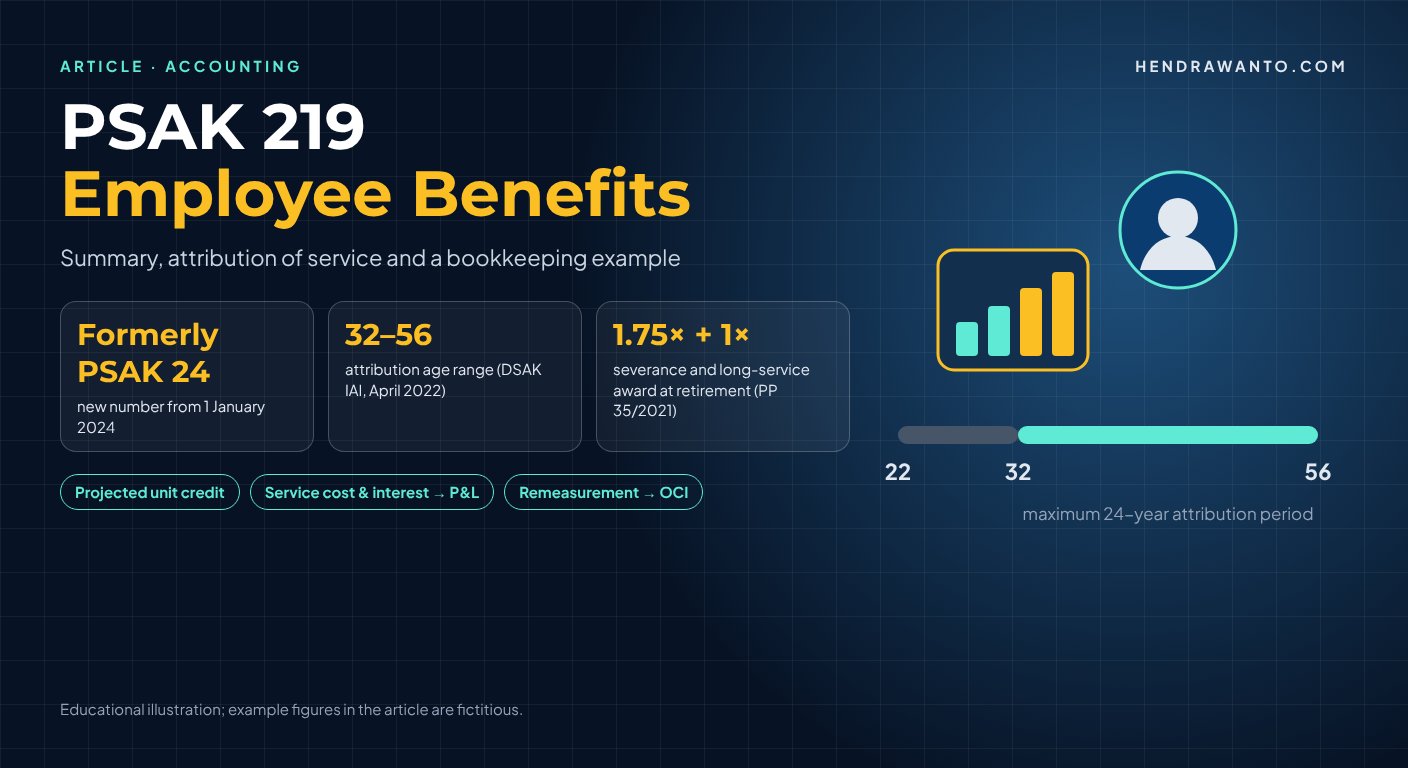
PSAK 219 is the new number for PSAK 24 following the renumbering of SAK Indonesia on 1 January 2024. Its content did not change because of the renumbering, and the leading "2" shows that it refers to IAS 19 Employee Benefits. Other old and new numbers are listed in the article PSAK and ISAK Number Conversion Table.
Four Types of Employee Benefits
| Type | Examples | Basic treatment |
|---|---|---|
| Short-term employee benefits | Salaries, religious holiday allowance (THR), paid leave, annual bonus | Recognised as an expense as the service is rendered, without discounting |
| Post-employment benefits | Statutory retirement benefits, pension fund programmes | Split between defined contribution and defined benefit plans |
| Other long-term employee benefits | Long-service awards (long leave, jubilee) | Measured like defined benefits, but all changes go to profit or loss |
| Termination benefits | Compensation for termination at the entity's initiative or for accepting a voluntary redundancy offer | Recognised when the entity can no longer withdraw the offer or when it recognises restructuring costs |
Defined Contribution and Defined Benefit Plans
Under a defined contribution plan, the company's obligation is limited to the contributions it pays, for example to a Financial Institution Pension Fund (DPLK). Contributions are expensed in the related period, and the employee bears the investment risk.
Under a defined benefit plan, the company promises a specified benefit, so actuarial and investment risk stay with the company. Retirement benefits under Indonesian labour regulations fall into this group. Government Regulation No. 35 of 2021 (PP 35/2021) provides, among other things, that an employee reaching retirement age is entitled to severance pay of 1.75 times the basic provision, a long-service award of 1 time, and compensation for entitlements. These amounts depend on years of service and wages, so they must be estimated actuarially.
If the company also participates in a defined contribution pension programme, the benefits of that programme may reduce the obligation depending on the regulation and the employment agreement. This needs to be analysed case by case.
Measuring the Defined Benefit Liability
PSAK 219 requires the projected unit credit method. In simple terms:
- Estimate the benefit at the payment date based on projected wages, years of service and the probability that the employee stays until retirement age.
- Attribute the benefit to periods of service. Each year of service "earns" a part of the benefit.
- Discount it to present value using high-quality bond yields. In Indonesia, because the market for high-quality corporate bonds is not deep enough, government bond yields with matching terms are generally used.
- Deduct the fair value of plan assets, if any, to arrive at the net defined benefit liability (asset).
Actuarial assumptions include the discount rate, salary increases, mortality, employee turnover and normal retirement age. In practice the calculation is prepared by an actuary, but management remains responsible for the reasonableness of the assumptions. The auditor will test the assumptions and the employee data used.
Attribution of Service: Age 32 to 56
In April 2022, DSAK IAI issued a press release on attributing benefits to periods of service. It refers to the IFRS Interpretations Committee agenda decision (May 2021) on plans where benefits are capped at a set number of years of service immediately before retirement.
Does not increase the retirement benefit; not attributed.
A maximum of 24 consecutive years of service is attributed.
DSAK IAI concluded that the retirement scheme under Indonesian labour regulations has a similar fact pattern. As a result:
- The retirement benefit is based on a maximum of 24 consecutive years of service up to age 56.
- Service before age 32 does not increase the retirement benefit, so it is not attributed.
- Attribution stops at age 56.
For illustration, an employee who started work at age 25 only begins to be attributed benefits at age 32. An employee who started at age 40 is attributed from age 40 to 56.
An entity that previously attributed benefits from the employment start date and switches to this pattern treats the switch as a change in accounting policy under PSAK 208 (formerly PSAK 25), not as a change in estimate.
What Goes to Profit or Loss and Other Comprehensive Income
| Component | Presented in |
|---|---|
| Current service cost | Profit or loss |
| Past service cost, including the effect of plan amendments or curtailments | Profit or loss |
| Net interest on the net defined benefit liability (asset) | Profit or loss |
| Remeasurements: actuarial gains and losses, return on plan assets excluding interest | Other comprehensive income, not reclassified to profit or loss |
A Simple Bookkeeping Example
Assume the actuary's report for PT Contoh for 2026 shows the following (fictitious figures, in million rupiah).
| Item | Amount |
|---|---|
| Employee benefit liability, 1 January 2026 | 1,000 |
| Current service cost | 150 |
| Interest cost (7% discount rate) | 70 |
| Benefits paid to retiring employees | (80) |
| Actuarial loss because the discount rate fell | 60 |
| Employee benefit liability, 31 December 2026 | 1,200 |
Summary journal:
| Account | Debit | Credit |
|---|---|---|
| Employee benefit expense (profit or loss) | 220 | |
| Remeasurement of employee benefit liability (other comprehensive income) | 60 | |
| Employee benefit liability | 280 | |
| Employee benefit liability | 80 | |
| Cash | 80 |
The 220 expense is the 150 current service cost plus 70 interest. For income tax, the employee benefit provision is generally not deductible until it is actually paid, so a temporary difference arises and is accounted for under PSAK 212 Income Taxes.
To try the calculation with your own data, use the Employee Benefits calculator.
Commonly Missed Points
- Incomplete employee data. Wrong dates of birth, joining dates or wages change the liability directly.
- Assumptions not updated. The discount rate and salary increases should be reviewed at each reporting date.
- Company policy more generous than the law. Company regulations or collective labour agreements that give higher benefits must be included.
- Insufficient disclosure. PSAK 219 requires disclosure of plan characteristics, risks, reconciliation of balances, key actuarial assumptions and sensitivity analysis.
Conclusion
PSAK 219 requires companies to recognise post-employment obligations as employees render service, not when benefits are paid. For retirement benefits under Indonesian labour regulations, apply the age 32 to 56 attribution pattern described in the 2022 DSAK IAI press release, and make sure employee data and actuarial assumptions are updated every year.
Official References
- DSAK IAI: Siaran pers pengatribusian imbalan pada periode jasa (April 2022)
- IAI: Komparasi Perubahan Penomoran PSAK ISAK
- Peraturan Pemerintah Nomor 35 Tahun 2021 tentang Perjanjian Kerja Waktu Tertentu, Alih Daya, Waktu Kerja dan Waktu Istirahat, dan Pemutusan Hubungan Kerja
Disclaimer. This article is general information and does not replace the official text of PSAK 219, labour regulations or the actuary's report. The figures are illustrative. For application to specific circumstances, consult an actuary and a public accountant. The Indonesian version is the original text.