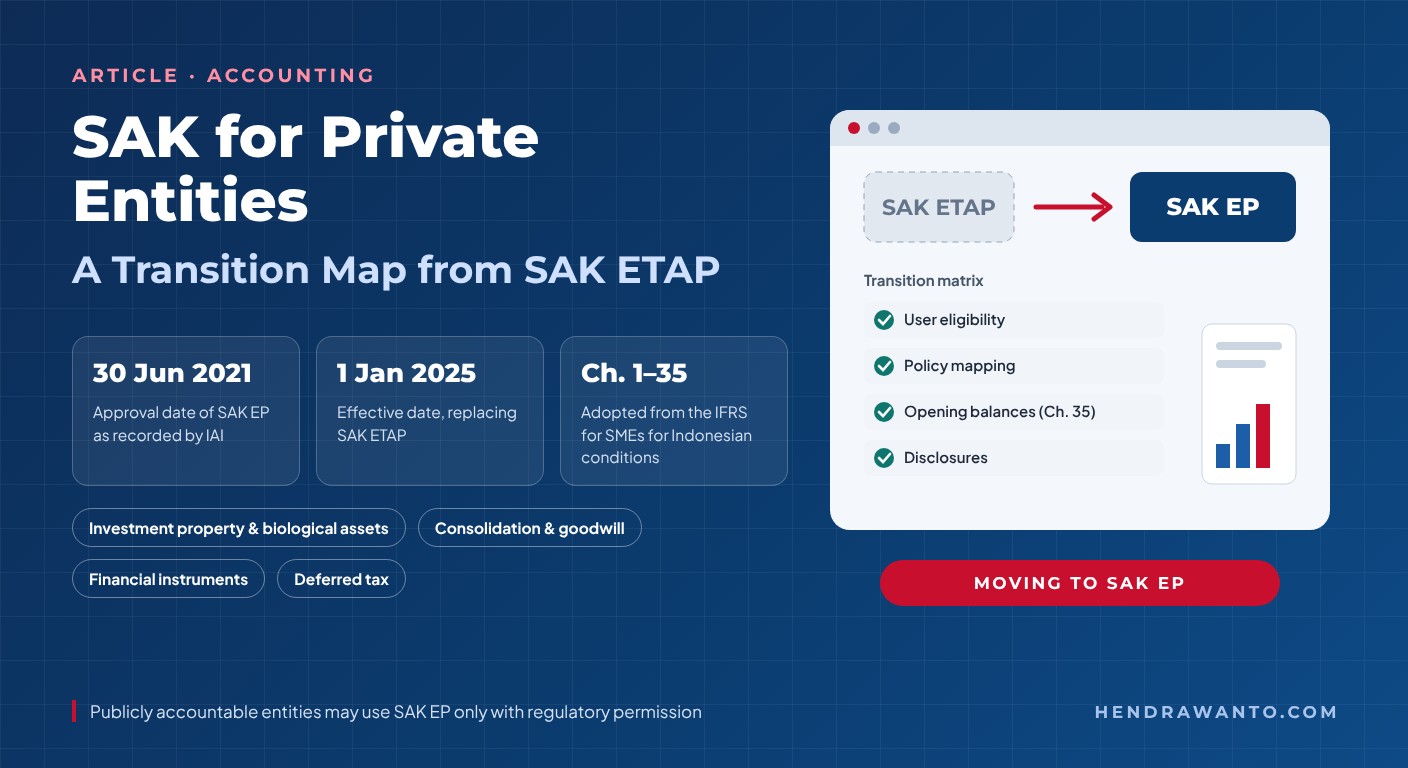
Since 1 January 2025, SAK Entitas Privat (SAK EP, the Indonesian Financial Accounting Standards for Private Entities) has been effective and has replaced SAK ETAP (the Financial Accounting Standards for Entities Without Public Accountability). The change should not be treated as a mere renaming. Entities need to confirm the basis for selecting the standard, map the impact on accounting policies, and prepare opening balances, comparative information and disclosures in an orderly way.
According to the Indonesian Institute of Accountants (IAI), SAK EP is intended for entities that do not have public accountability and that publish general purpose financial statements for external users. On its SAK ETAP page, IAI gives an example of external users: owners who are not directly involved in managing the business. An entity that has public accountability may use SAK EP only if the competent regulatory authority permits it. Business size alone therefore does not determine which standard applies.
- 30 Jun 2021Approval date of SAK EP as recorded by IAI.
- Before 1 Jan 2025Early application of SAK EP permitted.
- 1 Jan 2025SAK EP becomes effective and replaces SAK ETAP.
- 2025 onwardsEntities that meet the criteria prepare financial statements under SAK EP.
Confirm Eligibility Before Discussing Bookkeeping
The first step is to assess the entity's characteristics and the needs of its financial statement users. The key question is not simply "is this entity small?", but whether the entity meets the criteria for using SAK EP and whether any regulatory requirements apply. This assessment matters because the reporting framework affects presentation, recognition, measurement and disclosure.
SAK ETAP was previously intended for entities without significant public accountability that publish general purpose financial statements. IAI states that SAK ETAP is replaced by SAK EP as of 1 January 2025. Entities still using the old terminology or policies should revisit the basis of preparation of their financial statements. An overview of the other SAK pillars is available in the article Implementing the Latest SAK for Business.
What to Map from SAK ETAP to SAK EP
SAK EP is organised by topic in Chapters 1 to 35. IAI explains that the standard adopts the IFRS for SMEs while taking Indonesian conditions into account, and that it is simpler than the IFRS-based SAK in several ways:
- it removes topics considered irrelevant to private entities, such as earnings per share, interim financial reporting and operating segments;
- it limits accounting policy choices; for example, investment property is measured at fair value if this is possible without undue cost or effort, and otherwise under the cost model;
- it simplifies a number of recognition and measurement principles;
- it requires fewer disclosures and uses simpler language.
These simplifications do not mean that every SAK ETAP policy can be carried forward without evaluation. IAI also highlights significant differences from SAK ETAP, summarised in the figure below. The list is no substitute for reading the standard, but it helps identify which areas to prioritise in an impact analysis.
- 01Fair value for investment property and biological assets
- 02The concept of other comprehensive income
- 03Consolidated financial statements
- 04Business combinations and goodwill
- 05More detailed requirements for financial assets and liabilities
- 06Deferred tax
The financial reporting team can build a simple matrix showing the old policy, the relevant SAK EP requirement, the impact on opening balances, the impact on profit or loss or disclosures, supporting evidence, and the person responsible. Such a matrix helps distinguish changes that require numerical adjustments from changes that mainly require documentation or additional disclosure.
Organising the Transition
Transition requirements are set out in Chapter 35 of SAK EP. Outreach material on SAK EP published on the IAI website explains that the transition is in principle applied retrospectively, subject to certain exceptions and exemptions, and that the resulting adjustments are recognised in retained earnings. That material states that it does not represent the official position of IAI's implementation team, so the text of Chapter 35 remains the authoritative reference.
A good transition starts with an inventory of the main accounts and transactions. Inventories, property and equipment, investment property, financial instruments, revenue, employee benefits and income taxes are examples of areas worth mapping according to the entity's materiality and complexity. Management should then assess the availability of historical data and contract documents needed to apply the new policies consistently.
Next, prepare draft financial statements and notes early. SAK EP comes with Illustrative Financial Statements adopted from the IFRS for SMEs; IAI notes that their use should take account of consistency with Indonesian practice. Examples do not replace judgement about the entity's facts. Fair presentation remains the objective; being concise does not mean material information may be omitted.
Management, the finance function and the auditor or professional advisers should coordinate in good time. The aim is not to shift responsibility for preparing the financial statements to the auditor, but to make sure that policy, data and disclosure issues are identified early. Documenting management's judgements makes it easier to trace decisions and to hold later discussions.
Avoid Two Common Mistakes
The first mistake is to assume that every non-public entity automatically uses SAK EP. Public accountability status, user needs and regulatory requirements still have to be checked. The second mistake is to assume that SAK EP is identical to SAK ETAP simply because both are aimed at entities without public accountability. Replacing the standard requires an evaluation of the policies actually applied, not merely a change to the report title.
Entities should also avoid claiming full compliance before the mapping, adjustment and disclosure work is complete. Where there is uncertainty, the primary reference remains the applicable SAK EP and, where needed, professional advice based on the entity's specific facts.
Conclusion
SAK EP replaced SAK ETAP effective 1 January 2025. For entities that meet the user criteria, the focus is on confirming eligibility to use the standard, mapping material policy differences, applying the Chapter 35 transition requirements, preparing data and disclosures, and documenting management's judgements. A phased approach keeps the transition under control without oversimplifying important accounting issues.
See also the Accounting & SAK Implementation service, the article PSAK 118: Presentation and Disclosure, or request an estimate through the Proposal page.
Official References
- Indonesian Institute of Accountants (IAI), "Tentang SAK Entitas Privat (EP)", web.iaiglobal.or.id.
- Indonesian Institute of Accountants (IAI), "Tentang SAK ETAP", web.iaiglobal.or.id.
- Indonesian Institute of Accountants (IAI), "SAK Efektif Disahkan Selama Tahun 2021" (note on SAK Entitas Privat), web.iaiglobal.or.id.
- Indonesian Institute of Accountants (IAI), presentation "Sosialisasi SAK Entitas Privat" (Chapter 35 Transition), web.iaiglobal.or.id.
This article is general information and is not accounting, audit, legal or professional advice for any particular situation. Application of the standards must consider the entity's facts and applicable requirements. The Indonesian version is the original text.