In everyday conversations about auditing companies in the capital market, the term "listed company" is often used as a shortcut. It helps the conversation, but it is not always enough to determine which professional requirements apply. International standards are now shifting the reference from listed entity to publicly traded entity, while the code of ethics for public accountants in Indonesia has also updated its category to entities whose financial instruments are publicly traded. For auditors, this change in terminology needs to be read together with the purpose, scope, and effective date of each document.
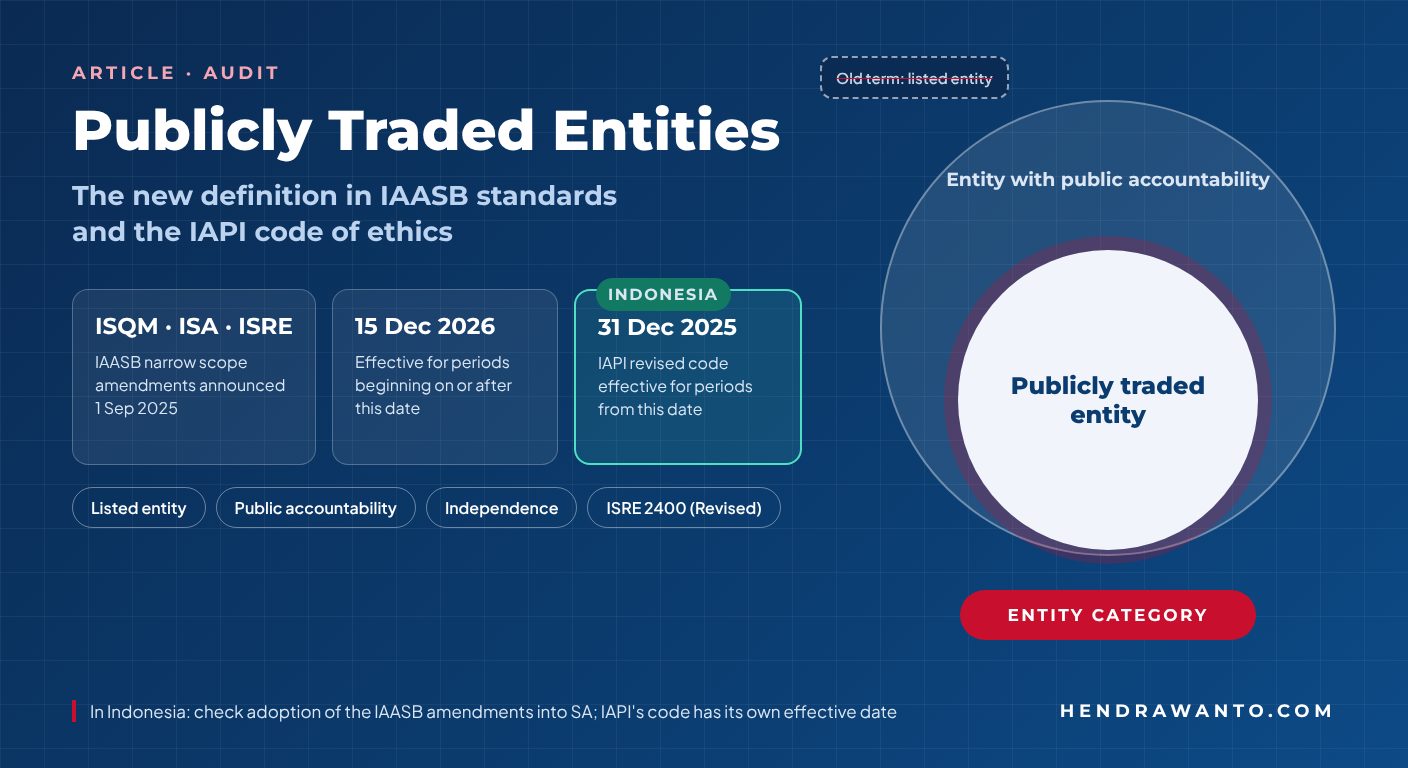
On 1 September 2025, the IAASB announced narrow scope amendments to the International Standards on Quality Management (ISQMs), the International Standards on Auditing (ISAs), and ISRE 2400 (Revised) to align their terminology with the IESBA Code of Ethics. The amendments are effective for engagements for periods beginning on or after 15 December 2026, a date deliberately aligned with ISA 570 (Revised 2024) and ISA 240 (Revised). In Indonesia, IAPI states that the revision to the code of ethics concerning entities listed in the capital market and entities with public accountability is effective for audits of financial statements for periods beginning on or after 31 December 2025, with early application permitted. The two dates must not be interchanged because they refer to different documents and different authorities.
- Narrow scope amendments to the ISQMs, ISAs, and ISRE 2400 (Revised) announced
- Effective for engagements for periods beginning on or after this date (aligned with revised ISA 570 and ISA 240)
- Revised code effective for audits of financial statements for periods beginning on or after this date
- Early application permitted
Why Does the Entity Definition Matter?
Certain audit and independence requirements distinguish entities by their level of public interest. Classification can determine whether additional requirements apply and what needs to be communicated or disclosed. If entity categories are set using misaligned terms, the audit team risks applying the wrong set of requirements to an engagement. Conversely, treating every large entity as a publicly traded entity can lead to conclusions that are too broad.
According to the IAASB publication, the amendments bring into the ISQMs and ISAs the same definition of publicly traded entity as the IESBA Code, while recognising the role local standard setters and regulators play in defining that category for their jurisdictions. In other words, the international term provides a common framework, while assessing an engagement in Indonesia still requires checking the applicable professional rules and local regulations.
IAPI explains that the revised Indonesian code replaces the term "entitas yang terdaftar di pasar modal" (entity listed in the capital market) with "entitas yang instrumen keuangannya diperdagangkan secara publik" (entity whose financial instruments are publicly traded). The revision also broadens the definition of entities with public accountability and sets an overarching objective for the additional independence requirements. The two categories are related, but they should not simply be equated in every context.
What Did the IAASB Change in the International Standards?
The IAASB release sets out four directions of change. First, the definition of publicly traded entity is incorporated into the ISQMs and ISAs. Second, requirements that have applied to audits of listed entities are redirected to apply to audits of entities in the new category. Third, the IAASB adds an overarching objective for the differential requirements for that category, together with a framework for considering when similar requirements may be appropriate for other entities.
Fourth, beyond audits, the IAASB adds a new requirement to ISRE 2400 (Revised) for public disclosure in the practitioner's review report when the practitioner has applied independence requirements specific to certain entities, such as public interest entities. This shows that the consequences of aligning the definition do not stop at a single type of engagement. The IAASB has also published a Basis for Conclusions to help stakeholders understand and implement the amendments.
However, applying the international provisions in Indonesia requires checking which standards have been adopted and their domestic effective dates; the IAASB release does not by itself change the text of Indonesia's Standar Audit (SA). Nor should the change of category be read as an automatic determination that every instrument ever listed on an exchange meets the new definition. Auditors need to examine the facts about the instruments, how they are traded, and the wording of the applicable definition, including any detail provided by local regulators.
Where Does IAPI's Revised Code of Ethics Stand?
On its official page, IAPI states that the revised Indonesian code refers to IESBA's final pronouncement on the revised definitions of listed entity and public interest entity, and that the Professional Ethics Committee prepared a basis for conclusions on its adoption. Besides replacing the term, IAPI mentions guidance on the factors for assessing an entity's level of public interest, a broader definition of entities with public accountability, and application material encouraging firms to consider whether other entities should be treated as entities with public accountability. The revision also requires firms to disclose when an audit client has been treated as an entity with public accountability.
These points relate to independence and professional ethics, whereas the IAASB amendments relate to the wording of the quality management, audit, and review standards. Aligned terminology does not mean that all requirements of the two documents are identical. In practice, teams need to read IAPI's code of ethics, Indonesian auditing standards, and the relevant regulatory provisions side by side. For group engagements, this assessment also touches on revised SA 600 on audits of group financial statements.
Checklist Before Setting the Category
- 1Gather the factsThe entity's financial instruments, markets, and trading mechanisms.
- 2Match the definitionThe wording in the applicable rules and any detail from local regulators.
- 3Map the consequencesAdditional independence requirements, audit or review procedures, and disclosures.
- 4Document & reviewRecord the basis for classification; revisit it when circumstances change.
The first step is to gather facts about the entity's financial instruments and how they are traded. The key question is not merely whether a listing code exists, but whether the nature of the instruments and their market access match the definition in the rules being applied. Documentation may include the terms of issue, trading status, and relevant regulatory references.
The next step is to map the consequences of the category against the applicable requirements. The audit team can record the source of the definition, the reasons for the classification, additional independence requirements, and the audit or review provisions that may be affected. Where more than one framework is used, for example international standards for network reporting and Indonesian professional standards for local engagements, note the difference in effective dates and do not draw a single conclusion for both without checking.
Finally, revisit the classification when the entity's circumstances change. Changes in instruments or trading mechanisms can make an earlier analysis inadequate. Periodic review helps the team explain its decisions to those charged with governance and prevents applying requirements that no longer fit the current circumstances.
Conclusion
The IAASB amendments shift the international reference from listed entity to publicly traded entity, effective for periods beginning on or after 15 December 2026. IAPI has issued a revised Indonesian code of ethics with an aligned category but its own effective date, namely periods beginning on or after 31 December 2025. Auditors need to set the classification based on the facts about the instruments and markets, read the definition in the rules that actually apply, and document the consequences for independence and for performing the engagement.
Need to discuss how auditing standards and the code of ethics apply to your entity? See our Financial Statement Audit service.
Official References
- IAASB: IAASB Adopts New Publicly Traded Entity Definition Aligned with IESBA Code of Ethics (1 September 2025)
- IAASB: Narrow Scope Amendments to the ISQMs, ISAs, and ISRE 2400 (Revised)
- IAPI: Revision of the Code of Ethics for Public Accountants on the Definitions of Listed Entity and Entity with Public Accountability (in Indonesian)
This article is general information, not a determination of any entity's status or advice for a specific engagement. Auditors should refer to the text of the standards and code of ethics applicable in Indonesia and the relevant regulatory provisions. Check official IAPI and IAASB publications before making decisions. The Indonesian version is the original text.