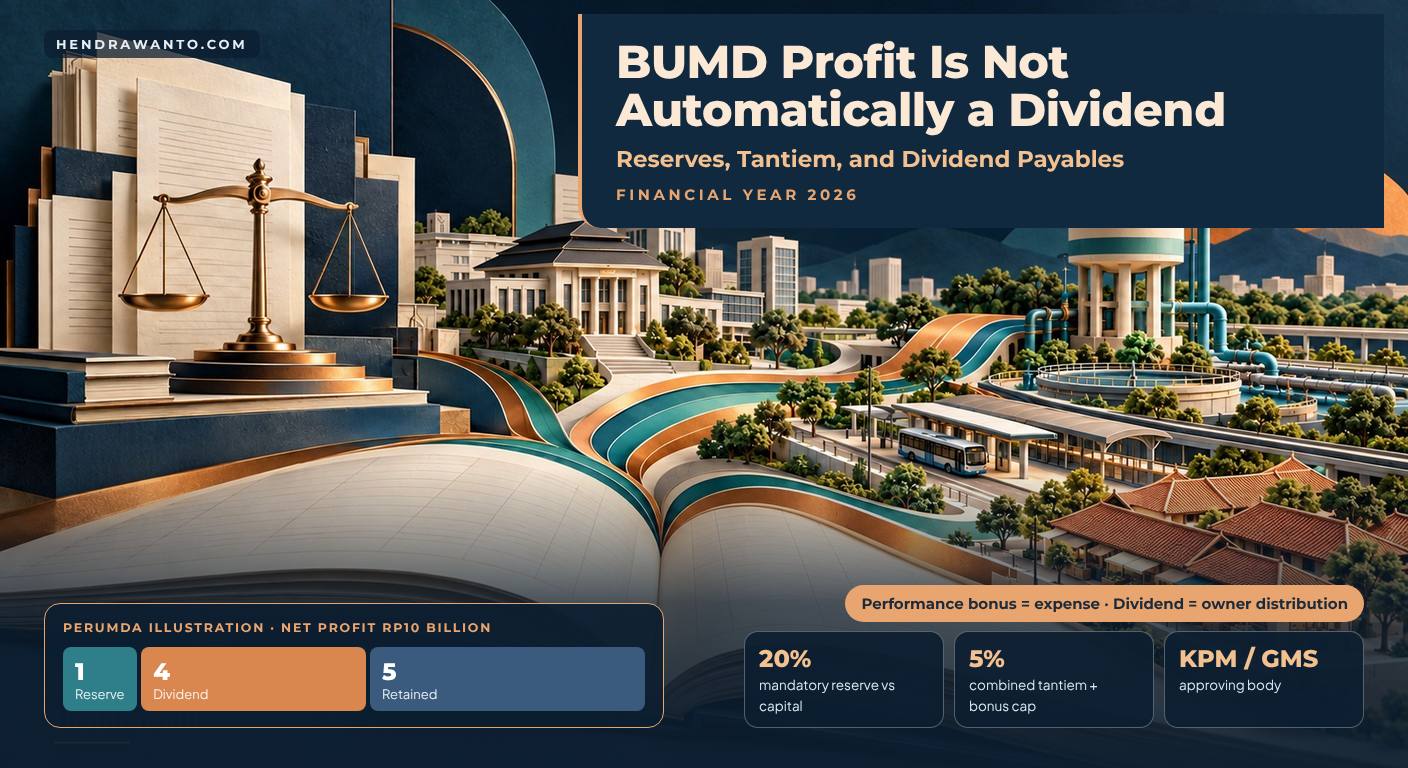
How a regional-owned enterprise (Badan Usaha Milik Daerah, BUMD) uses its profit determines the economic benefit to the regional government as well as the company's ability to maintain services and fund growth. Problems arise when every payment calculated from profit is treated as a profit distribution. Dividends, reserves, tantiem, bonuses, and social programmes can have different accounting treatments.
For financial year 2026, harmonisation must bring together the authority to decide on profit use with the substance of each transaction and the timing of obligations. A valid owner decision has to be translated into the right accounting entries. Approval of profit use alone does not determine whether an item is an expense, an equity movement, a liability, or the acquisition of an asset.
Legal Form Determines the Applicable Rules
The first step is to distinguish a regional public company (perusahaan umum daerah, Perumda) from a regional limited company (perusahaan perseroan daerah, Perseroda). Government Regulation (PP) 54 of 2017 on BUMD governs the use of Perumda profit in Articles 100 to 104, while Article 105 refers Perseroda profit use to limited liability company law. The approving body also differs: the Capital Owner's Representative (Kuasa Pemilik Modal, KPM) for a Perumda and the General Meeting of Shareholders (GMS) for a Perseroda.
| Aspect | Perumda | Perseroda |
|---|---|---|
| Approval of profit use | KPM each year, under the articles | GMS, under the Company Law and the articles |
| Mandatory reserve | Set aside each year until it reaches at least 20% of Perumda capital, while retained earnings are positive | Set aside each year until it reaches at least 20% of issued and paid-up capital, while retained earnings are positive |
| Use of reserve below 20% | Only to cover losses | Only to cover losses not covered by other reserves |
| Dividends | Become regional revenue once approved by the KPM; not distributable while retained earnings are negative | Only distributable if retained earnings are positive; become regional revenue once approved by the GMS |
| Tantiem and bonuses | Combined cap of 5% of net profit after the reserve; performance-linked amounts are budgeted and treated as expenses | Follow the articles, GMS decisions, and applicable regional rules |
| Main basis | PP 54/2017 Articles 100–104 | PP 54/2017 Article 105; Law 40/2007 Articles 70–71 |
The 20% figure is an accumulation threshold for reserves relative to capital, not a percentage automatically taken from each year's profit. The annual amount follows the legal basis and the decision of the authorised body. Article 101 also provides that reserves above 20% can be used by KPM decision, and the directors must manage the reserve fund so that it earns returns recognised in profit or loss.
For a Perumda, Article 100 prioritises service improvement and start-up ventures once the reserve is met. PP 54/2017 does not set a single dividend percentage for all BUMDs. A target for local own-source revenue (pendapatan asli daerah, PAD) therefore cannot replace testing of reserves, services, and the basis for distribution.
The founding regional regulation (perda), the head of region's regulation on profit use, the articles, and owner decisions should be read as one set. For financial-sector BUMDs, such as regional development banks or regional rural banks, OJK rules on capital, remuneration, and distribution limits must also be reviewed. A percentage used at one company cannot be transferred to another BUMD without testing its legal basis.
- 1Prior losses covered?Negative retained earnings block dividends (Elucidation of Article 102).
- 2ReserveSet aside until at least 20% of capital (Article 101).
- 3Services and start-upsPriority once the reserve is met (Article 100).
- 4Region's dividendRegional revenue once approved by the KPM (Article 102).
- 5Tantiem and bonusesCombined cap of 5%; performance-linked amounts expensed (Article 103).
The Reporting Framework Must Be Clear Before Profit Is Distributed
Ownership by a regional government does not mean a BUMD's financial statements use Government Accounting Standards (SAP). A BUMD prepares its statements under the financial accounting standards applicable to it; the regional government as owner records its investment separately under SAP.
An eligible BUMD may use SAK for Private Entities (SAK EP), effective 1 January 2025 and replacing SAK ETAP. Its use must be supported by eligibility and authority requirements, not merely size or regional ownership. See SAK for Private Entities: A Transition Map from SAK ETAP.
For BUMDs using SAK Indonesia, relevant standards include PSAK 201 (presentation), PSAK 219 (employee benefits), PSAK 210 (events after the reporting period), PSAK 237 (provisions), PSAK 208 (policies, estimates, and errors), and PSAK 212 (income taxes). SAK EP users apply the relevant sections of that framework; the two frameworks should not be mixed selectively.
PSAK 118, which replaces PSAK 201, was approved by DSAK IAI on 28 May 2025 and is effective 1 January 2027. It does not apply to financial year 2026, but preparing 2026 comparative data is already part of the year-end agenda. See PSAK 118: The New Profit or Loss Statement from 2027.
Performance-Linked Tantiem and Bonuses Are Expenses
Article 100 of PP 54/2017 lists tantiem and bonuses among the uses of Perumda profit. That must be read with Article 103(2), which provides that tantiem and bonuses linked to Perumda performance are budgeted and treated as expenses. The list of profit uses cannot justify charging performance remuneration directly to retained earnings.
Article 103(1) caps the combined tantiem of the directors and supervisory board plus employee bonuses at 5% of net profit after deducting the reserve. The cap applies to the total, not 5% per group. Because the article sits within the Perumda provisions, applying it to a Perseroda needs its own legal basis, such as the articles or a head of region's regulation.
Under PSAK 219, the cost of profit-sharing and bonus plans is recognised when the entity has a present legal or constructive obligation to pay as a result of past events and the amount can be estimated reliably. The expense does not always wait for cash payment or an owner's meeting.
For example, a valid remuneration policy and consistent practice have created an obligation to pay bonuses for 2026 services. If the estimate is reliable at 31 December 2026, the company recognises an expense and liability in 2026; a decision on the amount after year end is further evidence of that estimate. Conversely, if at year end the award is still fully discretionary and there is no present obligation, a bonus proposal is not enough to create a liability.
Owner approval cannot be used to remove an expense that has already arisen. Equally, accrual recognition does not authorise remuneration beyond legal limits. Compliance, measurement, and recording must all be satisfied.
Funding from profit does not turn every transaction into a profit distribution.
Expense and liability
Performance tantiem or bonuses for services already rendered. Recognised when there is a present obligation and a reliable estimate.
Reclassification within equity
A mandatory reserve from profit. Total equity is unchanged and cash is not automatically set aside.
Retained earnings and dividend payable
Dividends validly approved by the KPM or GMS. Not an expense in profit or loss.
Expense when delivered, or a provision if a present obligation exists
Internal earmarking of profit is not a liability to the community. Assistance handed over is usually an expense; spending that creates a controlled asset is tested as an asset.
Reserves and Dividends Affect Equity Differently
Setting up a mandatory reserve from profit is an allocation within equity: debit unappropriated retained earnings and credit retained earnings appropriated for the reserve. Total equity does not change. A reserve in equity also does not mean the same amount of cash has been set aside; if funds are placed in a specific account or instrument, that asset is recorded separately. The mandatory reserve must also be distinguished from credit loss allowances or provisions, which have different purposes and measurement bases.
A dividend is a distribution to owners in their capacity as owners. It reduces retained earnings and creates a liability once the distribution is properly approved and no longer at the company's discretion. Payment settles that liability. A dividend is not an expense in profit or loss.
Current-year profit cannot be read separately from accumulated losses. The Elucidation of Article 102 of PP 54/2017 states that a Perumda cannot distribute dividends if the year's net profit has not covered accumulated losses so that retained earnings remain negative; Article 104 adds that losses not covered by the reserve remain on the books and the company is treated as having no profit until they are covered. For a Perseroda, Article 71(3) of the Company Law requires positive retained earnings.
Beyond legality, a sound decision tests free cash, maturing obligations, investment needs, and service continuity. Profit still held as receivables does not have the same capacity to pay as available cash.
The Decision Date Determines the Year a Dividend Is Recognised
The year profit is earned, the year distribution is approved, and the year cash is paid can all differ. Under PSAK 210, dividends declared after the reporting period are not recognised as a liability at the end of that period, but are disclosed in the notes if declared before the statements are authorised for issue. This is consistent with Articles 102 and 105 of PP 54/2017: the region's dividend becomes regional revenue once approved by the KPM or GMS.
As an illustration, profit comes from the financial year ending 31 December 2026, and the KPM or GMS approves a dividend on 30 April 2027. Without an earlier valid approval, no dividend payable is recorded at 31 December 2026; it is recognised on 30 April 2027. If the 2026 statements were already authorised before that decision, the approval falls outside the events-after-the-reporting-period window for those statements.
No dividend payable yet
2026 profit does not create a liability without a valid distribution decision. If the decision comes before the statements are authorised, disclose it in the notes.
Dividend payable recognised
A valid decision moves the dividend amount from retained earnings to a liability to the regional government.
Liability settled
Payment settles the dividend payable and becomes realised BUMD revenue for the regional treasury.
This dividend treatment differs from bonuses for 2026 services whose obligation already exists at year end. Both may be decided at the same meeting, but their recognition dates can differ because the substance of each obligation differs.
Social Funds Need an Assessment of Obligation and Delivery
Article 106 of PP 54/2017 provides for BUMD social and environmental responsibility (TJSL) by setting aside part of net profit, with priority for developing micro and small businesses and cooperatives. Separately, Article 74 of the Company Law and PP 47/2012 govern the budgeting and expensing of TJSL for companies whose business is in or related to natural resources, as company costs budgeted with due regard to propriety and fairness.
The implication is to separate three things: internal earmarking of profit, the emergence of an obligation to others, and programme delivery. A budget allocation or internal earmark is not automatically a liability to the community. If a present obligation from a past event exists, liability recognition should be assessed; for provisions, PSAK 237 requires a present obligation, a probable outflow of resources, and a reliable estimate.
When a programme is delivered, spending is recorded by its substance. Assistance handed to the community is usually an expense, while spending that creates an asset controlled by the company is tested against asset recognition criteria. If funds were earmarked in equity and the spending is later expensed, the release of the earmark must be clear so retained earnings are not reduced twice.
Year-End Illustration and Journal Entries
The following illustration uses a Perumda with no accumulated losses. All figures are hypothetical. Net profit for financial year 2026, after tax and after tantiem and bonus expense, is Rp10 billion; that expense includes tantiem and bonuses of Rp400 million. An additional reserve of Rp1 billion and a dividend of Rp4 billion are planned.
| Test | Calculation or result |
|---|---|
| Combined tantiem and bonus cap | 5% × (Rp10 billion − Rp1 billion) = Rp450 million |
| Amount already expensed | Rp400 million, below the illustrative cap of Rp450 million |
| Use of Rp10 billion net profit | Reserve Rp1 billion + dividend Rp4 billion + retained Rp5 billion |
The definition of "net profit" used for the 5% cap, its relationship with the remuneration expense itself, and the order of calculation with the reserve should be stated clearly in policy and reconciled to the final financial statements. Interdependent formulas need a documented basis of calculation.
| When recorded | Debit | Credit |
|---|---|---|
| 31 December 2026, if accrual criteria are met | Tantiem and bonus expense Rp400 million | Tantiem and bonus payable Rp400 million |
| When the reserve appropriation is validly approved | Unappropriated retained earnings Rp1 billion | Appropriated retained earnings (reserve) Rp1 billion |
| When the dividend is approved in 2027 | Retained earnings Rp4 billion | Dividend payable to regional government Rp4 billion |
| When the dividend is paid | Dividend payable Rp4 billion | Cash or bank Rp4 billion |
Entries are shown gross without tax withholding. The validity of the reserve appropriation, reserve adequacy, and the ability to pay dividends must still be tested separately.
Tax Reconciliation and Regional Government Records
Recognising a commercial expense does not mean it is deductible for tax. Article 9(1) of the Income Tax Law provides that distributions of profit under any name or form, and the creation of reserves (other than those specifically allowed), cannot be deducted from gross income. For tantiem, bonuses, and TJSL, check the nature of the payment, the basis for granting it, reasonableness, deduction conditions, and any Article 21 withholding. Account names or meeting decisions do not determine tax treatment. Commercial and tax differences are reconciled, and deferred tax is assessed under the reporting framework.
On the regional government side, PSAP 06 on investment accounting distinguishes the cost method and the equity method. Under the equity method, the share of profit is recognised as investment income in the operational statement and increases the investment; cash dividends declared reduce the investment. Under the cost method, dividends declared are recognised as investment income. Cash dividends received are recorded as revenue in the budget realisation report when received in the regional treasury account.
- Valid decision: dividend payable
- Payment: cash falls, payable settled
- Equity falls on decision
- Valid decision: dividend receivable
- Cash into treasury: budget revenue
- Equity method: investment value adjusts
Reconciliation between the BUMD and its owner must therefore match the distribution decision, each owner's share (where several regions are shareholders), payables, receivables, and proof of payment.
Harmonisation Agenda for Financial Year 2026
- 1Inventory the rulesNational regulations, perda, head of region's regulations, sector rules, and the articles governing profit use.
- 2Set framework and classificationSAK Indonesia or SAK EP; document the classification of each component: expense, equity, liability, or asset.
- 3Finalise year-end estimatesPerformance remuneration and social programme obligations that exist at 31 December 2026.
- 4Reconcile retained earningsFrom profit after tax to distributable retained earnings: prior losses, reserves, audit adjustments, and amounts already expensed.
- 5Document decisionsDates of KPM or GMS decisions, matched to regional records, and assess correction of material errors under PSAK 208 or the relevant SAK EP section.
Supervisory boards, commissioners, audit committees, and auditors should review the evidence behind these classifications. An audit opinion does not replace the KPM's or GMS's authority over profit use. Equally, an owner decision does not replace the duty to present in line with accounting standards.
Short checklist before the profit-use meeting
- Retained earnings after covering accumulated losses are positive.
- Accumulated reserves compared with 20% of capital; additional appropriations based on a valid decision.
- Performance tantiem and bonuses already expensed and tested against the 5% combined cap (Perumda) or the applicable legal basis.
- The proposed dividend is supported by analysis of free cash, maturing obligations, and service needs.
- CSR programmes separated into earmarking, obligation, and delivery.
- The draft decision states the date, amount, and each owner's share for reconciliation with the region.
Strong harmonisation produces one traceable decision trail: profit is measured properly, its use is approved by the authorised body, obligations are recorded in the right period, and payments can be reconciled. On that basis, a BUMD's contribution to its region can go hand in hand with capital maintenance and the quality of public services.
Need help with a profit-use policy or a BUMD financial statement audit? See our Financial Statement Audit and Accounting & SAK services.
Official References
- Government Regulation 54 of 2017 on Regional-Owned Enterprises (in Indonesian), especially Articles 100–106 and the Elucidation of Article 102
- Law 40 of 2007 on Limited Liability Companies as amended, especially Articles 70, 71, and 74; and PP 47 of 2012 on Corporate Social and Environmental Responsibility
- IAI: About SAK for Private Entities (in Indonesian)
- SAK Indonesia: PSAK 201, PSAK 208, PSAK 210, PSAK 212, PSAK 219, and PSAK 237; IAI: Approval of PSAK 118
- Income Tax Law as last amended by Law 7 of 2021 on Harmonisation of Tax Regulations, especially Articles 6 and 9
- Government Accounting Standards Committee: PSAP 06 on Investment Accounting and PSAP 02 on the Budget Realisation Report
This article is educational and is not a legal or audit opinion for any particular entity. All illustrative figures and dates are hypothetical. Application to a specific BUMD should follow the regional regulations, head of region's regulations, articles of association, sector rules, and reporting framework that apply. The Indonesian version is the original text.