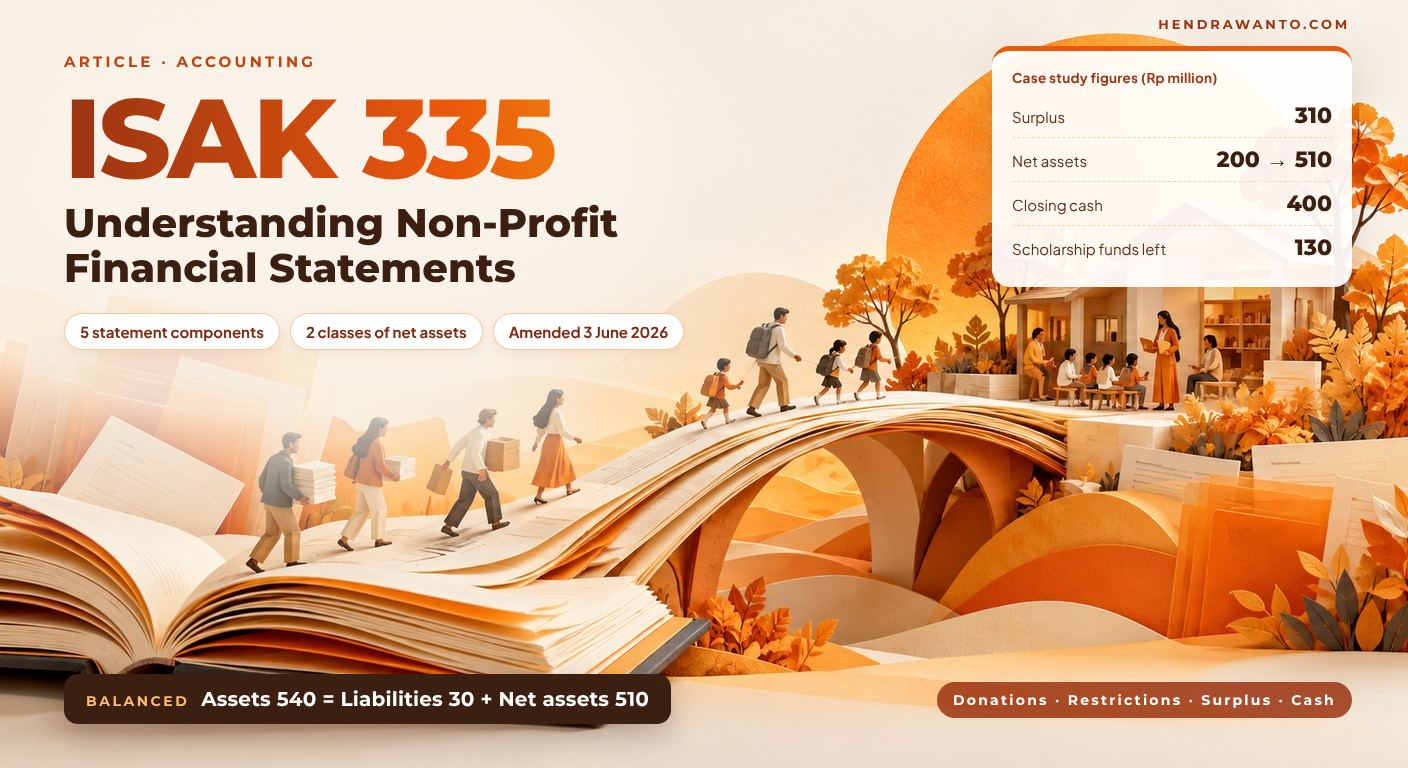
Non-profit organisations need to explain what happened to the resources entrusted to them. Donors want to know how their support was used, boards need a picture of the ability to meet obligations, and supervisors need to judge whether funds were used for their intended purpose. This article links donations, fund restrictions, surplus, and cash through one case study whose figures can be traced from start to finish.
01 What ISAK 335 Does
A cash book records receipts and payments, but financial statements also need to explain assets, liabilities, and changes in the organisation's net worth. ISAK 335 Presentation of Financial Statements of Non-Profit Oriented Entities is an interpretation of the presentation requirements in the standard on presentation of financial statements. Its core is adjusting the descriptions of line items and the names of the statements to reflect the nature of a non-profit organisation. Recognition and measurement of transactions still follow the other standards in the framework the entity uses.
An education foundation may earn a surplus from training. That surplus does not change its social purpose. What matters is how activities are run, how the surplus is used, and what conditions attach to its funding. An organisation cannot be judged from a single surplus figure or bank balance.
PSAK 45, ISAK 35, and ISAK 335
DSAK IAI approved ISAK 35 and PPSAK 13 on 11 April 2019. ISAK 35 applies to annual periods beginning on or after 1 January 2020, together with the withdrawal of PSAK 45 on Financial Reporting of Non-Profit Entities through PPSAK 13. Under the SAK renumbering effective 1 January 2024, ISAK 35 became ISAK 335. This change of number is different from the substantive amendment approved in June 2026 (see section 09). IAI also states that the illustrative examples and basis for conclusions are not part of the interpretation.
02 Choosing the Right Reporting Framework
The reporting framework comes before the choice of format. This article uses SAK Indonesia for the 2026 illustration, assuming the entity has not early-applied PSAK 118. Organisations using SAK for Private Entities (SAK EP) follow that framework. SAK EP has been effective since 1 January 2025 and replaced SAK ETAP; eligibility depends on the entity's characteristics and the relevant authority's rules. See also SAK for Private Entities: A Transition Map from SAK ETAP.
Foundations (yayasan) and associations are typical settings. Organisations managing zakat, infaq, waqf, government funds, or other special transactions should also check the relevant standards and sector rules. Legal form or a "non-profit" label alone does not determine the full accounting treatment.
03 Reading Net Assets and Donor Restrictions
Net assets are total assets minus total liabilities. To help readers assess the use of resources, the illustration in this article distinguishes net assets without restrictions from resource providers and net assets with restrictions from resource providers. Restrictions that expire or are fulfilled result in a reclassification between classes of net assets.
| Situation | Analysis needed |
|---|---|
| A donor gives support for the foundation's general activities. | Presented without restrictions because the donor set no purpose or timing. |
| A donor specifies the support for student scholarships only. | Use of funds is traced against the scholarship terms. Balances whose restrictions are not yet met are shown separately within net assets. |
| The board sets aside general funds for a planned renovation. | An internal decision is identified separately. A board designation is not the same as a donor restriction. |
| An agreement requires refunds if certain conditions are not met. | Review the substance of the agreement and the applicable recognition standard. The question may be about a liability or the timing of income, so it is not solved by labelling it "net assets with restrictions". |
In the scholarship example below, the support already meets the criteria for recognition as income. The agreement only restricts its purpose and allows unused funds to be carried forward; there is no obligation to return the balance at the end of 2026. An agreement with different terms needs a fresh analysis.
Releasing a restriction does not increase total net assets. The reclassification reduces one class and increases the other by the same amount. Receiving a donation, paying programme expenses, and releasing a restriction are three different events that must be kept apart so income is not counted twice.
50 + 300 − 220 = 130
04 Five Components Read Together
The ISAK 335 illustrative examples include a statement of financial position, a statement of comprehensive income, a statement of changes in net assets, a statement of cash flows, and notes. Each answers a different question, and their figures lock into each other.
| Component | Reader's question | 2026 example figures |
|---|---|---|
| Statement of financial position | What is owned and what is still owed? | Assets 540; liabilities 30; net assets 510. |
| Statement of comprehensive income | What were income and expenses for the period? | Income 750; expenses 440; surplus 310. |
| Statement of changes in net assets | How did each class of net assets change? | Without restrictions 380; with restrictions 130. |
| Statement of cash flows | Why did cash rise or fall? | Operating cash 340; purchase of equipment 60. |
| Notes to the financial statements | What basis, detail, and assumptions lie behind the figures? | Scholarship, fixed asset, and expense details. |
05 Case Study: Yayasan Cahaya Pendidikan
All names and figures below are fictitious. The statements simulate a full year ending 31 December 2026 with 2025 comparatives. This is a simplified teaching example, not an actual report or a full statement of compliance with SAK. 2025 is assumed to be the first year of activity with all opening balances at zero.
The foundation provides scholarships and training. At the start of 2026 it had cash of 120, net fixed assets of 100, and operating payables of 20. Its net assets were 200: 150 without restrictions and 50 restricted to scholarships. All figures are in Rp million; 400 means Rp400,000,000.
| Transactions and conditions during 2026 | Amount |
|---|---|
| General donations received in cash | 400 |
| Scholarship donations received in cash | 300 |
| Training income received in cash | 50 |
| Scholarships disbursed, meeting donor terms | 220 |
| Training expenses paid in cash | 100 |
| General and administrative expenses excluding depreciation | 80 |
| Fundraising expenses paid in cash | 20 |
| Depreciation of equipment | 20 |
| New equipment purchased for cash | 60 |
| Operating payables at year end | 30 |
The opening payable of 20 was settled during the year and the closing payable of 30 arises from 2026 administrative expenses. Administrative payments are therefore 20 + 80 − 30 = 70. There are no receivables, inventories, borrowings, interest, income tax transactions, or other comprehensive income. The absence of tax is a simplification, not a conclusion that non-profit entities are tax-exempt.
A. Statement of financial position
Yayasan Cahaya Pendidikan · 31 December 2026 and 2025 · Rp million
| Item | 2026 | 2025 |
|---|---|---|
| ASSETS | ||
| Cash and bank | 400 | 120 |
| Fixed assets at cost | 180 | 120 |
| Accumulated depreciation | (40) | (20) |
| Net fixed assets | 140 | 100 |
| Total assets | 540 | 220 |
| LIABILITIES AND NET ASSETS | ||
| Short-term operating payables | 30 | 20 |
| Net assets without restrictions from resource providers | 380 | 150 |
| Net assets with restrictions from resource providers | 130 | 50 |
| Total net assets | 510 | 200 |
| Total liabilities and net assets | 540 | 220 |
The basic equation holds: 540 = 30 + 510. Cash of 400 is not the same as net assets of 510; the difference of 110 is net fixed assets of 140 less payables of 30.
B. Statement of comprehensive income
For the year ended 31 December · Rp million
| Item | 2026 | 2025 |
|---|---|---|
| INCOME | ||
| General donations | 400 | 350 |
| Scholarship donations | 300 | 200 |
| Training income | 50 | 50 |
| Total income | 750 | 600 |
| EXPENSES BY FUNCTION | ||
| Scholarship programme | (220) | (150) |
| Training programme | (100) | (100) |
| General and administrative, including depreciation | (100) | (120) |
| Fundraising | (20) | (30) |
| Total expenses | (440) | (400) |
| Surplus for the year | 310 | 200 |
| Other comprehensive income | 0 | 0 |
| Total comprehensive income | 310 | 200 |
This single-column format shows total income and expenses; changes by class of net assets are shown in the next statement. A surplus of 310 means income exceeded expenses this period, but the ability to spend cash still depends on restrictions and obligations.
C. Statement of changes in net assets
Movements in 2025 and 2026 · Rp million
| Item | Without restrictions | With restrictions | Total |
|---|---|---|---|
| Balance 1 January 2025 | 0 | 0 | 0 |
| Income 2025 | 400 | 200 | 600 |
| Expenses 2025 | (400) | 0 | (400) |
| Scholarship restrictions released 2025 | 150 | (150) | 0 |
| Balance 31 December 2025 | 150 | 50 | 200 |
| Income 2026 | 450 | 300 | 750 |
| Expenses 2026 | (440) | 0 | (440) |
| Scholarship restrictions released 2026 | 220 | (220) | 0 |
| Balance 31 December 2026 | 380 | 130 | 510 |
Under this illustrative policy, all expenses are presented in the unrestricted class and restriction releases appear as transfers between classes. Net assets without restrictions: 150 + 450 − 440 + 220 = 380. Net assets with restrictions: 50 + 300 − 220 = 130. The total of 510 matches the statement of financial position.
D. Statement of cash flows, direct method
For the year ended 31 December · Rp million
| Item | 2026 | 2025 |
|---|---|---|
| OPERATING ACTIVITIES | ||
| Donations received | 700 | 550 |
| Training receipts | 50 | 50 |
| Scholarships paid | (220) | (150) |
| Training programme payments | (100) | (100) |
| General and administrative payments | (70) | (80) |
| Fundraising payments | (20) | (30) |
| Net cash from operating activities | 340 | 240 |
| INVESTING ACTIVITIES | ||
| Purchase of fixed assets | (60) | (120) |
| FINANCING ACTIVITIES | ||
| Financing cash flows | 0 | 0 |
| Net increase in cash | 280 | 120 |
| Cash at beginning of year | 120 | 0 |
| Cash at end of year | 400 | 120 |
Scholarship donations in the example fund an operating programme, so their cash flows are operating. The 220 net asset reclassification is not a cash receipt or payment. For donations of a different nature, for example restricted to long-term investment, cash flow classification needs separate review.
The 2026 reconciliation also works from surplus 310 + depreciation 20 + increase in payables 10 = operating cash 340. After purchasing fixed assets of 60, cash rises by 280; with opening cash of 120, the closing balance is 400.
E. Example notes to the financial statements
Basis of preparation. The example uses the accrual basis and historical cost; cash flows use the direct method; there is no other comprehensive income. Actual statements need the reporting framework, material policies, estimates, and other disclosures appropriate to the entity.
Scholarship donations. The opening balance of 50 plus receipts of 300 gives scholarship resources of 350. Disbursements of 220 met donor terms, so the same amount is released from restriction. The remaining 130 is for scholarships in future periods and is held entirely in cash, included in cash and bank of 400.
Fixed assets. Existing equipment cost 120 with accumulated depreciation of 20. Depreciation for 2026 of 20 brings the accumulated total to 40. New equipment of 60 was still being installed at year end and not yet ready for use, so in this example depreciation has not started. Closing carrying amount: 120 + 60 − 40 = 140.
Expenses by nature and function. The example allocates all depreciation to administration because the equipment in use supports that function. In practice, allocation follows asset use on a basis that can be explained.
| Nature of 2026 expense | Scholarships | Training | Administration | Fundraising | Total |
|---|---|---|---|---|---|
| Scholarship grants | 220 | 0 | 0 | 0 | 220 |
| Training activity costs | 0 | 100 | 0 | 0 | 100 |
| Other operating expenses | 0 | 0 | 80 | 20 | 100 |
| Depreciation | 0 | 0 | 20 | 0 | 20 |
| Total | 220 | 100 | 100 | 20 | 440 |
Actual notes also need material information not in this simulation, such as related parties, commitments, liquidity risk, continuity of activities, and events after the reporting period where relevant. Having all five components does not by itself prove complete disclosure.
06 Recording the Main Transactions
The entries below show the logic of the 2026 case study in Rp million. Account names can follow the foundation's chart of accounts; income and expenses are closed to the classes of net assets under the illustrative policy.
| Transaction | Debit | Credit |
|---|---|---|
| General donations received | Cash 400 | General donation income 400 |
| Scholarship donations received | Cash 300 | Restricted donation income 300 |
| Training income received | Cash 50 | Training income 50 |
| Scholarships disbursed | Scholarship expense 220 | Cash 220 |
| Scholarship restriction fulfilled | Net assets with restrictions 220 | Net assets without restrictions 220 |
| Training expenses paid | Training expense 100 | Cash 100 |
| 2026 administrative expenses excluding depreciation | Administrative expense 80 | Cash 50; Operating payables 30 |
| Opening payable settled | Operating payables 20 | Cash 20 |
| Fundraising paid | Fundraising expense 20 | Cash 20 |
| Equipment under installation purchased | Construction in progress 60 | Cash 60 |
| Depreciation recognised | Depreciation expense 20 | Accumulated depreciation 20 |
The restriction release entry is a reclassification. If the system uses a clearing account for presentation, make sure total income does not rise by another 220. Administrative payments of 70 in the cash flow statement come from two entries: current-year expenses paid of 50 and settlement of the opening payable of 20.
07 Test the Links Between Statements
Choose a scholarship disbursement amount. In this experiment every disbursement immediately meets donor terms, is paid in cash, and all other transactions stay the same. The case study tables still use disbursements of 220.
- Closing cash
- Rp620 million
- Net assets with restrictions
- Rp350 million
- Net assets without restrictions
- Rp380 million
- Total net assets
- Rp730 million
Assets 760 = Liabilities 30 + Net assets 730 BALANCED
- Closing cash
- Rp510 million
- Net assets with restrictions
- Rp240 million
- Net assets without restrictions
- Rp380 million
- Total net assets
- Rp620 million
Assets 650 = Liabilities 30 + Net assets 620 BALANCED
- Closing cash
- Rp400 million
- Net assets with restrictions
- Rp130 million
- Net assets without restrictions
- Rp380 million
- Total net assets
- Rp510 million
Assets 540 = Liabilities 30 + Net assets 510 BALANCED
- Closing cash
- Rp270 million
- Net assets with restrictions
- Rp0
- Net assets without restrictions
- Rp380 million
- Total net assets
- Rp380 million
Assets 410 = Liabilities 30 + Net assets 380 BALANCED
08 Mistakes Boards Should Avoid
Boards should keep a register of donation agreements, balances by programme, bank reconciliations, a fixed asset register, and beneficiary documents. Closing the books should link the opening balance, receipts, use, restriction releases, and closing balance of each fund. These reconciliations give a strong basis for oversight and audit.
09 The 2026 Amendment and Preparing for 2027
- 11 Apr 2019ISAK 35 and PPSAK 13 approved; PSAK 45 withdrawn.
- 1 Jan 2020ISAK 35 becomes effective.
- 1 Jan 2024Renumbering: ISAK 35 becomes ISAK 335.
- 1 Jan 2025SAK for Private Entities takes effect, replacing SAK ETAP.
- 30 Apr 2026Public hearing on the Exposure Draft Amendment to ISAK 335.
- 3 Jun 2026DSAK IAI approves the Amendment to ISAK 335 (announced 22 June 2026).
- 1 Jan 2027PSAK 118 takes effect, replacing PSAK 201.
DSAK IAI approved the Amendment to ISAK 335 on 3 June 2026, as announced by IAI on 22 June 2026. The amendment updates references and illustrative examples to accommodate PSAK 118 for non-profit entities applying SAK Indonesia. The statement of financial performance format requires sub-classification into operating, investing, financing, income tax, and discontinued operations within the surplus or deficit section. For the indirect cash flow method, operating surplus is the starting point. The IAI announcement does not state the amendment's effective date; refer to the final text in SAK Online.
PSAK 118 was approved by DSAK IAI on 28 May 2025, replaces PSAK 201, and is effective 1 January 2027. Organisations using SAK Indonesia should review account mapping and comparatives before preparing statements under the new requirements. The 2026 example above does not assume early application. See PSAK 118: The New Profit or Loss Statement from 2027.
Mapping the same transactions. If all income and expenses in this case are operating, the operating surplus is 750 − 440 = 310. The investing and financing categories have no income or expenses, and income tax and discontinued operations are nil. The final surplus remains 310. The equipment purchase of 60 is an investing cash flow but does not automatically become an investing-category expense in the statement of financial performance.
With this simple data, starting from an operating surplus of 310 gives operating cash of 340 after adding depreciation of 20 and the increase in payables of 10. Organisations with investment income (for example interest on endowment deposits), financing costs, or special main activities need more detailed mapping. The identical figures here result from the assumptions, not proof that PSAK 118 never has an effect.
IAI's April 2026 public consultation material distinguished illustrations for SAK Indonesia and SAK for Private Entities. That material was a draft when issued; implementation of the amendment and its transition must follow the final text.
10 Judging the Statements Through Their Links
The foundation's statements can be traced from income of 750 and expenses of 440 to a surplus of 310. Opening net assets of 200 rise to 510. At the same time, closing cash of 400 is explained by opening cash of 120, operating cash of 340, and fixed asset purchases of 60. The remaining scholarship restriction of 130 appears in both net assets and cash.
These links let readers assess the organisation's ability to meet obligations while running its programmes. Boards need to keep the evidence behind the figures and the donor terms, so that the transparency of the statements can be tested again through the accounting records.
Need help preparing or auditing a foundation's financial statements? See our Accounting & SAK and Financial Statement Audit services, or request a proposal on the Proposal page.
Official References
- IAI: Approval of ISAK 35, PSAK 1 amendments, and PPSAK 13 (26 April 2019, in Indonesian)
- DSAK IAI: Discussion Paper, Post-Implementation Review of ISAK 335 (2025) — consultation document, not a final standard
- IAI: Comparison of PSAK and ISAK renumbering (in Indonesian)
- IAI: About SAK for Private Entities (in Indonesian)
- IAI: Approval of the Amendment to ISAK 335 (22 June 2026, in Indonesian)
- IAI: Approval of PSAK 118 (in Indonesian)
- DSAK IAI: Public hearing material, Exposure Draft Amendment to ISAK 335 (30 April 2026)
- IAI: SAK Online — final text of the standards
This article is educational and is not an accounting or audit opinion for any particular entity. All case study names and figures are fictitious and prepared for this article; they do not copy IAI's illustrative figures or tables. Actual application should follow the final text of ISAK 335 and its amendment, the entity's reporting framework, and sector rules. The Indonesian version is the original text.