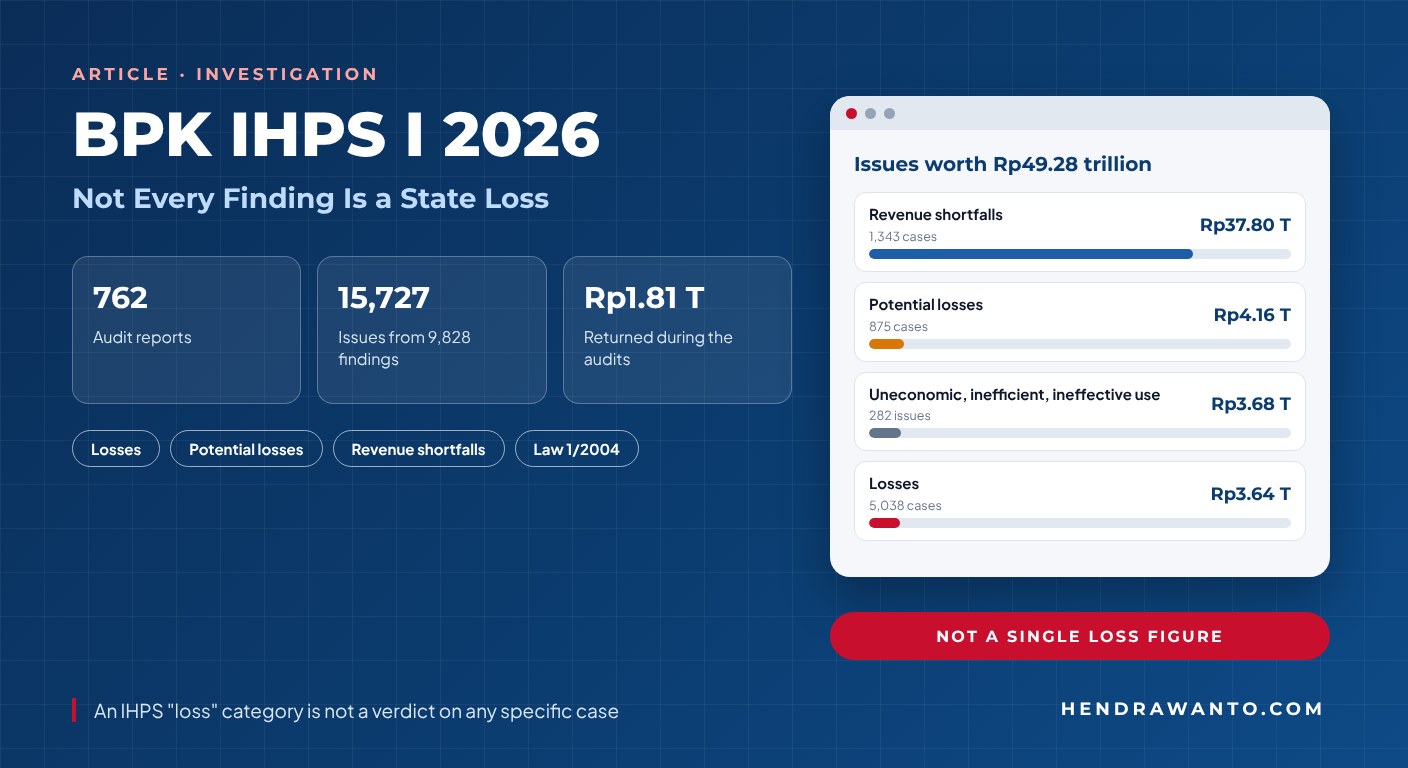
A single large figure from an audit summary easily becomes a headline. Yet an aggregate figure does not necessarily mean the same thing as a state loss that has already occurred. When the Audit Board of Indonesia (BPK) submitted its Summary of Semester Audit Results (IHPS) I 2026 to the House of Representatives (DPR) on 6 October 2026, it reported issues worth Rp49.28 trillion. The figure matters, but reading it correctly requires separating the types of issues that make it up.
BPK's press release states that the figure covers losses, potential losses, revenue shortfalls, and uneconomic, inefficient and ineffective use of resources. Calling the whole Rp49.28 trillion "money the state has lost" therefore erases the very category distinctions BPK makes. This article explains how to read the figure using the BPK press release and the detailed summary in Warta BPK (21 October 2026), without drawing conclusions about any particular case or party.
From Reports to Recommendations: Different Units
IHPS I 2026 summarises 762 audit reports (LHP): 706 financial audit reports, 20 performance audit reports, and 36 special-purpose audit reports. According to Warta BPK, these audits produced 9,828 findings containing 15,727 issues and 27,068 recommendations. These four numbers are not four ways of saying the same thing. One report may contain several findings, one finding may contain several issues, and follow-up may require more than one recommendation.
- 762audit reports706 financial · 20 performance · 36 special-purpose
- 9,828findingsone report may contain many findings
- 15,727issuesworth Rp49.28 trillion
- 27,068recommendationsdeposits, control improvements, or programme fixes
Distinguishing the units matters when judging the scale of the problem. The number of recommendations should not be called the number of loss cases, and the number of issues is no substitute for the number of reports or court rulings. Of the 15,727 issues, Warta BPK records 6,097 (39%) as internal control weaknesses, 9,348 (59%) as non-compliance with regulations, and 282 (2%) as uneconomic, inefficient or ineffective use of resources. In other words, most issues are not designed to produce the same measure of financial loss.
What Makes Up the Rp49.28 Trillion?
Warta BPK breaks the total into Rp45.60 trillion of non-compliance issues and Rp3.68 trillion of uneconomic, inefficient or ineffective use. Within non-compliance, 2,092 issues are administrative deviations and 7,256 issues have a financial impact. It is this financially impactful group that is split further into three: losses (5,038 cases, Rp3.64 trillion), potential losses (875 cases, Rp4.16 trillion), and revenue shortfalls (1,343 cases, Rp37.80 trillion).
Rp37.80 + Rp4.16 + Rp3.64 = Rp45.60 T (non-compliance with financial impact) · + Rp3.68 T = Rp49.28 T
The loss category refers to audit results that BPK classifies as losses. Potential losses indicate amounts at risk of becoming losses, not an acknowledgement that all of the money has already left the treasury. Revenue shortfalls concern receipts that should have been collected but, according to the audits, have not been; this is different from harmful spending. Uneconomic, inefficient and ineffective use, meanwhile, assesses how resources were used or what results were achieved.
Warta BPK also groups the value by budget manager: central government, 2,483 issues worth Rp3.57 trillion; regional governments, 12,797 issues worth Rp2.77 trillion; and state-owned enterprises (BUMN) and other bodies, 447 issues worth Rp42.95 trillion. Regional governments account for the most issues, while BUMN and other bodies account for the largest value. This is another reason why counts and values should not be read as a single measure.
A Loss in IHPS Is Not a Verdict
In legal terms, Article 1 point 22 of Law Number 1 of 2004 on the State Treasury defines a state/regional loss as a shortfall of money, securities and goods that is real and definite in amount as a result of an unlawful act, whether intentional or negligent. The "real and definite" element is what distinguishes it from a potential loss. See also our articles on state financial loss calculation after the new Criminal Code and Constitutional Court Decision 66/2026 (in Indonesian).
IHPS is a summary of many audits, not a verdict on every issue recorded. A figure in the IHPS "loss" category does not by itself prove the elements of a crime or determine who is responsible in a particular case. Conversely, the label "potential" does not mean the problem can be ignored. Both require follow-up suited to the nature of the finding and the authority of the institutions involved.
Warta BPK also reports two figures closer to the investigative domain: investigative audits recorded indications of state loss of Rp43.49 billion, while state loss calculations recorded Rp2.21 trillion. The summary does not explain how these two figures relate to the Rp49.28 trillion of issues, so they should not be added to or subtracted from the aggregate without checking the full IHPS. Such calculation methods are discussed in our article on investigative audit procedures and state financial loss calculation.
Recoveries During the Audit Are Not the Full Resolution
BPK's press release states that around Rp1.80 trillion was returned to the state, regional governments, companies or other bodies while the audits were still in progress. Warta BPK records this as asset handovers and/or cash deposits of Rp1.81 trillion: central government Rp1.06 trillion, regional governments Rp740.93 billion, and BUMN and other bodies Rp11.27 billion. The difference in presentation is a matter of rounding and should not be treated as a new finding.
The recovery figure is information about follow-up at a point in time, not a redefinition of all the issues. Subtracting Rp1.81 trillion from Rp49.28 trillion does not yield a "remaining loss", because the total covers impacts of different kinds. Note also that another BPK publication presents the Rp49.28 trillion figure in terms of safeguarding state finances. This difference in terminology between publications is a further reason to always refer to the definitions and source tables in the IHPS.
How to Use These Data Responsibly
- State the source, period and unit. "Value of issues in the IHPS I 2026 audit results" is more accurate than "total state loss" when referring to Rp49.28 trillion.
- Show the components. Do not merge losses, potential losses and revenue shortfalls under a single label.
- Distinguish counts from values. The number of cases is not the size of the value, as the comparison between regional governments and BUMN and other bodies shows.
- Separate findings from follow-up. State whether a figure describes an identified problem, a recommended action, or a recovery that has already occurred. See our article on following up on BPK recommendations.
- Trace the underlying report. For a specific entity or programme, refer to the audit report behind the summary, not only the aggregate statistics.
BPK stresses that state financial governance requires cross-sector synergy. Recommendations are not only about depositing money; they may also call for fixes to controls, compliance or programme effectiveness. For readers of investigative reports, IHPS statistics can signal risk areas and further questions, but they do not replace tracing evidence on a specific audit object. Avoid inferring motive, individual fault or the value of a case from aggregate figures.
Conclusion
IHPS I 2026 shows how much work remains to improve state financial management. Yet the Rp49.28 trillion reported by BPK is the combined value of different kinds of issues, not a single, uniform state loss figure; the portion classified as losses is Rp3.64 trillion. Separating the categories, understanding the report–finding–issue–recommendation units, and reading recoveries according to their timing help the public assess audit results more fairly and usefully.
Need support with an investigative audit or a state loss calculation? See the Investigative Audit & State Loss service.
Official References
- BPK: BPK Submits IHPS I 2026 to the DPR, Highlights Strategic State Finance Issues (6 October 2026, Indonesian)
- BPK: Submitting IHPS I 2026 to the DPR, BPK Encourages Synergy to Improve Governance (Indonesian)
- Warta BPK: BPK Issues 27,068 Recommendations from Semester I 2026 Audits (21 October 2026, Indonesian)
- JDIH Ministry of Finance: Law Number 1 of 2004 on the State Treasury (Indonesian)
This article is general information on how to read BPK publications. It is not an audit conclusion on any entity, a determination of loss in any case, or legal advice. For specific decisions or disputes, consult the full IHPS, the relevant audit reports and official documents. The Indonesian version is the original text.