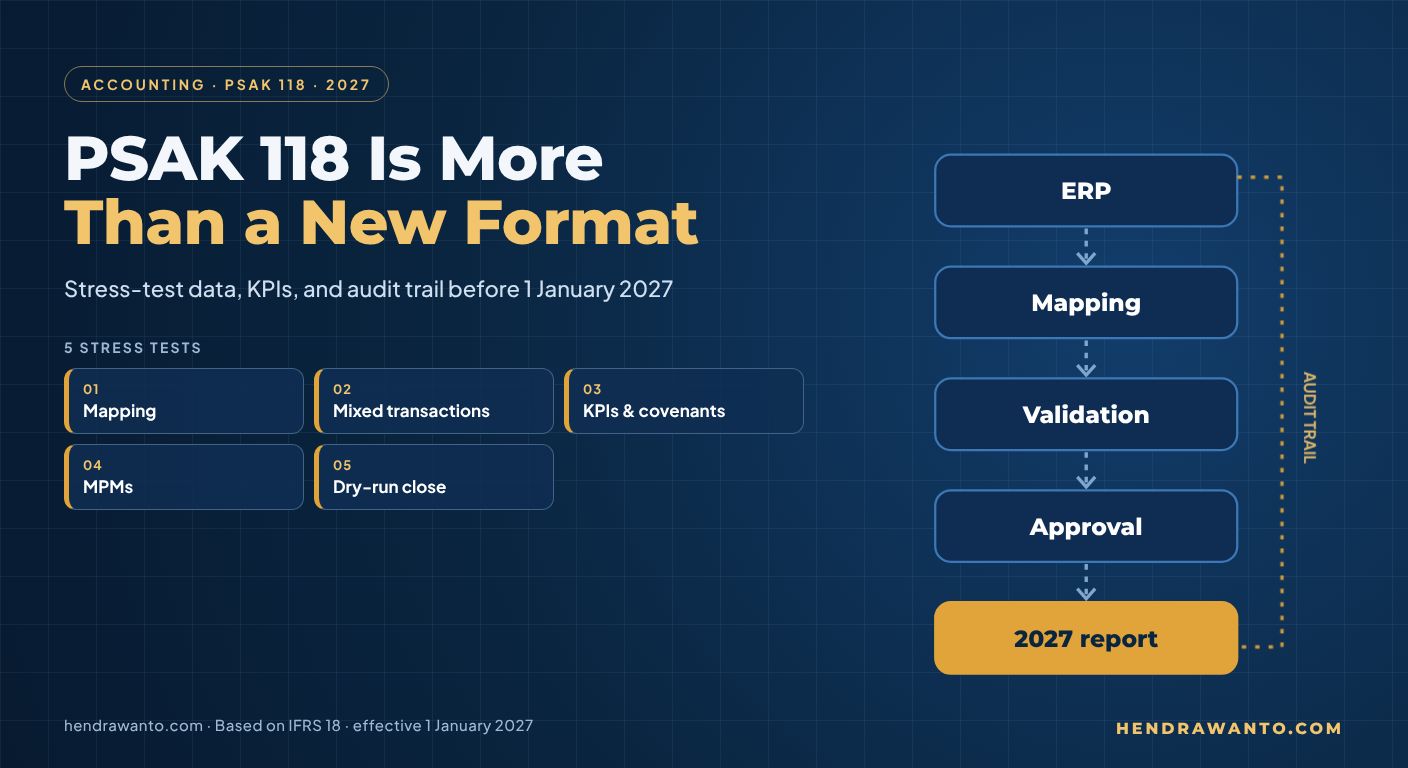
Many PSAK 118 projects start with the wrong question: "What does the new income statement format look like?" That question matters, but it is not enough. The format is only the final output. The real risks sit earlier: in general ledger data, mapping rules, KPI definitions, public communication, covenants, change controls, and the evidence auditors will examine.
PSAK 118 Presentation and Disclosure in Financial Statements was approved by Indonesia's DSAK IAI on 28 May 2025. It is based on IFRS 18, replaces PSAK 201, and takes effect on 1 January 2027. It changes presentation and disclosure, not recognition and measurement. Because it applies retrospectively, 2026 comparatives must be ready for remapping. November–December 2026 is therefore not the time to merely design a template; it is the time to stress-test.
This article builds on three earlier pieces: what changes under PSAK 118, a sample income statement format, and issuer readiness for 2027. The focus here is data, controls, and evidence.
Why a "Swap the Template" Approach Fails
A template cannot fix source data that lacks the right attributes. A single "other income" account may hold investment returns, gains on asset disposals, contract compensation, or operating items. If the system stores only aggregates, the reporting team must unpick transactions by hand. That is slow, hard to repeat, and prone to inconsistency.
The same problem arises with expenses by function. An entity presenting expenses by function must still disclose certain amounts by nature, such as depreciation, amortisation, employee benefits, impairment losses, and inventory write-downs. That requires data dimensions traceable across functions. The final report may look tidy, but without a trail from number to transaction, the controls are fragile.
Five Stress Tests to Run
- Mapping completenessExport every 2026 income statement account and add the account owner, source system, transaction nature, relevant main business activity, PSAK 118 category, classification rationale, and approval evidence. The goal is not just 100% of accounts mapped but 100% of material balances with a defensible rationale.
- Mixed transactionsPick the largest, most heterogeneous accounts. Test whether classification can be done at transaction, cost centre, contract, or counterparty level. If manual splitting is needed, document the rule and build a reconciliation control.
- KPIs and covenantsRecalculate operating margin, interest coverage, debt/EBITDA, management bonuses, and covenant thresholds with the new subtotals. Contracts using "operating profit" or EBITDA need review; accounting definitions are not automatically the same as contractual ones.
- Public communication and MPMsInventory investor presentations, press releases, annual reports, websites, and public expose materials. Identify measures that may be management-defined performance measures (MPMs), then prepare definitions, usefulness, calculation method, period consistency, and a reconciliation to the most comparable subtotal.
- Dry-run closeRun one parallel close on 2026 data: extraction, mapping, presentation entries if needed, statements, notes, review, and approval. Log processing time, manual adjustments, errors, and points with no evidence. A dry run that produces no defect list is not a dry run but a demonstration.
The PSAK 118 Control Room: Who Controls What?
PSAK 118 is not a project for the technical accounting team alone. Data owners sit in operations and IT; performance communication sits with the board or investor relations; covenants sit with treasury and legal; controls sit with the financial controller; and auditors need evidence of design and consistent application.
| Role | Project responsibility |
|---|---|
| CFO | Sponsor and final decision-maker |
| Accounting policy | Owner of standard interpretation and decision memos |
| Financial reporting | Owner of statements, notes, and comparatives |
| IT | Owner of data lineage and master data changes |
| Treasury and legal | Owner of contract, covenant, and remuneration impacts |
| Investor relations | Owner of public communication and MPM candidates |
| Internal audit | Independent challenger of design and testing |
| External auditor | Consulted early on key issues, without taking over management's responsibility |
Example: Same Profit, Different Reporting Risk
PT Contoh Manufaktur (fictional) has revenue of Rp1,000 billion and profit for the year of Rp125 billion. It previously included Rp40 billion of investment income in its internal "operating profit". After PSAK 118 mapping, that income moves to the investing category, so operating profit falls from Rp190 billion to Rp150 billion and operating margin from 19% to 15%.
In accounting terms there is no new loss. But if directors' bonuses, bank targets, or investor messaging rely on "operating profit", the impact is real. The right question is not "did net profit change?" but "do users understand the change in definition, do contracts use the same definition, and can the reconciliation be audited?"
Minimum Evidence to Have Ready
An implementation evidence pack should include at least:
- A scope memo and main business activity assessment
- An account and transaction mapping matrix with classification judgements
- An inventory of public communication, the MPM list, and reconciliations
- Covenant and remuneration analysis
- Sample statements, notes, and reconciliation of restated comparatives
- Dry-run results, an issues and decisions log, master data change controls, and layered approvals
This documentation is not extra bureaucracy. It stops classification decisions from changing without reason, speeds up review, and proves that the final numbers come from a controlled process.
A Realistic 60-Day Plan
- Days 1–15DiagnosisForm the team; inventory accounts, systems, KPIs, public communication, and contracts; identify material areas and mixed transactions.
- Days 16–30DesignFinalise mapping principles, data attributes, the MPM list, the control matrix, and draft statements and notes.
- Days 31–45Dry runProcess 2026 data, test reconciliations, recalculate KPIs and covenants, and document exceptions with an independent reviewer.
- Days 46–60RemediationFix data and controls, finalise decision memos, rerun failed parts, and lock the 2027 closing procedure.
Closing
PSAK 118 is not a cosmetic project. Treated as a format change only, it can produce statements that look right but rest on untraceable data, KPIs that change without governance, and manual adjustments that are hard to audit.
A more honest readiness test is this: can one number in operating profit be traced back to its transactions, classification rule, approval, and reconciliation, and then reproduced by someone else? If not, the project is not ready. Start with data and controls; the format will follow.
2027 Readiness Checklist
- Mapping of all material balances approved
- Mixed transactions can be separated
- MPMs and public communication inventoried
- KPIs, bonuses, and covenants retested
- 2026 comparatives reconciled
- Dry run produced evidence and a remediation list
References
This educational article does not replace reading the official standard or professional judgement on each entity's facts. The example company is fictional.