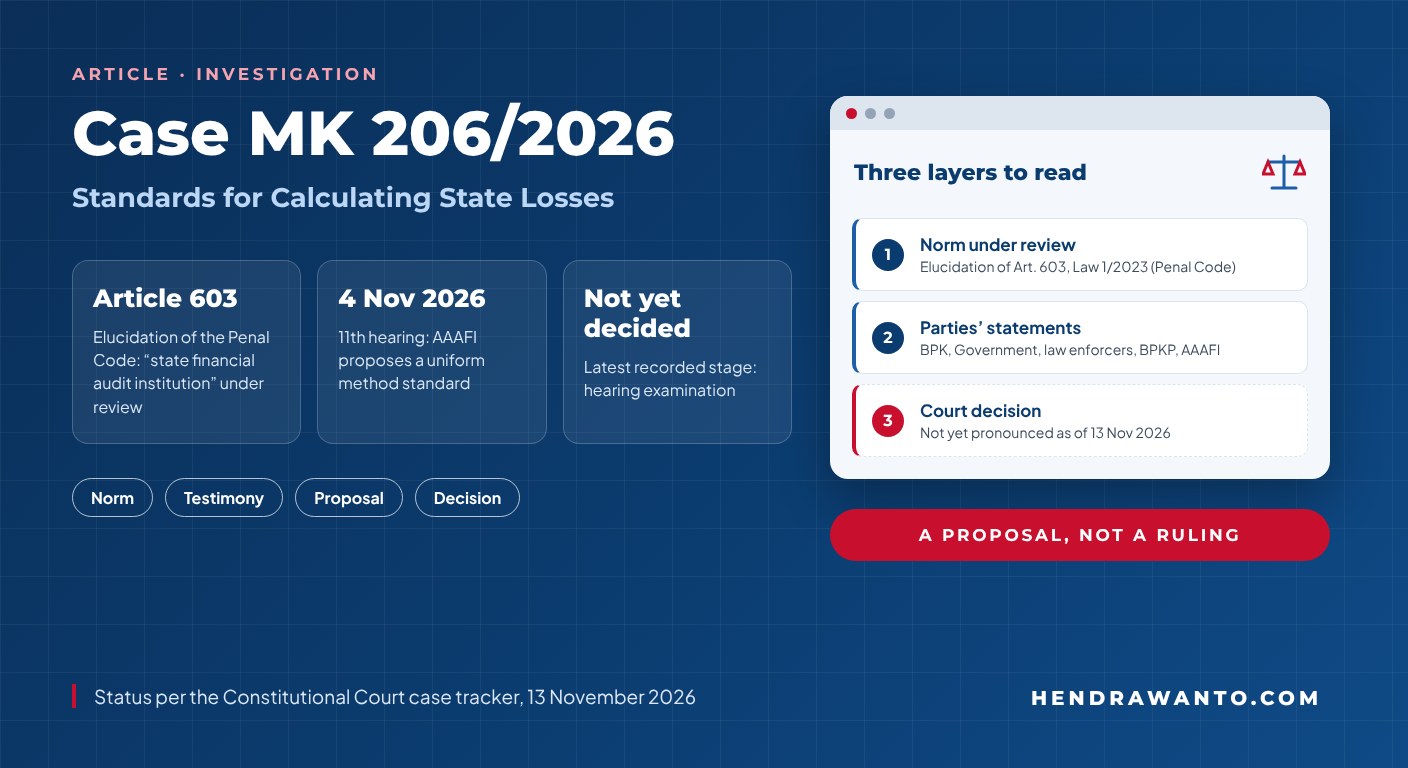
A Constitutional Court hearing on how state financial losses are calculated has drawn renewed attention after the Indonesian Association of Advocates and Forensic Accountants (AAAFI) proposed a uniform standard for calculation methods. Case 206/PUU-XXIV/2026 reviews the phrase “state financial audit institution” in the Elucidation of Article 603 of Law Number 1 of 2023 on the Penal Code (KUHP). AAAFI’s proposal at the hearing on 4 November 2026 is a statement by a related party, not a decision of the Court.
What Is Actually Under Review?
The Elucidation of Article 603 of the Penal Code states that “causing loss to state finances” is based on the examination results of a state financial audit institution. According to the Court’s report on the 4 November 2026 hearing, the Petitioner argues that the phrase does not expressly name the Audit Board of Indonesia (BPK), so that in practice loss determinations may rely on BPK, BPKP, an Inspectorate, or other examiners. In the petitum, the Petitioner asks that the phrase be declared conditionally unconstitutional unless interpreted as “the Audit Board of the Republic of Indonesia”, citing, among others, Article 23E(1), Article 27(1), and Article 28D(1) of the 1945 Constitution.
That request concerns the constitutional interpretation of a norm. It is not a request for the Court to recalculate the loss figure in a particular criminal case. The 4 November session was the eleventh hearing in this case. According to the Court’s case tracker, checked on 13 November 2026, the latest recorded stage was the hearing examination of 4 November 2026, while the pronouncement of the decision had not yet been recorded.
- Filing & registrationThe petition is filed and then registered.
- Preliminary examinationTwo preliminary hearings and a revised petition.
- Coordination orderThe Court asks the parties to align their views under BPK’s coordination.
- Coordination reportBPK reports on meetings with the Government and law enforcers.
- 11th hearingAAAFI proposes a uniform method standard.
- Decision pronouncedNot recorded as of 13 November 2026.
It therefore helps to separate three layers: the norm, the statements, and the decision. A petitum is a request. Statements by BPK, the Government, law enforcement agencies, and professional associations are material submitted to the Court. Questions from the bench, such as Constitutional Justice Arsul Sani’s question on whether the phrase should properly be read as BPK, are part of the examination. Only the operative part and reasoning of a decision can show how the Court interprets the norm.
Why Has Methodology Become the Focus?
AAAFI started from the phrase “real and definite in amount” in the definition of state loss. In its view, that concept cannot be measured directly; it needs testable parameters applied through a method whose selection can be justified. On that basis AAAFI proposed a method standard that applies equally to everyone who performs a calculation, whoever performs it and whoever commissions it, as input for lawmakers and the competent institutions.
AAAFI also noted that the same case facts can produce different figures from BPK, BPKP, and experts in court, which it said often stems from differences in sources and in how the elements of loss are interpreted rather than from different facts. The association mentioned methods known in practice, including total loss, total adjusted loss, and net loss, whose application must fit the character of each case. The questions it raised are methodological: whether an amount is an actual loss or only a potential one, whether source documents show a reduction in state money, and how examiner objectivity is safeguarded.
- 1AssignmentMandate, scope, and the party commissioning the work.
- 2Source documentsEvidence of a reduction in state money or assets.
- 3Choice of methodTotal loss, total adjusted loss, net loss, or another, with reasons.
- 4Test assumptionsActual or potential; treatment of benefits received.
- 5Explain the resultComponents of the figure, data limitations, and reconciliation of differences.
The proposal is best read as a proposal to improve methodology, not as the endorsement of a single formula for every case. Not every payment automatically becomes a loss equal to the amount paid, and benefits the state is said to have received cannot necessarily be deducted without evidence. A single final figure can look convincing, but its quality depends on the path from the evidence to that figure. Where two calculations differ, the discussion should go down to component level: data, treatment of benefits, period, or how the subject of the examination is interpreted. For a description of calculation procedures, see also Investigative Audit Procedures and How to Calculate State Financial Loss.
What Positions Did the Institutions Present?
At the hearing of 6 October 2026, BPK reported on meetings with the Government, the Police, the Prosecutor’s Office, the Corruption Eradication Commission (KPK), the Supreme Court, and BPKP. BPK explained that calculating state losses (PKN) is part of investigative examination under Article 13 of Law Number 15 of 2004. BPK may also use examiners from outside BPK, including government internal auditors (APIP) and public accounting firms, working for and on behalf of BPK under Article 9(3) of Law 15/2004 and Article 9(1)(g) of Law Number 15 of 2006. According to BPK, PKN must follow the State Financial Audit Standards (SPKN) and BPK’s methodology and quality control system, referring to Article 5 of Law 15/2004 and BPK Regulation Number 1 of 2026. On when SPKN 2026 takes effect, see SPKN 2026: Understanding DTT Investigative Audits.
BPK cited three anticipatory steps: amending its regulations on investigative examinations, PKN, and expert testimony; establishing an investigation unit in every province; and developing governance for using APIP and public accounting firms working on BPK’s behalf. The responses of other institutions, as reported by BPK, differ in nuance:
Police & Prosecutors
23 Sep: agree BPK has authority for PKN, with faster completion, APIP/public accountants (Prosecutors: also law-enforcement forensic units) acting for BPK, and uniform methodology.
BPKP
18 Sep: understands BPK’s constitutional authority; further work is needed on PKN procedures to be followed jointly.
Supreme Court
24 Sep: supports BPK’s authority; APIP and public accountants may still be involved; uniform standards improve the quality of evidence.
Government (Law Ministry)
29 Sep: discussing amendments to Articles 603–604 of the Penal Code and the Anti-Corruption Law; PKN by BPK, BPKP, and public accountants using BPK standards; law enforcers not authorised; a transition period needed.
KPK
1 Oct: supports BPK as the sole authorised institution, hoping APIP and KPK’s forensic unit can still be involved on BPK’s behalf.
Court decision
Not pronounced as of 13 November 2026. Only the decision settles how the norm is interpreted.
These differences show why draft regulation, coordination results, and the law in force must be read separately. Amendments still being discussed by the Government cannot yet be treated as rules in force. Background on how the offence is framed in the new national Penal Code is covered in State Financial Loss Calculation After the New Criminal Code.
What Can Readers of a Loss Report Do Now?
Before relying on a loss calculation as the basis for a decision, readers can take these steps:
- Trace the examiner’s mandate and scope, including who commissioned the work.
- Match the final figure to the source documents and to the method chosen, with its reasons.
- Check whether the report separates actual from potential loss, and factual findings from assumptions.
- Where another calculation exists, compare the components and the basis of the difference, not just the totals.
Incomplete documents should be disclosed as a limitation, not covered by a figure that merely looks precise. Conversely, disagreement about method does not automatically prove that an entire examination is worthless. The assessment of evidence in legal proceedings still follows the applicable authority and procedures; this article does not determine the weight of evidence in any particular case.
Conclusion
Case MK 206/PUU-XXIV/2026 raises two connected questions: who is authorised to calculate state losses and how the result can be tested. AAAFI emphasises a uniform method standard; BPK’s coordination report highlights authority, the use of other examiners on BPK’s behalf, and audit standards; the Government described planned legislative amendments. All of these are inputs to a proceeding that is still under way. Until the decision is pronounced, avoid claiming that any single view expressed at a hearing has become a final legal rule.
Need a discussion of calculation methodology or a review of an examination report? See the Investigative Audit & State Loss service.
Official References
- Constitutional Court: AAAFI Usulkan Standar Penghitungan Kerugian Negara (4 November 2026)
- Constitutional Court: BPK Sampaikan Hasil Koordinasi Standar Penghitungan Kerugian Keuangan Negara (6 October 2026)
- Constitutional Court: Case Tracker 206/PUU-XXIV/2026
This article is general information based on official sources available as of 13 November 2026. It is not a legal opinion, an audit conclusion, or an assessment of any particular case. Check developments in the case and the applicable rules before making professional decisions. The Indonesian version is the original text.