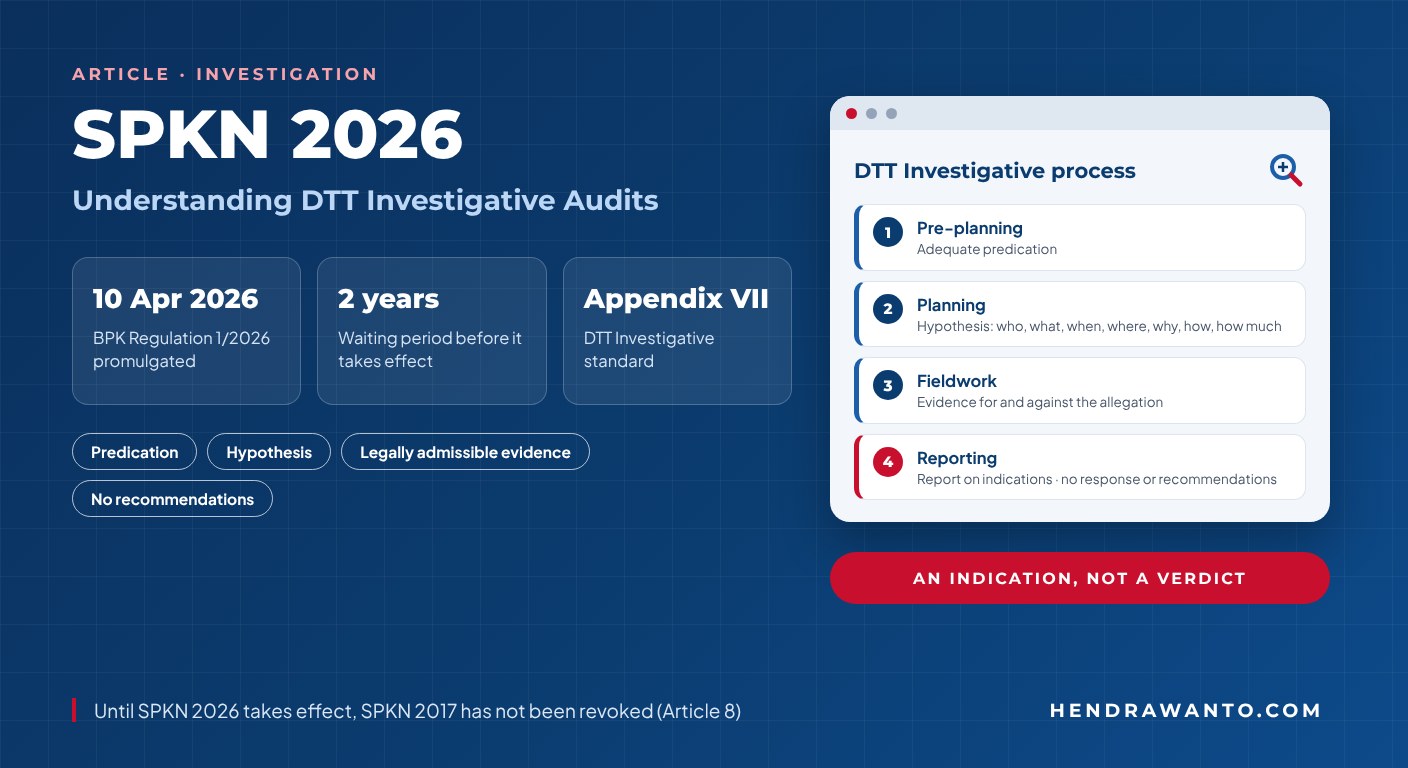
The word "investigative" often sounds like a conclusion, yet in audit standards it refers to a type of engagement with its own stages and limits. BPK Regulation Number 1 of 2026 on the State Finance Audit Standards (SPKN 2026) places the standard for Special Purpose (DTT) Investigative Audits in a separate appendix, namely Appendix VII. It explains why an audit begins, how an allegation is tested, what evidence is required and what form the conclusion takes.
One timing point must not be missed. Article 9 of BPK Regulation 1/2026 states that the regulation comes into force two years after its promulgation on 10 April 2026. Article 8 states that BPK Regulation Number 1 of 2017 on SPKN is revoked only when SPKN 2026 comes into force. The new text can therefore be studied now, but it is not yet accurate to describe it as the standard being applied to today's engagements.
From Promulgation to Application
According to BPK's legal information database (JDIH BPK), BPK Regulation 1/2026 was enacted and promulgated on 10 April 2026 and revokes SPKN 2017. BPK launched SPKN 2026 on 3 August 2026, describing the launch as a first step towards implementation, with effect two years after promulgation. Appendix VII itself, in paragraph 2, repeats the same effective date provision.
- 10 April 2026BPK Regulation 1/2026 enacted and promulgatedArticle 9 and JDIH BPK
- 3 August 2026BPK launches SPKN 2026first step towards implementation
- 29 Sep – 6 Oct 2026Public consultation on a draft BPK Regulation on investigative auditsa draft, not yet enacted
- April 2028Two years after promulgation: SPKN 2026 comes into forceSPKN 2017 revoked (Article 8)
Position in November 2026: SPKN 2017 has not been revoked, BPK Regulation 1/2020 on investigative audits is still listed as in force on JDIH BPK, and its replacement is still being drafted.
Article 3 organises SPKN 2026 into seven standards: the General Standard, the Audit Fieldwork Standard, the Audit Reporting Standard, the Financial Audit Standard, the Performance Audit Standard, the DTT Compliance Audit Standard and the DTT Investigative Audit Standard, set out in Appendices I to VII. Separating standards by audit type helps readers see that the question answered and the output differ. A financial audit produces an opinion, while a DTT Investigative Audit is directed at a conclusion on indications of state/regional losses and/or criminal elements.
Article 4 applies SPKN to BPK; to public accountants, professional audit staff of public accounting firms and internal supervisory officials auditing for and on behalf of BPK; to public accountants auditing state finances under laws and regulations; and to other parties auditing state finances. This does not mean that every financial statement audit by a public accountant becomes an investigative audit. The type of engagement and its basis still determine the applicable standard.
What Does Appendix VII Cover?
Paragraph 5 of Appendix VII divides DTT Investigative Audits into two: audits to reveal indications of state/regional losses and/or criminal elements, and the same audits carried out for the purpose of calculating state/regional losses. The two are related but not identical. An audit that finds indications is not necessarily a calculation of the amount of loss, so its purpose and scope must be read from the engagement documents.
The appendix also contains useful definitions. State/regional loss is a shortfall of money, securities or goods that is real and certain in amount as a result of an unlawful act, whether intentional or negligent, consistent with the State Treasury Law discussed in the article on how to calculate state financial losses. Fraud is a criminal offence only if the act is declared a criminal offence by statute. Authorised agencies include the Corruption Eradication Commission (KPK), the Attorney General's Office, the National Police and other agencies authorised to conduct inquiries and/or investigations. The audit criteria are the provisions of laws and regulations.
Predication: The Reason That Must Come First
Appendix VII defines predication as the totality of events and circumstances that would lead a professionally trained and prudent person to believe that fraud has occurred, is occurring or will occur. At the pre-planning stage the auditor must establish adequate predication so that the audit is objective and accountable, and a DTT Investigative Audit is carried out only when such predication exists (paragraphs 23–24). It may come from the results of financial, performance or DTT compliance audits, or from information inside or outside BPK, including from authorised agencies.
For news readers, this distinction matters. The decision to start an audit, the auditor's findings and proof in court are different stages. Predication is a starting point to be assessed, not a conclusion that fraud has been proven. The standard also states that materiality in a DTT Investigative Audit places greater emphasis on qualitative considerations (paragraph 26): the size of an amount is not the only measure of how important a deviation is.
- Pre-planningAdequate predicationThe audit starts only with an objective and accountable reason.Paragraphs 23–26
- PlanningHypothesisPrepared or understood from the predication, then turned into audit guidance.Paragraphs 27–28
- FieldworkEvidenceSufficient, appropriate and legally admissible; including evidence to the contrary.Paragraphs 29–30
- ReportingRestricted reportConclusion on indications; no response from the responsible party and no recommendations.Paragraphs 31–36
A Hypothesis Is a Testing Tool, Not a Verdict
Based on the predication, paragraph 27 requires the auditor to prepare or understand a hypothesis covering who is involved, the type of fraud, the period, the place, the reason, the method and the amount of loss. The auditor then prepares audit guidance to prove the hypothesis or case construction. Because it is provisional, the hypothesis must remain open to being refuted by evidence.
That is why paragraphs 29–30 matter. The auditor must obtain sufficient and appropriate evidence that is legally admissible. To judge sufficiency, the auditor considers both evidence supporting the involvement of the alleged party and evidence pointing the other way. As a general illustration that refers to no particular case, a discrepancy in procurement records may raise an initial question; following it up requires testing the data source, the approval trail, possible administrative corrections and the transaction documents before reaching a conclusion. Readers interested in the line between administrative error and state loss may read the article on Constitutional Court Decision 66/2026 (in Indonesian).
What the Report States, and Where Its Limits Lie
The DTT Investigative audit report (LHP) is prepared in writing and contains a conclusion on indications of state/regional losses and/or criminal elements based on the sufficiency and appropriateness of the evidence (paragraph 31). Paragraph 20 describes the assurance as high but not absolute. Contrary to the common assumption that every BPK report ends with recommendations, the auditor does not request a response from the responsible party and does not give recommendations (paragraphs 32–34). Mechanisms such as follow-up on BPK recommendations therefore cannot simply be applied to this type of report.
The report is delivered to its users, namely the agencies authorised to follow it up and/or the representative institution that requested the audit. Information obtained is confidential, so distribution is restricted (paragraphs 35–36). A conclusion on indications must not be rewritten as a ruling that a person has committed a crime; law enforcement has its own powers and stages.
Indication
- State/regional loss and/or criminal elements
- High but not absolute assurance
- No response or recommendations; restricted distribution
Loss calculation
- Second scope under paragraph 5
- Loss: real and certain in amount
- Purpose and scope read from the engagement
Legal ruling
- Process by authorised agencies and courts
- A crime only if declared so by statute
- An audit report is not a court judgment
The Rules in Force Now and the Draft Still Under Discussion
During the waiting period, BPK Regulation Number 1 of 2020 on Investigative Audits, Calculation of State/Regional Losses and Provision of Expert Testimony is still listed as in force on JDIH BPK. On 29 September 2026, BPK opened a public consultation on a draft BPK Regulation with a similar title, with comments due by 6 October 2026. That page shows a drafting process, not evidence that the draft has been enacted.
- Check the engagement date. For audits carried out before SPKN 2026 comes into force, the reference standard is still SPKN 2017.
- Check the engagement type. Distinguish financial audits, DTT compliance audits, DTT Investigative Audits and loss calculations.
- Check the document status. A regulation in force, a standard awaiting its effective date and a draft under public consultation must not be treated as one rule.
- Check the language of the conclusion. "Indication" in an audit report differs from "proven" in a court judgment.
Conclusion
SPKN 2026 provides a clearer framework for reading DTT Investigative Audits: adequate predication, a provisional hypothesis with seven elements, legally admissible evidence including contrary evidence, and a written report without responses or recommendations and with restricted distribution. However, the standard only comes into force two years after 10 April 2026. Until then, readers should treat it as the direction of change, while keeping indications, loss calculations and legal rulings apart.
Need support with an investigative audit or a state loss calculation? See the Investigative Audit & State Loss service.
Official References
- Copy of BPK Regulation Number 1 of 2026 on the State Finance Audit Standards (PDF, including Appendix VII; in Indonesian)
- JDIH BPK: BPK Regulation No. 1 of 2026 (metadata and status)
- BPK: SPKN 2026 Answers Present and Future Audit Challenges (5 August 2026; in Indonesian)
- JDIH BPK: BPK Regulation No. 1 of 2020 on Investigative Audits, Calculation of State/Regional Losses and Provision of Expert Testimony
- JDIH BPK: Public Consultation on the Draft BPK Regulation on Investigative Audits, Calculation of State Losses and Provision of Expert Testimony (29 September 2026)
This article is general educational information, not a legal opinion, an audit conclusion or a state loss calculation for any particular case. Application of the standards and assessment of evidence must follow the provisions in force on the engagement date and the facts of each case. The Indonesian version is the original text.