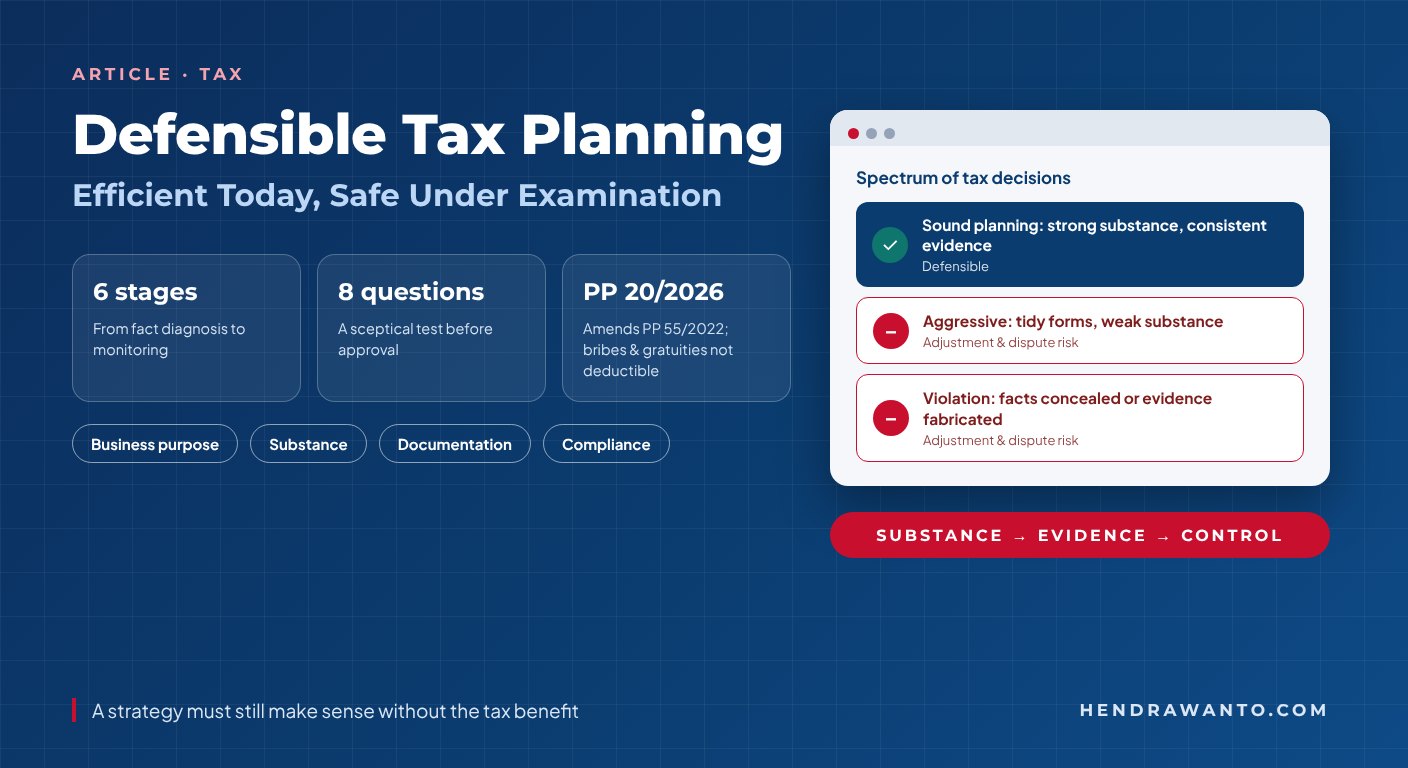
Good tax planning is not the art of hiding tax. It is the discipline of designing business decisions before transactions take place, calculating their full consequences, confirming the legal basis, and preparing the evidence so that the decision can be defended.
Key conclusion. If a scheme only looks attractive because it produces the lowest tax, but has no independent business rationale, weak documents, or an execution that differs from the contract, it is not a strong strategy. It is a deferred dispute.
What Tax Planning Really Is
Tax planning is a systematic process of considering tax consequences when a company chooses the timing, form, funding source, contract, location, transaction structure, and execution of a business decision. It is done before material action is taken, not after a transaction is finished and a justification is needed.
Sound planning does not separate tax from the business decision. Tax cost, cash flow, accounting, financing, legal aspects, operations, and reputation should be analysed together. The option with the lowest tax does not necessarily deliver the best economic value if it locks up cash, adds administrative cost, reduces flexibility, or increases the risk of adjustment.

Distinguishing Sound Planning from Aggressive Strategy
The dividing line is not merely whether a step is explicitly mentioned in the regulations. A stronger question is whether the legal form, economic facts, commercial purpose, execution, bookkeeping, and reporting tell the same story. The Income Tax Law itself, through Article 18 and its implementing rules, authorises the Director General of Taxes to redetermine income and deductions on related-party transactions that are not consistent with the arm's length principle.
| Dimension | Defensible planning | High-risk indicators |
|---|---|---|
| Purpose | There is a real business benefit beyond the tax benefit. | The transaction would not happen if the tax benefit disappeared. |
| Substance | Functions, assets, people, decisions, and risks are actually carried out. | An entity or contract exists on paper but does not perform its economic role. |
| Pricing | Prices can be explained with relevant data and analysis. | Prices are set merely to shift profit or expenses without support. |
| Documentation | Prepared on time and consistent with the facts and the books. | Documents are prepared after questions arise or differ from execution. |
| Reporting | Transactions are presented completely in the books and tax returns. | Material information is not reported or is manipulated. |
Why Tax Planning Can No Longer Be Reactive
Indonesian tax administration is increasingly integrated. Minister of Finance Regulation (PMK) No. 81 of 2024 sets the tax provisions for implementing the Core Tax Administration System (Coretax) and has been amended several times; the fourth amendment came through PMK No. 1 of 2026, effective 22 January 2026. Transaction data quality, reconciliations, counterparty identity, and accurate reporting are therefore key parts of a company's tax control.
For related-party transactions, PMK No. 172 of 2023 puts the arm's length principle and documentation at the centre of accountability, and also governs the mutual agreement procedure (MAP) and advance pricing agreements (APA). For large multinational groups, PMK No. 136 of 2024 applies the global minimum tax under the international agreement (Pillar Two), so incentives that push the effective rate below the minimum threshold need their impact reassessed.
Corporate tax incentives remain available—for example the tax holiday, tax allowance, investment allowance, super tax deduction for research and development and vocational activities, and incentives in Special Economic Zones and the Nusantara Capital City—but their use is tied to requirements, procedures, reporting, and possible revocation if conditions are not met.
A "calculate tax at year end" approach is therefore too late. Tax planning must be part of investment meetings, contract discussions, funding decisions, remuneration policy, related-party pricing, and data system design.
Regulatory note as of 22 October 2026. Government Regulation (PP) No. 55 of 2022 on Adjustments to Income Tax Provisions has been amended by PP No. 20 of 2026. One of the changes confirms that bribes, gratuities, or other gifts in any form—including to foreign public officials—are not deductible. Every planned transaction should be tested against the rules in force on the date of execution, not just against last year's memo or model.
Six Stages of Defensible Tax Planning
A strong tax plan comes from a traceable process. The sequence below prevents teams from jumping to a "solution" before the facts and business purpose are understood.
1. Diagnose the facts and business purpose
Start with the business model, revenue sources, value chain, contracting process, fund flows, related parties, assets, operating locations, and historical tax issues. The business objective should be written clearly: expansion, acquisition, capital efficiency, restructuring, a new investor, or better cash flow.
2. Design several options
Do not lock in one scheme too early. Prepare alternatives for transaction form, timing, contracts, funding sources, and implementation phases. Comparison options let management see the opportunity cost and the non-tax consequences.
3. Quantify the full impact
The model should cover tax cash, payment timing, income tax, VAT, withholding or collection, compliance cost, financial statement impact including deferred tax, working capital needs, and the cost of exiting or changing the strategy.
4. Stress-test the plan
Review it from the viewpoint of a sceptic. Identify weak assumptions, unproven facts, unsynchronised contracts, pricing areas, and provisions open to differing interpretations.
5. Implement and document
The tax decision must be translated into contracts, internal approvals, payment flows, accounting entries, transaction evidence, system parameters, SOPs, and a reporting calendar. A tax memo without consistent implementation is not enough.
6. Monitor
Compare actual results with assumptions. Changes in prices, parties, functions, financing, or regulation can make the original conclusion irrelevant. Tax planning is a control system, not a one-off document.
Seven Areas That Most Often Determine Tax Planning Quality
Transaction structure and contracts
Object, rights, obligations, recognition timing, payment terms, risks, and change mechanisms must match execution.
Funding and capital structure
Debt, equity, cost of funds, repayment capacity, deduction limits—including the debt-to-equity ratio rules—and the character of payments should be tested together.
Related-party transactions
Functions, assets, risks, service benefits, arm's length pricing, and documentation under PMK 172/2023 must be built from actual conditions, not just contracts.
Capital expenditure and assets
Buying, leasing, building, or acquiring a business should be compared on tax, accounting, cash, control, and exit.
Remuneration and benefits in kind
Compensation design should consider HR needs, treatment for the company and the recipient, administration, and policy evidence.
VAT and supply chain
The flow of goods or services, the time VAT is due, invoices, input tax credits, vendors, and reconciliations should be mapped from the start.
Incentives
Eligibility is not only about the business sector. Investment requirements, filing timing, commitments, realisation reports, revocation risk, and interaction with the global minimum tax must be calculated.
Data and governance
Master data, evidence, reconciliations, authority, audit trails, and owners determine whether a strategy can be defended.
Eight Questions Before a Strategy Is Approved
Every proposal should pass an internal sceptical test. If answers to two or more of these questions still depend on assumptions or documents that do not yet exist, the strategy is not ready.
- Does the decision still have a strong commercial rationale if the tax benefit is removed from the calculation?
- Do the contracts, invoices, fund flows, books, and actions of the parties describe the same transaction?
- Does the entity receiving the payment actually have the people, capability, assets, and control over the risks involved?
- Can the price or fee be explained with comparable data, a method, and relevant analysis?
- Is key documentation prepared before or at the time of the transaction, not after questions arise?
- Can the figures in the model be reconciled to the general ledger, contracts, invoices, bank records, and tax reporting?
- Do all incentive requirements, approvals, reports, and utilisation periods have a clear owner?
- Is management willing to explain this decision openly to auditors, investors, and the tax authority?
Case Study: Why the Lowest Tax Is Not Always the Best Choice
PT Arunika (fictitious) plans to expand capacity with an asset investment of Rp12 billion. Management is considering a cash purchase, bank financing, a lease, or a phased investment that might qualify for an incentive. The example is illustrative and uses no specific rates or requirements.
A common mistake is comparing only the first-year tax charge. A proper analysis also weighs cash flow, cost of funds, control over the asset, useful life, VAT risk, incentive conditions, documentation, exit flexibility, and the consequences when the asset is transferred.
Select an option to see the analytical focus. Bar length shows the level of attention required, not a feasibility score.
Cash purchase
High control over the asset and a relatively simple structure, but a large upfront cash need. Focus: asset classification, capitalised costs, depreciation, VAT, and the effect on liquidity.
Bank financing
Preserves upfront cash but adds cost of funds and covenants. Test the character of the debt, use of funds, repayment capacity, deduction limits, and consistency of the financing documents.
Lease
Provides flexibility and reduces upfront investment. Check the substance of the lease, rights and obligations, payment pattern, withholding tax, VAT, accounting under PSAK 116, and termination costs.
Phased investment
Aligns investment with growth and may open certain incentives. Complexity rises because timing, investment commitments, requirements, realisation reports, and revocation risk must be controlled.
A strong decision. Management should choose the option with the best after-tax economic value over the relevant horizon at an acceptable level of risk—not simply the option with the lowest tax payment in a single year.
See also: Right-of-Use Assets Under PSAK 116: Measurement and Tax for a comparison of the accounting and tax treatment of leases.
A 90-Day Roadmap to Operational Tax Planning
- Days 1–30 · DiagnosisBuild the tax profile, transaction map, compliance calendar, incentive list, historical issues, reconciliations, and risk register. Assign data owners.
- Days 31–60 · Design and decisionBuild scenarios, calculate tax cash and other impacts, run a red-team review, document assumptions, then obtain management approval.
- Days 61–90 · ImplementationAlign contracts, systems, accounting, payment flows, evidence, SOPs, and reporting. Set indicators and a periodic review forum.
- Monthly · ControlReconcile the general ledger, invoices, withholding slips, payments, reporting, and unusual transactions. Resolve differences before they pile up.
- Quarterly · RefreshTest business and regulatory changes, measure realised benefits, close documentation gaps, and update the roadmap.
Who Should Be Accountable
The tax function cannot work alone. The board sets risk tolerance and approves material transactions. The CFO ensures the economic model, accounting, and data sources. The tax function tests the rules and compliance. Legal ensures contracts and authorisations. Business units prove the commercial purpose and execution. Internal audit or an independent reviewer challenges assumptions and the effectiveness of controls.
Useful indicators include reconciliation accuracy, timely document completion, repeat findings, the number of manual transactions, realised benefits versus the model, open exposures, and overdue actions. The effective tax rate and tax cash remain relevant, but should not stand alone because many factors that do not reflect strategy quality can affect them.
Warning signs that must not be normalised
Good Tax Planning Must Still Make Sense Without the Tax Benefit
Companies need efficiency. But fragile efficiency only shifts today's burden into the future as adjustments, penalties, disputes, adviser fees, transaction disruption, and reputational risk. Tax planning should therefore be treated as part of business design and governance, not cosmetic work before filing.
The best strategy answers three things at once: why the transaction is needed for the business, how its impact is measured in full, and what evidence shows that execution matches the plan.
"Tax savings that cannot be explained are a risk. Efficiency with substance, evidence, and control is a strategy."
Need help designing or testing a tax plan? See our Corporate Tax Advisory service or request a proposal on the Proposal page.
Official References
- Law No. 7 of 2021 on the Harmonisation of Tax Regulations (in Indonesian)
- Government Regulation No. 55 of 2022 on Adjustments to Income Tax Provisions, as amended by Government Regulation No. 20 of 2026
- PMK No. 172 of 2023 on the Arm's Length Principle in Related-Party Transactions
- PMK No. 81 of 2024 on Tax Provisions for the Core Tax Administration System, fourth amendment by PMK No. 1 of 2026
- PMK No. 136 of 2024 on the Global Minimum Tax Under the International Agreement
- Directorate General of Taxes: Corporate Income Tax Incentives in Indonesia (2025)
This article is general educational material and is not a tax or legal opinion or a transaction recommendation for any particular situation. Tax treatment depends on the facts, documents, period, status of the parties, and the rules in force. Obtain a specific review before applying any structure or incentive. The Indonesian version is the original text.