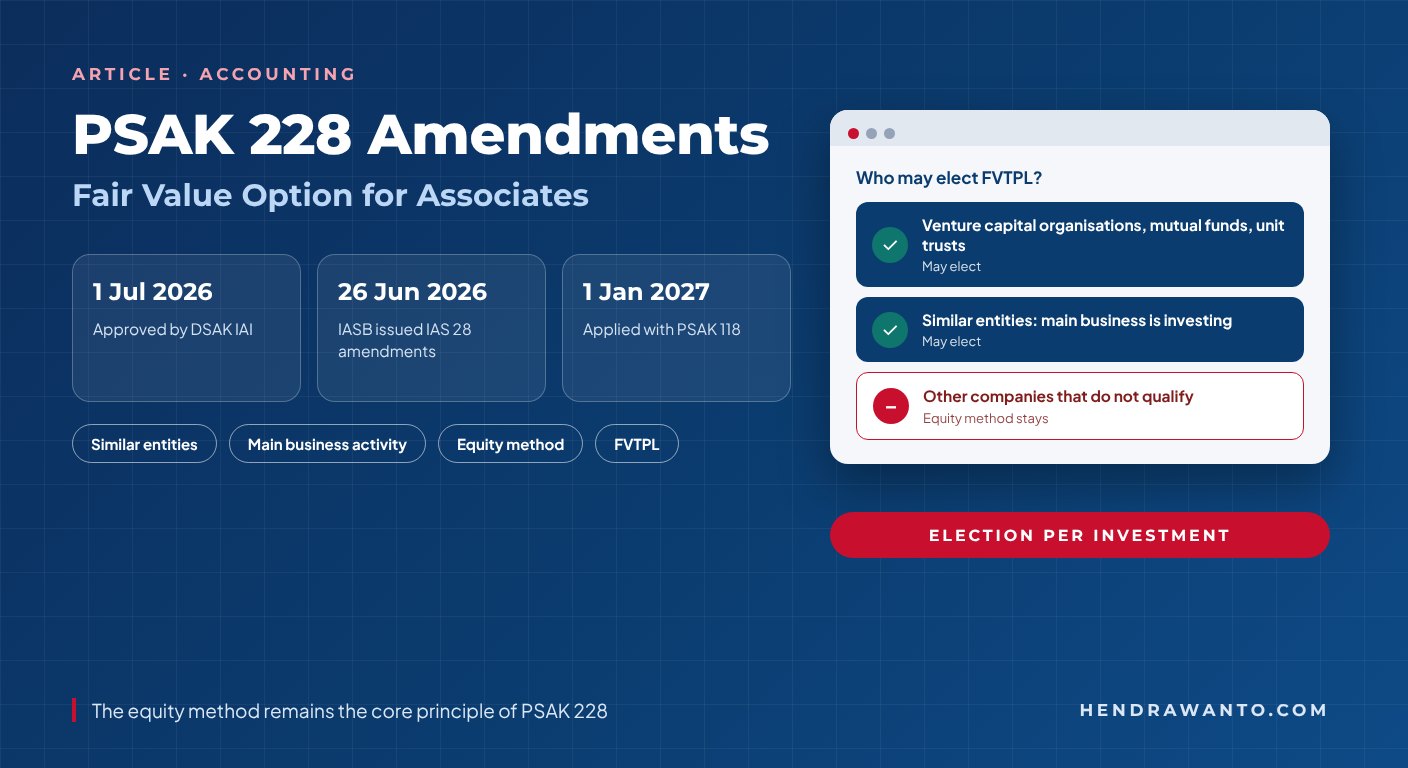
The Financial Accounting Standards Board of the Institute of Indonesia Chartered Accountants (DSAK IAI) has approved amendments to PSAK 228 that clarify which entities may measure investments in associates and joint ventures at fair value through profit or loss. The amendments are not a free choice for every investor, and they do not remove the equity method as the core principle.
PSAK 228 Still Starts from the Equity Method
Investments in associates and joint ventures are not automatically treated like an ordinary share portfolio. Under PSAK 228, an entity with significant influence over an associate or joint control of a joint venture generally accounts for the investment using the equity method. The investment is initially recognised at cost, and its carrying amount is then adjusted for the investor's share of the investee's profit or loss and other comprehensive income, less distributions received.
PSAK 228 provides a limited exception. Investments held by, or indirectly through, venture capital organisations, mutual funds, unit trusts and similar entities may be measured at fair value through profit or loss (FVTPL) under PSAK 109 Financial Instruments. The question is: what counts as a "similar entity"? The 2026 amendments answer that question.
Status of the Amendments
DSAK IAI approved the Amendments to PSAK 228 Investments in Associates and Joint Ventures: Fair Value Option for Investments in Associates and Joint Ventures on 1 July 2026, and IAI announced them on 14 July 2026. The amendments started from an exposure draft approved on 8 April 2026, with comments due by 28 May 2026.
They follow the amendments to IAS 28 proposed by the International Accounting Standards Board (IASB) in a February 2026 exposure draft and issued in final form on 26 June 2026. According to IAI, the amendments address diverse interpretations of how the fair value option in PSAK 228 interacts with PSAK 118 Presentation and Disclosure in Financial Statements, and their scope is deliberately narrow so as not to change broader existing practice.
- Feb 2026IASB publishes the exposure draft of the IAS 28 amendments.
- 8 Apr 2026DSAK IAI approves the exposure draft of the PSAK 228 amendments.
- 26 Jun 2026IASB issues the final IAS 28 amendments.
- 1 Jul 2026DSAK IAI approves the PSAK 228 amendments.
- 1 Jan 2027PSAK 118 takes effect; the amendments apply at the same time.
What Has Been Clarified?
The main clarification is that "similar entities" eligible for the fair value option include entities whose main business activity is investing in assets of a particular type, as referred to in paragraph 49(a) of PSAK 118. In the IAS 28 amendments issued by the IASB, "investment-linked insurance funds" are no longer named as a specific example; the eligibility of such entities is assessed through the same main business activity test. The final wording in PSAK 228 should be confirmed in the final text on SAK Online.
The analysis therefore does not stop at an entity's name or legal form. A company does not qualify simply because it calls itself an investment company, a holding company, or a portfolio manager. The substance of its business must be assessed. Practical indicators for gathering evidence include:
- whether the entity's main activity really is earning returns from investments;
- how management assesses and monitors investment performance, including segment information;
- whether fair value is the primary information used in decision-making;
- how the entity raises funding and communicates its business model to investors; and
- whether other operating activities dominate the investing activity.
These indicators do not replace the requirements of PSAK. Conclusions must be supported by facts, governance documents, transaction patterns, internal reporting, and the substance of the business model.
Who Can Consider the FVTPL Option?
The fair value option is relevant when an investment is held by, or indirectly through:
- a venture capital organisation;
- a mutual fund;
- a unit trust; or
- a similar entity, including an entity whose main business activity is investing in assets of a particular type.
The key words are may elect, not must. Conversely, a manufacturing, trading, services, or construction company, or an ordinary parent holding one or more associates, does not automatically gain the FVTPL option. If it does not meet the substance of a similar entity, the equity method remains the basis of its accounting.
A Practical Four-Step Eligibility Test
- 1Type of investmentIs the investee an associate or joint venture (significant influence or joint control)?
- 2Investor characteristicsIs it held directly or through a venture capital organisation, mutual fund, unit trust, or similar entity?
- 3Timing of electionElected per investment at initial recognition, or on initial application of PSAK 118.
- 4Measurement readinessCan fair value be measured, controlled, and disclosed with sufficient evidence?
Step 1 — Confirm the type of investment. Shareholding alone is not enough. The analysis should consider voting rights, board representation, participation in policy-making, contractual arrangements, and other substantive rights.
Step 2 — Test the investor or ownership route. For the "similar entity" category, document why the entity's main business activity is investing in assets of a particular type. For indirect holdings, eligibility is assessed at the intermediate entity that holds the investment.
Step 3 — Make the election at the right time. Generally the election is made separately for each associate or joint venture at initial recognition, and should not be made at year end after fair value results are known. The transition provisions give an exception: on initial application of PSAK 118, eligible entities may elect to measure existing investments at fair value.
Step 4 — Make sure measurement and disclosure are workable. The entity must be able to measure fair value under the fair value measurement framework, identify valuation techniques, set observable and unobservable inputs, control models, and prepare relevant disclosures. FVTPL is not a shortcut to avoid gathering investee data.
The Election Is Made per Investment
An eligible entity may use FVTPL for investment A and the equity method for investment B, as long as each election meets the requirements and is made on time. Different decisions still need a clear basis and must not be used opportunistically to shape profit.
What If an Investment Is Held Through Two Routes?
PSAK 228 also covers cases in which part of an interest in an associate is held indirectly through a venture capital organisation, mutual fund, unit trust, or similar entity, while the rest is held through a route that does not qualify for the exception. The portion held through the eligible entity may be measured at FVTPL, while the remainder continues to use the equity method.
Example. PT Investama holds an interest in PT Target through two routes: 15% directly and 10% through a qualifying venture capital fund. In aggregate there is significant influence. If the requirements are met and the election is made properly, the 10% portion may be measured at FVTPL, while the 15% portion remains under the equity method.
The split must be reconcilable. The entity needs records that separate ownership percentages, cost, fair value changes, share of profit or loss, dividends, and carrying amounts for each portion.
Equity Method and FVTPL Compared
| Aspect | Equity method | FVTPL |
|---|---|---|
| Initial measurement | Cost | Fair value; in an arm's length transaction usually equal to the transaction price |
| Subsequent measurement | Adjusted for share of profit or loss, other comprehensive income, and distributions | Remeasured at fair value at each reporting date |
| Profit or loss impact | Investor's share of the investee's profit or loss | All changes in fair value |
| Dividends | Reduce the carrying amount | Recognised under PSAK 109 |
| Data focus | Investee financial statements and accounting policy alignment | Market data, projections, valuation assumptions, and model controls |
| Volatility | Follows the investee's accounting performance | Follows fair value changes and market conditions |
Measurement Example and Journal Entries
Illustrative assumptions. PT Dana Ventura meets the criteria of a venture capital organisation. On 1 January 2027 it buys 30% of PT Inovasi for Rp40 billion and obtains significant influence. At initial recognition, PT Dana Ventura elects FVTPL for the investment. On 31 December 2027 the fair value of the investment is Rp47 billion. Transaction costs are ignored.
| 1 January 2027 | Debit | Credit |
|---|---|---|
| Investment in associate — FVTPL | Rp40 billion | — |
| Cash | — | Rp40 billion |
| 31 December 2027 | Debit | Credit |
|---|---|---|
| Investment in associate — FVTPL | Rp7 billion | — |
| Fair value gain (profit or loss) | — | Rp7 billion |
If fair value instead falls to Rp36 billion at the end of the period, a fair value loss of Rp4 billion is recognised in profit or loss. That result is not replaced by a share of PT Inovasi's profit or loss as under the equity method.
For comparison, suppose PT Inovasi reports profit of Rp10 billion and pays dividends of Rp5 billion in 2027. Under the equity method, the investor recognises a share of profit of Rp3 billion (30% × Rp10 billion) and reduces the carrying amount by dividends of Rp1.5 billion, giving a closing balance of Rp41.5 billion. Under FVTPL, the closing balance follows the fair value of Rp47 billion, while dividends are recognised as income under PSAK 109 and their effect on the investment's value is reflected in the fair value measurement. This example only shows the basic mechanics; in practice the entity must also consider transaction costs, tax, the fair value hierarchy, valuation techniques, and disclosures.
Why Are the Amendments Linked to PSAK 118?
PSAK 118 introduces a new structure for the statement of profit or loss with operating, investing, financing, income tax, and discontinued operations categories. The share of profit or loss of associates and joint ventures accounted for using the equity method is always classified in the investing category. In contrast, for an entity whose main business activity is investing in assets of a particular type, income and expenses from investments measured at fair value may be classified in the operating category.
Without clarification, the phrase "similar entities" in PSAK 228 could be interpreted differently from the main business activity concept in PSAK 118, so the measurement basis of investments and the classification of income or expenses in profit or loss could be inconsistent. The amendments align the two. That alignment does not mean every entity with investment income automatically has investing as its main business activity.
See also the articles on PSAK 118 and the new statement of profit or loss and the PSAK 118 profit or loss format.
Effective Date and Transition
PSAK 118 applies to annual reporting periods beginning on or after 1 January 2027. Under the exposure draft, the PSAK 228 amendments apply at the same time and on the same basis as PSAK 118, including its transition provisions. The new transition paragraph (paragraph 45M) refers to transition paragraph C07 of PSAK 118, which allows eligible entities to change their election from the equity method to FVTPL for existing investments on initial application of PSAK 118; the change is applied retrospectively.
The full final text of the PSAK 228 amendments is available on IAI's SAK Online. Entities should confirm the effective date and transition paragraphs in that final text, then complete the eligibility analysis, policy decisions, valuation readiness, and account mapping before the start of the application period—not when the 2027 financial statements are about to be issued.
Implementation Risks to Avoid
- Assuming the fair value option is available to every company with associates.
- Concluding on eligibility from the label "holding" or "investment company" alone.
- Making the election after seeing whether fair value went up or down.
- Applying FVTPL to the whole interest when only the portion held through a particular route qualifies.
- Using valuations without an adequate basis of assumptions, data, or controls.
- Ignoring the link to the classification of income and expenses under PSAK 118.
- Not disclosing significant judgements, sources of estimation uncertainty, and relevant risks.
Preparation Steps for Companies
- List all associates and joint ventures and their ownership routes.
- Document the basis for significant influence or joint control.
- Assess whether the investor or intermediate entity falls into an eligible category.
- Evidence the substance of the main business activity with management reports, investment mandates, and how performance is assessed.
- Make the decision per investment at initial recognition, or on initial application of PSAK 118 for existing investments.
- Assess data availability and valuation governance.
- Map fair value accounts to the PSAK 118 profit or loss categories.
- Assess the impact on performance indicators, covenants, tax, and shareholder communication.
- Involve the auditor early to discuss evidence, judgements, and disclosures—without shifting responsibility for accounting decisions away from management.
Conclusion
The PSAK 228 amendments provide an important clarification, but they do not open the fair value option to every investor. The equity method remains the core principle for investments in associates and joint ventures. FVTPL can only be considered by venture capital organisations, mutual funds, unit trusts, and similar entities—including entities whose main business activity is investing in assets of a particular type.
A sound decision must answer four questions: is the investment within the scope of PSAK 228, does the investor or ownership route qualify, was the election made at the right time for that investment, and can the entity support fair value and its presentation with sufficient evidence? With PSAK 118 taking effect in 2027, the assessment should be done now.
Need support implementing PSAK 228 and PSAK 118? See the Accounting & SAK Implementation service.
Official References
- IAI: Approval of the PSAK 228 Amendments (14 July 2026)
- IAI: Exposure Draft of the PSAK 228 Amendments (April 2026)
- IAI: Public hearing materials on the PSAK 228 and ISAK 335 exposure drafts
- IFRS Foundation: IASB issues amendments clarifying the fair value option in IAS 28 (26 June 2026)
- IFRS Foundation: IAS 28 Investments in Associates and Joint Ventures
This article is general information and does not replace reading the final text of the standards, professional judgement, or advice on a specific transaction. Determining significant influence, joint control, eligibility for the fair value option, measurement, presentation, and disclosure must be based on each entity's facts and circumstances and the standards applicable to the reporting period. The Indonesian version is the original text.