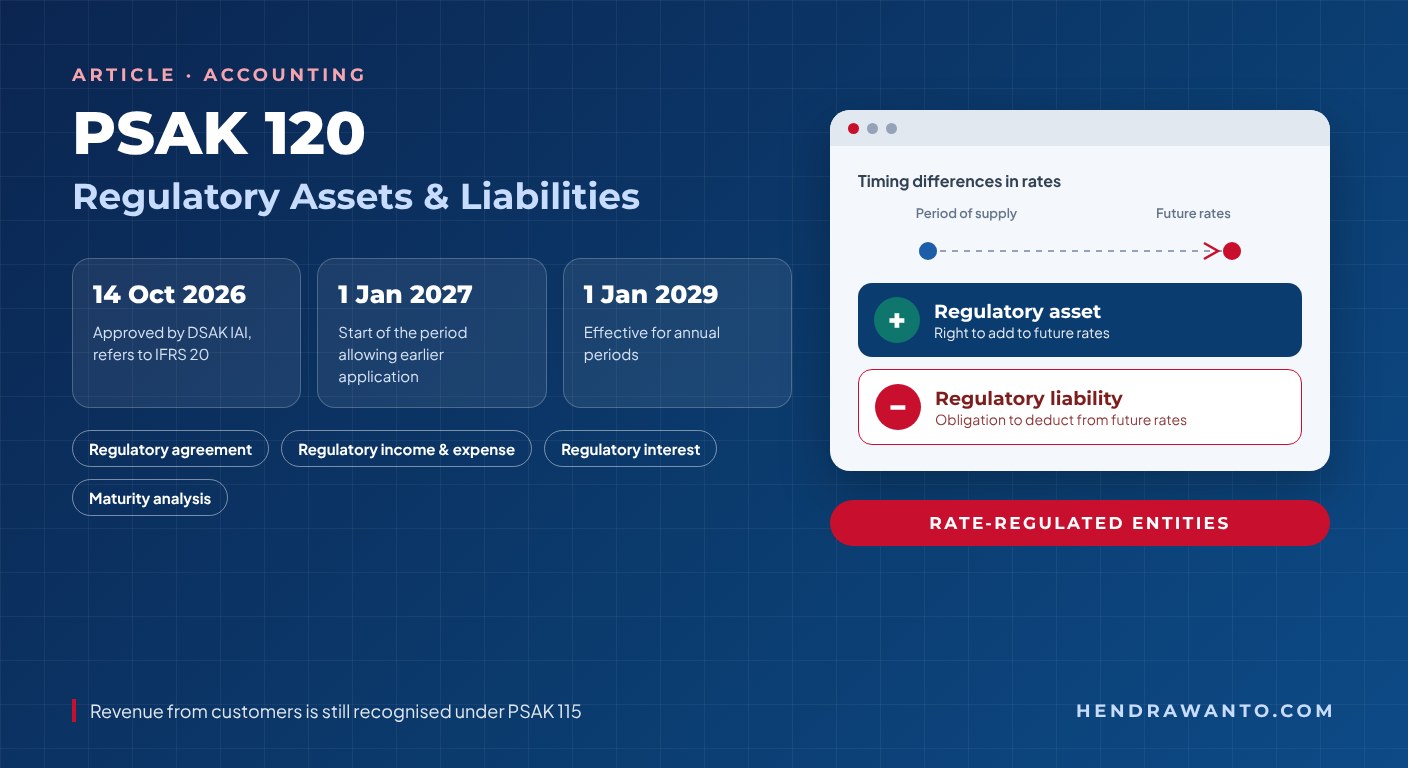
On 14 October 2026, the Financial Accounting Standards Board of the Institute of Indonesia Chartered Accountants (DSAK IAI) approved PSAK 120: Regulatory Assets and Regulatory Liabilities. The standard refers to IFRS 20 and is effective for annual reporting periods beginning on 1 January 2029, with an option for earlier application for annual reporting periods beginning on 1 January 2027.
PSAK 120 is relevant to entities that supply goods or services at rates set through a regulatory agreement. In its IFRS 20 summary, the International Accounting Standards Board (IASB) names industries such as utilities and energy as examples of sectors where this kind of rate regulation is common. The standard focuses on differences in timing: compensation for goods or services supplied in one period is included in customer rates in another period.
- May 2026The IASB issues IFRS 20 Regulatory Assets and Regulatory Liabilities.
- 26 Aug 2026DSAK IAI approves the Exposure Draft of PSAK 120.
- 14 Oct 2026DSAK IAI approves PSAK 120.
- 1 Jan 2027Start of the annual period from which earlier application is allowed.
- 1 Jan 2029PSAK 120 becomes effective.
Why Is PSAK 120 Needed?
In rate-regulated businesses, the amount billed to customers in a period does not always equal the total allowed compensation for goods or services supplied in that period. IAI explains that, as a result, revenue recognised under PSAK 115 in a period can differ from the total allowed compensation for that period. Without a dedicated standard, profit or loss may rise and fall simply because of the timing of rate billing rather than actual performance.
According to IAI, PSAK 120 aims to help users of financial statements understand how regulatory assets and regulatory liabilities, together with regulatory income and regulatory expense, affect financial performance, financial position, and the amount, timing and uncertainty of future cash flows.
Core Concept: Regulatory Asset or Regulatory Liability?
The IFRS 20 summary defines a regulatory asset as an enforceable present right to add an amount to future regulated rates because part of the compensation for goods or services already supplied has not yet been included in revenue. A regulatory liability is the reverse: an enforceable present obligation to deduct an amount from future rates because current-period revenue already includes compensation for goods or services still to be supplied. Changes in either give rise to regulatory income or regulatory expense.
A right to add to future rates → recognise a regulatory asset and regulatory income.
An obligation to deduct from future rates → recognise a regulatory liability and regulatory expense.
Scope: A Regulatory Agreement Is Required
The existence of a regulator or of government-supervised prices does not automatically create regulatory assets or liabilities. The IFRS 20 summary requires a regulatory agreement, meaning an agreement that creates enforceable rights and obligations about how a regulator sets rates. A regulator here is a body required by law or regulation to determine the regulated rate. In addition, there must be a difference in timing: compensation for one period is charged to customers in another period.
The summary also describes the components of total allowed compensation, including allowable expenses, regulatory returns on a regulatory capital base, performance incentives, and under- or over-recovery of allowed revenue. Mapping these components is an important first step because each can create a different timing difference.
Recognition and Measurement
Under the IFRS 20 summary, an entity generally recognises all regulatory assets and regulatory liabilities that exist at the end of the period, including those that are "more likely than not" to exist. For some items, such as regulatory depreciation of a regulatory capital base, recognition applies only when specified conditions are met.
Measurement uses a cash-flow-based technique: the entity estimates future cash flows, including cash flows from regulatory interest, and discounts them using the regulatory interest rate. Uncertainty is reflected using either the most likely amount or the expected value method, whichever better predicts the ultimate cash flow. Assumptions such as the recovery period, the rate formula and the interest rate in the agreement therefore need to be documented and traced to available evidence.
Journal Entry Example: Regulatory Asset
Illustrative assumptions. In 20X1, a utility incurs allowable expenses of Rp12 billion which, under its regulatory agreement, can only be recovered through 20X2 rates. The amount is not included in 20X1 customer bills, all recognition criteria are assumed to be met, and the effect of regulatory interest is ignored.
| Account (20X1) | Debit | Credit |
|---|---|---|
| Regulatory asset | Rp12 billion | — |
| Regulatory income | — | Rp12 billion |
In 20X2, when the Rp12 billion is billed through rates, revenue from customers is recognised under PSAK 115. Recovery of the regulatory asset is recorded as regulatory expense:
| Account (20X2) | Debit | Credit |
|---|---|---|
| Regulatory expense | Rp12 billion | — |
| Regulatory asset | — | Rp12 billion |
The reverse pattern applies to a regulatory liability. For example, 20X1 rates recover Rp5 billion more than the allowed compensation and the agreement requires a reduction in 20X2 rates. In 20X1 the entity debits regulatory expense and credits a regulatory liability of Rp5 billion. In 20X2, when rates are reduced, the regulatory liability is debited and regulatory income is credited.
Presentation and Disclosure
The IFRS 20 summary states that regulatory income and regulatory expense are generally classified as revenue, with the net amount presented as a single line item in the statement of profit or loss. Regulatory income or expense relating to items in other comprehensive income, such as remeasurements of a pension liability, is presented in other comprehensive income. In the statement of financial position, regulatory assets and regulatory liabilities are presented as separate line items and split between current and non-current.
For disclosure, the overall objective is to provide information about the amount, timing and uncertainty of regulatory items. Examples given in the IFRS 20 summary include reconciliations of opening to closing balances, a maturity analysis by time band, explanations of uncertainties, and information about unrecognised items.
Transition and Preparing for 2029
The IFRS 20 summary offers two transition options: retrospective application under the accounting policies standard, or a modified retrospective approach that permits hindsight at the transition date. Under either approach, comparative information for the preceding period is presented after adjustment. Historical data therefore needs to be prepared before the period of initial application.
Practical preparation steps:
- Inventory the regulatory agreements and rate formulas in force.
- Map the components of total allowed compensation and their timing differences.
- Reconcile billing data, the general ledger and the rate model.
- Document cash flow estimates, the regulatory interest rate and uncertainties.
- Design internal controls and the presentation and disclosure format.
- Simulate the impact on profit or loss and comparative information before deciding on earlier application.
PSAK 120 does not replace PSAK 115; revenue from customers is still analysed under PSAK 115. Changes to the structure of profit or loss under PSAK 118 also need to be aligned; related reading is available in PSAK 118: Presentation and Disclosure, PSAK 118 Statement of Profit or Loss Format and Implementing the Latest SAK.
Conclusion
PSAK 120 brings new items to the financial statements of rate-regulated entities: regulatory assets and regulatory liabilities, together with regulatory income and regulatory expense. Although it is only mandatory for annual periods beginning on 1 January 2029, mapping agreements, historical data and measurement assumptions should start early, especially if an entity is considering earlier application from 2027. The detailed points in this article refer to the IASB's IFRS 20 summary; the authoritative reference in Indonesia remains the text of PSAK 120 in IAI's SAK Online.
See also our Accounting & SAK Implementation service or request an estimate through the Proposal page.
Official References
- Institute of Indonesia Chartered Accountants (IAI), "Pengesahan PSAK 120: Aset Regulatori dan Liabilitas Regulatori" (16 October 2026), web.iaiglobal.or.id.
- IAI, "Pengesahan Draf Eksposur PSAK 120" (8 September 2026), web.iaiglobal.or.id.
- IFRS Foundation/IASB, "IFRS 20 Regulatory Assets and Regulatory Liabilities — Project Summary" (May 2026), ifrs.org.
- IFRS Foundation/IASB, "At a glance — IFRS 20 Regulatory Assets and Regulatory Liabilities", ifrs.org.
This article is general information and is not accounting, audit, legal or professional advice for any particular situation. Application of PSAK 120 must consider the text of the standard and each entity's facts and regulatory agreements. The Indonesian version is the original text.