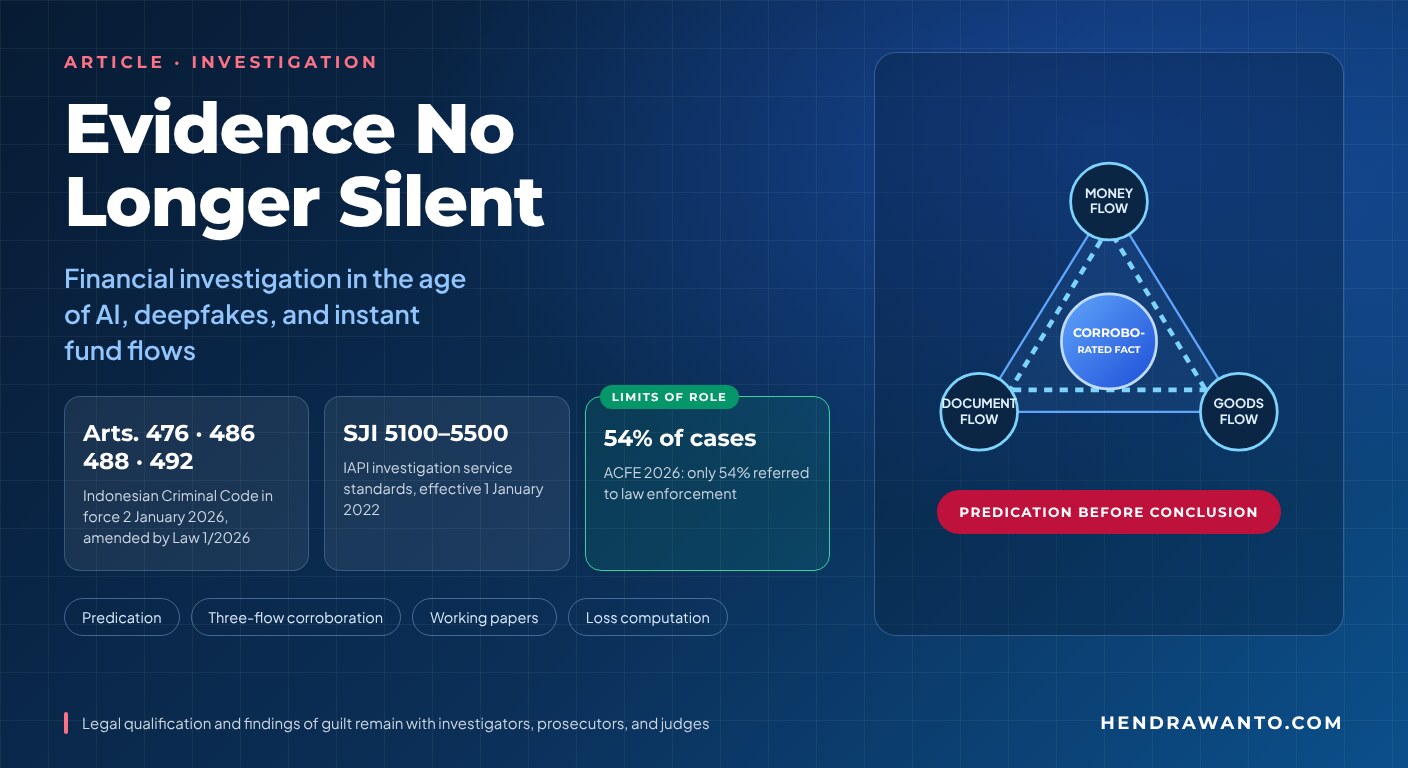
Modern fraud moves through bank accounts, user accounts, synthetic identities, documents that look flawless, and communications that can be forged. The challenge is no longer a shortage of data, but telling authentic traces from digital noise, protecting the integrity of evidence, and resisting the urge to turn an anomaly into a verdict.
Technology changes the method, not the standard of proof. Precisely because artificial intelligence can now compose convincing emails, invoices, voices, and faces, machine speed must be answered with human care. An investigator's first question is not “who is guilty?” but “what can be proven, with what evidence, through which method, and how far may that conclusion be drawn?”
The 2026 Landscape: More Data, More Room to Manipulate
According to PPATK's Record of Strategic Achievements for 2025, Indonesia's financial intelligence unit received 43,723,386 reports during 2025, up 25.5% from 35,650,984 reports in 2024. The total value of funds analysed reached IDR 2,085.48 trillion, up 42.88% from IDR 1,459.65 trillion. Transactions analysed in connection with suspected fraud amounted to IDR 22.53 trillion, and those linked to hacking to IDR 1.03 trillion.
On 16 March 2026, INTERPOL published its global financial fraud threat assessment and estimated that AI-enabled fraud is roughly 4.5 times more profitable than traditional methods. INTERPOL does not publish how that figure was calculated, so it is better read as an indication of direction than as a computational parameter.
One finding in ACFE's Occupational Fraud 2026: A Report to the Nations — which analyses 2,402 cases from 143 countries with losses exceeding USD 3.4 billion — speaks directly to the limits of an investigator's role: only 54% of cases are referred to law enforcement, down from 69% in 2008. Investigative work more often ends as the basis for an organisation's internal decision than as a criminal case, and that calls for tighter documentation, not looser.
These figures must be read carefully. Reports received by PPATK are a reporting volume, and the value of transactions analysed is the turnover examined. Neither is proven loss. Statistics quoted without that distinction easily turn into case conclusions that were never actually tested.
Choose the Type of Engagement Before Examining Anything
Many investigations fail at the pre-engagement stage. A prospective client says “investigative audit” when what they need may only be data clarification, agreed-upon procedures, a loss computation, or expert testimony. Choosing the wrong standard sends everything that follows to the wrong address.
- SA 200–800 — financial statement audit. To express an opinion on the fairness of financial statements as a whole; risk and materiality based, not an engagement to identify the perpetrator of a fraud.
- SJT 4400 — agreed-upon procedures. To perform specified procedures and report factual findings without an opinion or assurance; no conclusions beyond what was requested.
- SJI 5100–5500 — investigation services. For investigative examinations, financial loss computation, and expert testimony; predication and objectives must be clear, and evidence and report distribution are controlled.
According to IAPI, the Investigation Service Standards are effective for engagements on or after 1 January 2022 and comprise the Investigation Service Engagement Framework together with SJI 5100 (general standards), SJI 5200 (risk management), SJI 5300 (investigative examination), SJI 5400 (financial loss computation), and SJI 5500 (expert testimony). For examinations by the Audit Board, a different framework applies, discussed separately in SPKN 2026: Understanding Investigative DTT Examinations.
A Chain of Reasoning That Must Not Be Reversed
Strong conclusions come from a disciplined sequence. That sequence matters more when evidence can be machine-generated, because each stage acts as a brake on the next.
- 1AllegationDugaanUntested; not yet a fact
- 2PredicationPredikasiFactual basis to start and to limit scope
- 3HypothesisHipotesisIncluding non-fraud alternatives
- 4EvidenceBuktiRelevant, with integrity preserved
- 5AnalysisAnalisisCorroboration and testing against criteria
- 6FindingTemuanTested facts and their limitations
- 7ConclusionSimpulanProportionate to the engagement objective
Predication is skipped when an examination begins on an accusation alone, so the scope is never genuinely bounded. Alternative hypotheses are skipped when an investigator tests a single explanation and stops at the first supporting item — the classic confirmation bias that persists even among experienced examiners.
Three Flows Must Meet Before a Fact Holds
Tidy invoices, consistent emails, even voice recordings of approval can now be produced without visible traces. What saves a conclusion is not a cleverer detection tool but an old principle: preserve the evidence first, compute hash values over copies of digital evidence, record the chain of custody, and make sure the traceback can be repeated by someone else.
One distinction is often missed: authentication is not attribution. An authentic document or account does not by itself prove who used it. Device, credentials, timing, context, and linking evidence must still be tested separately.
Six Logical Corrections That Often Slip Through
- “An investigation is just a deeper audit.” The objective, users, methods, documentation, and output all differ. An audit gives an opinion on financial statements; an investigation answers a specific allegation.
- “A transfer to a personal account is a loss.” A transfer is an initial fact. Ultimate use, benefit, authorisation, repayment, and causation must still be tested transaction by transaction.
- “If it was approved, it was used for the company.” Approval of the need, approval of the transfer, knowledge of the ultimate recipient, and benefit are four different propositions.
- “An analytical anomaly is evidence of fraud.” Duplicates, Benford, split payments, or outliers only set the direction of testing. An anomaly shows where to look, not what has been proven.
- “The largest loss figure is the best one.” An expert's task is a figure that is traceable and defensible. Object, period, benefit, comparators, recoveries, and double counting must all be controlled.
- “A disclaimer can cover weak procedures.” A limitation-of-liability clause does not substitute for competence, objectivity, access, appropriate evidence, and adequate investigation working papers (KKPI).
Theft, Embezzlement, and Fraud: The Transfer Differs
The three must not be used interchangeably merely because each ends in a loss. The key distinctions are where the property sat before the act, how the perpetrator obtained control, the victim's role, and when the unlawful intent to take ownership arose.
One note before the articles themselves. The mapping below is an analytical framework for building and testing hypotheses, not a legal qualification. A public accountant performing an investigation engagement does not name suspects, does not determine which article applies, and does not conclude on guilt. What the engagement produces is facts, mechanisms, and supporting evidence; legal qualification and the assessment of criminal responsibility rest entirely with investigators, prosecutors, and judges.
Article 476
Articles 486 & 488
Article 492
The elucidation of Article 476 states that “taking” is not limited to a physical act but also covers functional or non-physical taking, including stealing money by transferring it. The elucidation of Article 486 sets out the distinction from theft: if the intent to own already existed when the property was taken, the act is theft; in embezzlement, that intent arises only after the property is already in the perpetrator's hands.
In a corporate setting the more commonly relevant form of embezzlement is Article 488: embezzlement by a person whose control over the property arises from an employment relationship, from their profession, or from being paid to hold it. An employee who receives funds to pay a vendor and then diverts them for personal benefit is more properly tested against Article 488 than Article 486.
It is also worth noting that a single course of conduct may touch several provisions at once. Breaking into credentials and then moving funds, for example, may also engage Article 332 on unlawful access to another person's computer or electronic system. That is the practical reason an investigator should not lock onto a single article from the outset.
| Dimension | Theft | Embezzlement | Fraud |
|---|---|---|---|
| Initial position of property | Still held by the owner or another party. | Already in the perpetrator's lawful control. | Still held by the victim. |
| How it moves | Taken by the perpetrator without right. | Lawful control converted into unlawful ownership. | Handed over by the victim after persuasion or deception. |
| When intent arises | Present when the property is taken. | Arises after the property is in the perpetrator's control. | Present when the deception is used. |
| Points of proof | The act of taking, another's ownership, access without right, intent to own. | Basis of initial control, mandate, act of conversion, benefit, concealment. | False statement, causation, the victim's handover, unlawful gain. |
| Principal penalty | Article 476: 5 years or a category V fine. | Article 486: 4 years or a category IV fine. Article 488: 5 years or a category V fine. | Article 492: 4 years or a category V fine. |
The shorthand: theft = taken; embezzlement = lawfully held, then misused; fraud = handed over by a deceived victim. In real cases a single series of transactions can raise several hypotheses at once. The investigator describes facts, mechanisms, and evidence without pre-empting which article applies.
Law Number 1 of 2023 on the Criminal Code came into force on 2 January 2026 and, on the same date, was amended by Law Number 1 of 2026 on Penalty Adjustments. That amendment touches Articles 3, 76, 100, 120, 121, 243, 251, 332, 609, and 610 among others, but does not amend Articles 476, 486, 488, or 492. For cases involving state finances, the computation framework is discussed in Computing State Financial Losses After the National Criminal Code and Standards for Computing State Losses in Constitutional Court Case 206/PUU-XXIV/2026.
Six Practice Updates for an Era of Synthetic Evidence
- Strengthen the acceptance gate. Test the client's motive and legal standing, the intended use of the report, the status of any legal proceedings, conflicts of interest, and the ability to obtain primary sources.
- Put digital access rights in the engagement letter. Access to systems, logs, metadata, devices, cloud data, confirmations, physical inspection, and a preservation notice must be agreed at the outset, not negotiated once evidence starts disappearing.
- Separate authentication from attribution. Test device, credentials, timing, context, and linking evidence before tying one document to one person.
- Make the analytics replicable. Use read-only data, control totals, transformation logs, script versioning, layered output, and re-performance by a second person.
- Build working papers for a sceptical reviewer. Every material sentence must be traceable to evidence, procedures, results, judgements, the responses of those concerned, and the limits of the conclusion.
- Test the figures against an opposing scenario. Document alternative methods, comparators, valuation dates, benefits, recoveries, tax, retention, and an anti-double-counting matrix. The computation approach is discussed further in How to Compute State Financial Losses.
Conclusion
A defensible investigation leaves a complete trail: why the work began, which allegation was tested, what evidence was obtained, how its integrity was preserved, which alternative explanations were considered, how the figures were computed, and why the conclusion stops where it does.
In the age of AI, the best investigator is not the one who spots a pattern fastest, but the one most disciplined in proving that the pattern is real, relevant, and not an artefact of the data or of their own bias. Not the courage to accuse, but the steadiness to keep suspicion and proof apart.
Official References
- IAPI: Investigation Service Standards (SJI 5100–5500)
- IAPI: SJI Guidebook — Investigative Examination Engagements for Public Accountants
- IAPI: SJI Guidebook — Investigative Engagements for Computing Financial/State Financial Losses
- IAPI: SJI Guidebook — Investigation Engagement Working Papers (KKPI)
- PPATK: Record of Strategic Achievements for 2025
- INTERPOL: Global Financial Fraud Threat Assessment (16 March 2026)
- ACFE: Occupational Fraud 2026 — A Report to the Nations (PDF)
- Law Number 1 of 2023 on the Criminal Code (Articles 332, 476, 486, 488, 492 and their elucidations)
- Law Number 1 of 2026 on Penalty Adjustments
This article is general information and educational material. It is not a legal opinion on any particular case and not a determination of criminal qualification. Please re-check the latest regulatory texts and professional standards against the date of the conduct and the circumstances of the engagement.