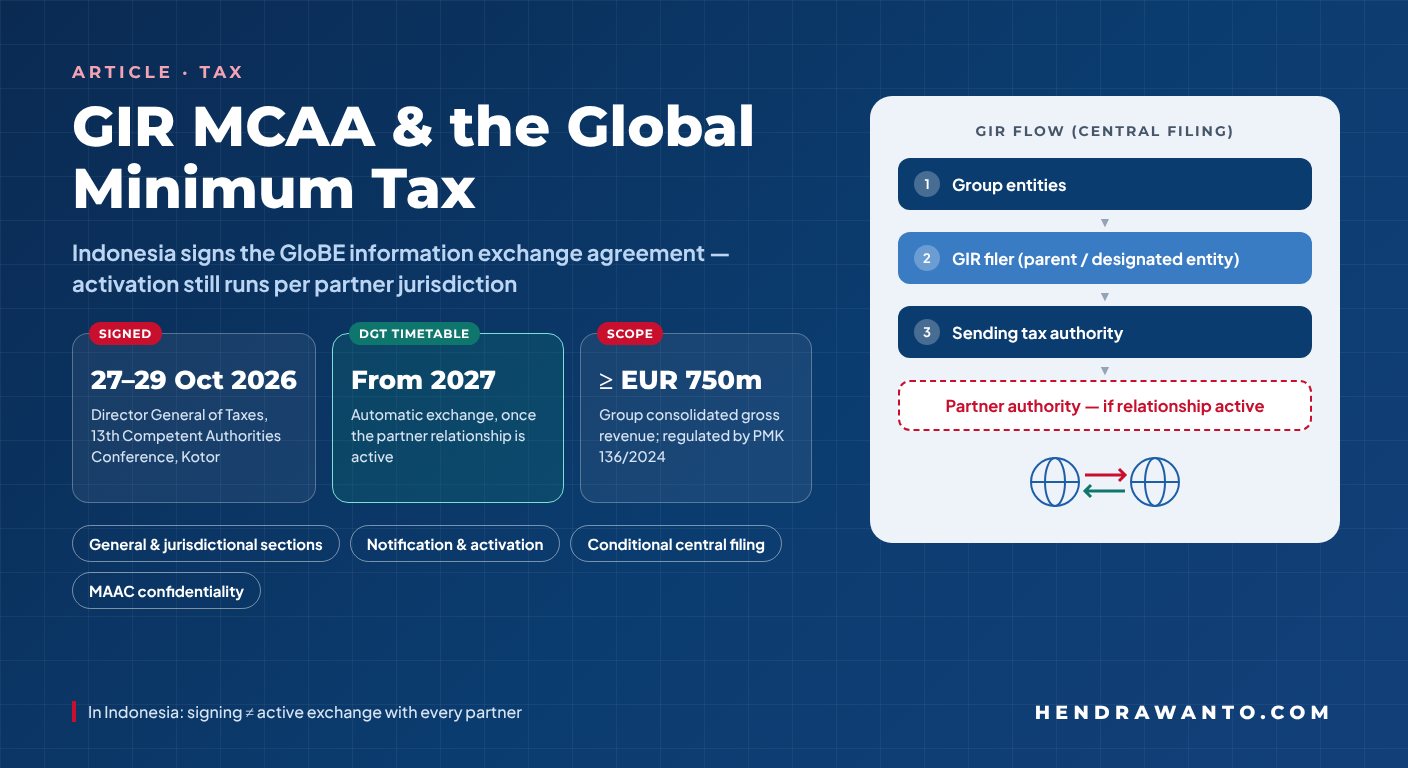
Indonesia is now a signatory to the Multilateral Competent Authority Agreement on the Exchange of GloBE Information (GIR MCAA). This matters for cross-border business groups within the scope of the global minimum tax. However, a signature on an agreement between tax authorities needs to be read carefully. It opens a channel for exchanging information; it does not mean every exchange relationship with partner countries becomes active on the same day, and it does not mean each entity's filing obligation automatically disappears.
A press release from the Directorate General of Taxes (DGT) dated 31 October 2026 states that the Director General of Taxes signed the GIR MCAA at the 13th Competent Authorities Conference in Kotor, Montenegro, held on 27–29 October 2026 and attended by representatives of 90 jurisdictions. The DGT plans automatic exchange of information from 2027, with exchanges with each partner jurisdiction depending on the fulfilment of requirements and the activation of the exchange relationship. The difference between a planned start and a relationship that is actually active is the core of how this policy should be read.
What Is the GIR and Why Is It Exchanged?
The GloBE Information Return (GIR) is a standardised return containing information about a multinational group and its application of the Global Anti-Base Erosion (GloBE) rules. According to the DGT press release, this information supports the global minimum tax for groups with annual consolidated gross revenue of at least EUR 750 million, as regulated in Indonesia by Minister of Finance Regulation (PMK) Number 136 of 2024. That figure is the scope threshold mentioned in the press release; whether a particular group is in scope still requires a review of the rules and the group's facts.
The GIR framework developed by the OECD divides the return into a general section on the group as a whole and jurisdictional sections describing how the rules apply in each operating jurisdiction (OECD GIR MCAA document). Not every tax authority automatically receives the entire GIR. The sections shared follow the agreed dissemination approach and depend on the group structure and the taxing rights of the jurisdiction concerned.
Automatic exchange allows tax authorities to receive relevant information from the authority where the GIR is filed. For companies, this framework can reduce repeated filing of the same return in many countries. For tax authorities, the information supports compliance oversight. Both benefits depend on the operational rules and exchange relationships actually in force; knowing that a country has signed the agreement is not enough.
- Group entitiesPrepare data on how GloBE applies in each jurisdiction
- GIR filerUltimate parent or designated filing entity
- Sending tax authorityReceives the GIR in the filer's jurisdiction
- Partner tax authorityReceives the relevant GIR sections, only once the exchange relationship is active
Signing Is Not Activation With Every Partner
The DGT states that the exchange relationship with each jurisdiction becomes active only after the competent authority has met the notification requirements to the Co-ordinating Body Secretariat and the jurisdictions have listed each other as sending and receiving partners. The GIR MCAA framework also keeps the list of signatories separate from the list of active exchange relationships, so "has signed" and "already exchanges with country X" are two different statuses.
A group operating in several countries should therefore not conclude that one signature immediately provides an exchange channel for each of its entities. What needs checking is the relevant pair of jurisdictions, the activation status at the time of filing, and whether the arrangement qualifies for central filing. This review is specific to the structure and location of the group's entities.
The DGT also stresses that exchanged information must be kept confidential and used in accordance with the Convention on Mutual Administrative Assistance in Tax Matters (MAAC); Article 6 of the Convention, which Indonesia has ratified, is the basis of the agreement. Because the GIR contains cross-jurisdictional information on the group's structure and its application of the tax rules, confidentiality is not merely a technical matter of data transmission but part of the legal framework that makes exchanges between authorities possible.
- GIR MCAA signedSigned by the Director General of Taxes in Kotor, Montenegro.
- Notification and mutual listingNotification to the Co-ordinating Body Secretariat; partners listed as sender and recipient.
- Automatic exchangeDGT timetable; runs with each partner once the relationship is active.
When Does Central Filing Reduce Duplication?
In principle, a group entity files the GIR with the tax administration of its own jurisdiction. An exemption from local filing may apply where the GIR is filed by the ultimate parent or a designated filing entity in a jurisdiction that has a qualifying exchange agreement in effect with that entity's jurisdiction. This mechanism is known as central filing. The DGT press release describes it as the possibility for a group to file the GIR through one qualifying jurisdiction, thereby reducing repeated filing.
In practical terms, one return at group level does not automatically remove every compliance step in each country. It must be established who the filer is, whether the filing and receiving jurisdictions have a qualifying relationship, when the return must be filed, and which parts of the information the relevant authority will receive. The position of one entity may differ from another in the same group if their countries have different exchange-relationship statuses.
Local filing
- Each group entity files the GIR with its own tax authority
- Applies when the exemption conditions are not met
- The same return may be filed in many countries
Central filing
- The GIR is filed once by the ultimate parent or a designated filing entity
- Requires a qualifying exchange agreement already active with the entity's jurisdiction
- Partner authorities receive the relevant GIR sections
To apply this, a group tax team needs to connect its entity map, the chosen filing location, and the status of the relevant exchange relationships. A general statement that a country is a signatory is not a sufficient operational basis. For groups that already manage transfer pricing documentation and country-by-country reports, existing data and governance can be a starting point, but the GIR still has its own content requirements (see also TP documentation under PMK 172/2023).
Sensible Preparation Steps
First, groups potentially within the scope of the global minimum tax can map their entities and operating jurisdictions. Determine who is expected to prepare and file the GIR and what data must be collected from each entity. This map helps identify data gaps and keep group information consistent ahead of the applicable filing deadlines.
Second, monitor official announcements on exchange relationships that are already active, not just the list of GIR MCAA signatories. If the group intends to rely on central filing, document why the conditions are met for each jurisdiction. Where the status of a jurisdiction pair is uncertain, the compliance plan should allow for a possible local obligation under that country's rules.
Third, separate the GIR from tax computations and other administrative obligations. The GIR is a vehicle for standardised reporting and data exchange. The amount of any top-up tax and the group's other obligations are still determined under the relevant domestic rules, including PMK 136/2024 in Indonesia. Putting all of these obligations under a single "GIR filing" label can hide work that still needs to be done.
Conclusion
Indonesia's signing of the GIR MCAA is a step towards exchanging global minimum tax information. The DGT plans automatic exchange from 2027, but exchanges with each partner depend on notification, activation of the relationship, and the requirements that must be met. For business groups, the benefit of central filing must be tested against entity locations, the filing party, and the relevant exchange relationships. The best preparation is to organise group data, monitor official status updates, and then assess obligations in each jurisdiction based on the actual circumstances.
Need to discuss global minimum tax readiness for a business group? See our Tax Advisory service.
Official References
- DGT: Press release "Indonesia Strengthens Global Tax Cooperation, Director General of Taxes Signs the GIR MCAA" (31 October 2026, in Indonesian)
- OECD: Multilateral Competent Authority Agreement on the Exchange of GloBE Information
This article is general information, not tax advice for any specific group or transaction. Filing obligations and tax computations must be assessed under the applicable regulations, the group structure, and the status of exchange relationships at the relevant time. Check official DGT and OECD publications before making decisions. The Indonesian version is the original text.