Companies within a group often sell goods to one another, provide services, lend money, or use group brands and technology. Those transactions are legitimate. What must be explainable is the price: would the company agree to the same terms with a party that has no special relationship with it?
That is the role of transfer pricing documentation, or TP Doc. Minister of Finance Regulation (PMK) 172 of 2023 calls it Dokumen Penentuan Harga Transfer. It supports the application of the arm's length principle (Prinsip Kewajaran dan Kelaziman Usaha, PKKU) and is more than an attachment to the tax return. PMK 172/2023 replaced the earlier documentation rules in PMK 213/2016 and brought the mutual agreement procedure (MAP) and advance pricing agreement (APA) rules into one regulation.
Three Layers of Documentation
Article 16(2) of PMK 172/2023 divides transfer pricing documentation into three documents with different purposes.
Master file
Dokumen induk · the group picture- Ownership structure and group chart
- Business activities and value chain
- Group intangibles and financing
- Consolidated financial statements
Local file
Dokumen lokal · the Indonesian taxpayer- Identity and business activities
- Details of related and independent transactions
- Comparability analysis, method, and comparables
- Financial information, segmented where needed
Country-by-country report
CbCR · multinational groups- Income, tax, and activity allocated by jurisdiction
- List of group members
- Used to assess tax avoidance risk
Not every company must prepare all three. The master and local files have their own criteria, while the country-by-country report (CbCR) applies only to groups that meet additional criteria. Documentation is prepared in Indonesian unless the taxpayer has permission to keep its books in a foreign language.
Who Must Prepare a Master File and a Local File?
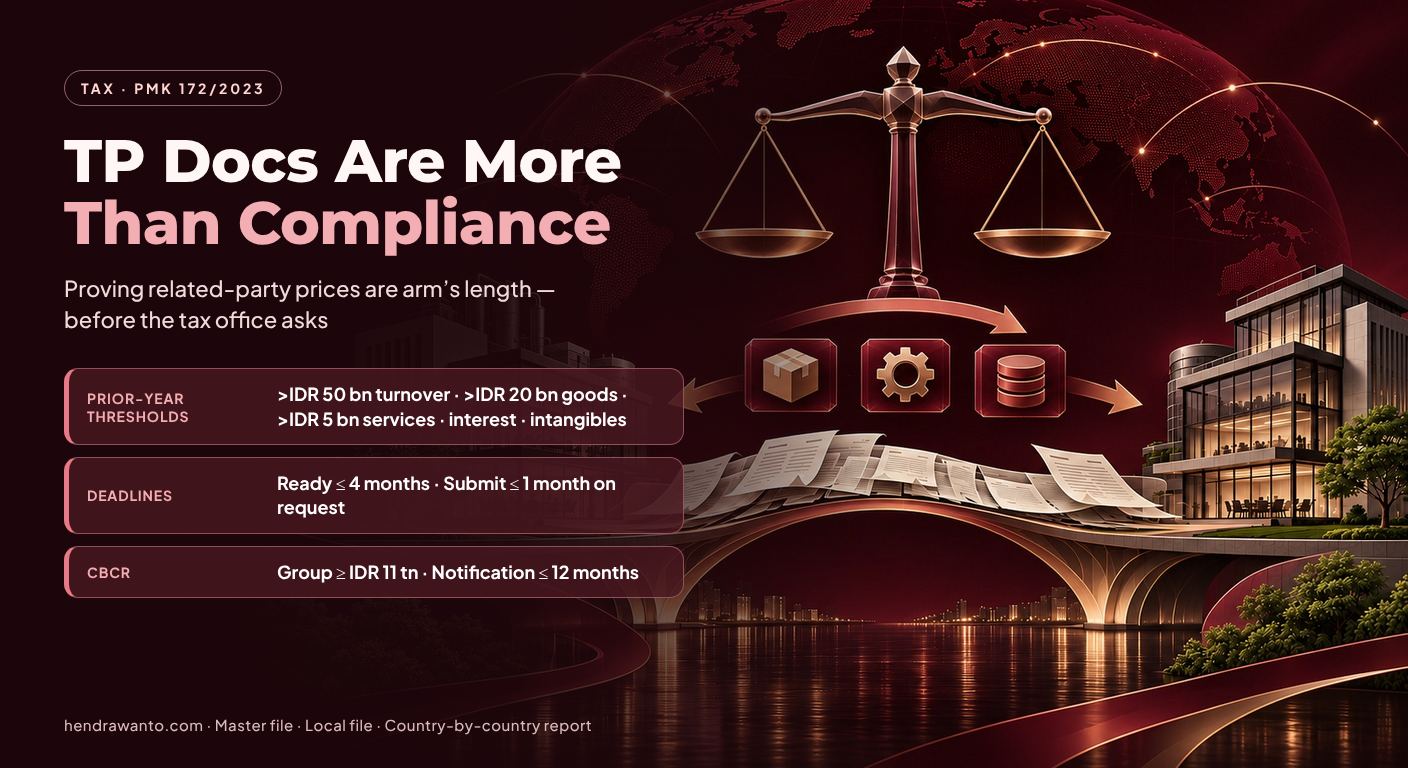
There are two layers of conditions. First, the taxpayer enters into related-party transactions in the tax year concerned. Second, the taxpayer meets any one of the following criteria, measured in the previous tax year (Article 16(3)):
| Criterion (previous tax year) | Threshold |
|---|---|
| Gross turnover | More than IDR 50 billion |
| Related-party transactions in tangible goods | More than IDR 20 billion |
| Each type of related-party transaction in services, interest, use of intangibles, or other related-party transactions | More than IDR 5 billion |
| Transactions with a related party in a country or jurisdiction whose income tax rate is lower than the Indonesian corporate rate under Article 17 of the Income Tax Law | No monetary threshold |
The words "more than" matter: an amount exactly equal to a threshold does not meet that monetary criterion, although another criterion may still apply. Thresholds are also not added across transaction types; services are tested against IDR 5 billion and tangible goods against IDR 20 billion. If the previous tax year was shorter than 12 months, the amounts are annualised first (Article 16(6)).
What about the country-by-country report (CbCR)?
It applies to a domestic parent entity whose group had consolidated gross turnover of at least IDR 11 trillion in the tax year before the reported year (Article 16(4)). A group member whose parent is abroad must file the CbCR locally only if Indonesia cannot obtain it through exchange of information, for example because the parent's country does not require a CbCR or no exchange agreement is in effect (Article 16(5)).
We are below the thresholds. Do any group obligations remain?
Yes. According to the Directorate General of Taxes (DJP), a corporate taxpayer that has related-party transactions or belongs to a business group must file a CbCR notification within 12 months after the tax year-end, including group members with no related-party transactions. Notifications are now filed through Coretax.
For the CbCR, watch the reference year. The IDR 11 trillion threshold is measured in the tax year before the reported year, so 2025 consolidated turnover decides the 2026 CbCR obligation. A CbCR analysis must also consider the group structure and the exchange-of-information mechanism between countries, not only the turnover of the Indonesian entity.
Falling below the TP Doc thresholds does not exempt a company from the arm's length principle. Article 3 of PMK 172/2023 requires every related-party transaction to be arm's length. The thresholds only remove the obligation to keep the master and local file format, not the substantive obligation to price transactions properly. The DJP can still test those transactions.
When Must TP Documentation Be Ready and Submitted?
The master file and local file must be available no later than four months after the tax year-end, together with a statement on when they became available (Article 18(1)). The CbCR is due within 12 months after the tax year-end (Article 18(2)). The master and local file summaries are attached to the annual corporate income tax return for the same tax year; proof of CbCR filing is attached to the return for the following tax year (Article 19).
The full documents are not attached to the return, but they must be ready on request. For compliance monitoring or a tax audit, the taxpayer must hand them over within one month of the request date (Article 34(2)).
- Transactions occurDocumentation is prepared from information available when the transactions take place (Article 17).
- 2025 notification & CbCRThe deadline for the previous tax year; filed through Coretax.
- 2026 master & local filesMust be available with a signed statement; the summary goes with the annual corporate return.
- 2026 notification & CbCRWithin 12 months after the tax year-end.
- Submission to the DJPWithin 1 month of the request date.
Preparing TP documentation only after a request letter arrives is risky. Comparable data may be hard to obtain, the reasons for choosing a method may never have been recorded, and the description of each party's functions may differ from the contracts and from actual conduct. Documents that are late or not submitted also weaken the taxpayer's position if prices are adjusted. The DJP's CbCR page also refers to administrative sanctions under the General Tax Provisions Law (UU KUP) for unmet reporting obligations.
Example: Intra-Group Management Services
PT Aruna pays IDR 8 billion to an affiliate for management services during 2026. Assume its related-party service payments in 2025 also exceeded IDR 5 billion. Absent any other exception, the monetary criterion for a 2026 master and local file is met. Had the 2025 service payments been exactly IDR 5 billion, with no other criterion met, no 2026 TP Doc format obligation would arise. The 2026 service fee would still have to be arm's length.
Good documentation does not stop at "the cost was IDR 8 billion". For service transactions, Article 13(1) of PMK 172/2023 requires preliminary steps before the price itself is tested:
- The service was actually provided and received
- The recipient needed the service
- The service gave the recipient an economic benefit
- It is not a shareholder activity
- It is not a benefit arising merely from group membership (passive association)
- It does not duplicate work the taxpayer already does itself
- Its benefit is not merely incidental
- For on-call services: they could not be obtained promptly from an independent party without an on-call contract
Passing these preliminary steps only opens the door to the comparability analysis and the choice of method. If a step fails, the transaction is treated as not meeting the arm's length principle.
Supporting evidence includes contracts, work reports, correspondence, minutes, and the cost allocation basis. The analysis should also set out each party's functions, assets, and risks, the reasons for the chosen method, and the comparison with relevant comparables. If the evidence is only invoices and a generic contract, the existence of a cost does not prove that the service delivered a benefit or that its price is arm's length.
A sound analysis connects business events, accounting figures, the transfer pricing method, and tax reporting. This example is illustrative; a real tax conclusion depends on the facts of the transaction and a complete analysis.
Five Practical Steps to Prepare TP Documentation
- MapRelated parties, transaction types, and values from the financial statements, ledger, and contracts.
- Test the obligationCompare prior-year data with the master/local file thresholds; test the CbCR at group level.
- CharacteriseFunctions, assets, and risks as they actually operate, before choosing a method.
- Evidence as you goKeep the pricing policy and supporting documents current throughout the year.
- AlignThe TP Doc, summary, financial statements, and tax return describe the same transactions.
First, map every special relationship and related-party transaction. Reconcile the related-party list in the financial statements with the general ledger, contracts, payments, and tax forms, and trace every difference between sources. Related parties under PSAK 224 are not always identical to parties with a special relationship under tax rules, such as ownership of at least 25% under PMK 172/2023.
Second, test the documentation obligation each year. Use the previous year's gross turnover and related-party transaction values to decide whether the master and local file thresholds are met. Test the CbCR obligation separately at group level, and do not forget the notification.
Third, understand the transaction before choosing a method. The characterisation of functions, assets, and risks must match actual conduct. PMK 172/2023 offers several methods, including the comparable uncontrolled price (CUP), resale price, cost plus, profit split, and transactional net margin (TNMM) methods. A method that looks right on paper can fail if its business assumptions are wrong.
Fourth, build evidence as you go. Article 17(1) requires the master and local files to be prepared from the data and information available when the related-party transactions take place. Pricing policies and supporting documents should therefore be maintained throughout the year, not reconstructed afterwards.
Fifth, check consistency before filing the return. Make sure the TP Doc, the summary, the financial statements, and the return describe the same transactions. For businesses with activities of different character, the local file is presented by segment (Article 30). This consistency also makes it easier to respond to questions from the tax office; see also amending tax returns in Coretax.
Conclusion
Strong TP documentation is not a thick file that simply declares prices to be arm's length. It is a chain of evidence explaining why a related-party transaction makes business sense and how its price was tested. Start by mapping the transactions and obligations, then build the documentation while the information is still available. For business groups, the 2025 notification and CbCR deadline of 31 December 2026 is the nearest checkpoint. When an audit comes, the quality of the argument will matter more than the page count.
Tax planning and transfer pricing are closely linked; see also Defensible Tax Planning. Need support? See our Tax Advisory service.
Official References
- DJP: PMK 172 of 2023 on the Application of the Arm's Length Principle in Transactions Affected by a Special Relationship (in Indonesian)
- Ministry of Finance legal database: PMK 172 of 2023 (PDF, in Indonesian)
- DJP: Country-by-Country Report and Notification (in Indonesian)
This article provides general information based on PMK 172/2023. It is not an arm's length assessment of any transaction or tax advice for a particular company. Check the rules and their status again before applying them to a specific tax year.