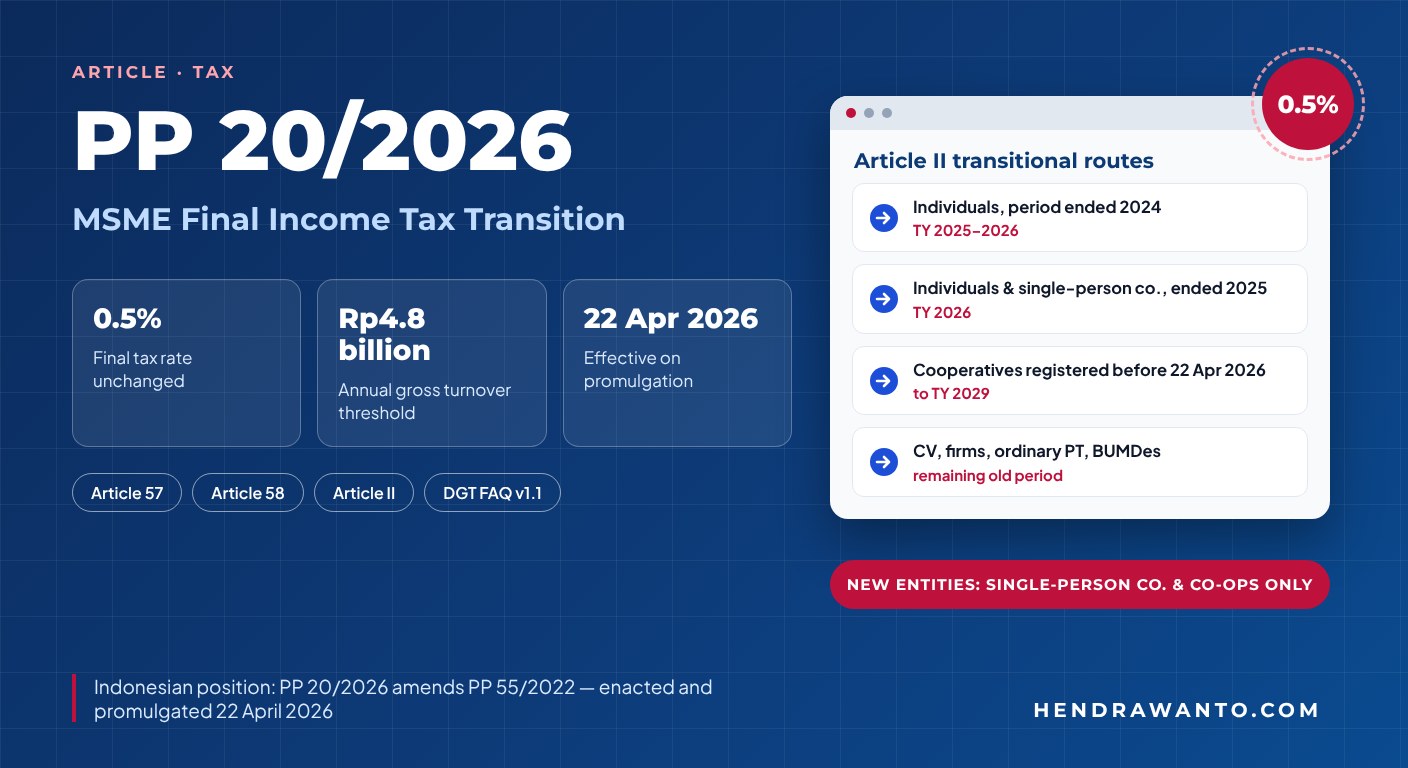
Government Regulation Number 20 of 2026 (PP 20/2026) amends the final income tax regime for taxpayers with certain gross turnover in Government Regulation Number 55 of 2022. The 0.5% rate and the gross turnover threshold of Rp4.8 billion per tax year remain, but the list of taxpayers who may use them has changed. The regulation was enacted and promulgated on 22 April 2026 and took effect on the date of promulgation. The practical question is therefore no longer “does the rate still exist?” but “is this taxpayer still within scope, and if not, is it protected by the transitional provisions?”.
Who Falls Within the Final Tax After PP 20/2026?
The new Article 57(1) names two groups: individual taxpayers, and corporate taxpayers in the form of a single-person company (perseroan perorangan) established by one person and cooperatives, provided their gross turnover does not exceed Rp4.8 billion in one tax year. Limited partnerships (CV), firms, limited liability companies other than single-person companies, and village-owned enterprises (BUMDes or joint BUMDes) are no longer listed.
Article 57(2) then excludes six situations: (a) the taxpayer elects the general rates of Article 17(1) of the Income Tax Law, which for entities take Article 31E into account; (b) a single-person company established by an individual with special expertise that delivers services similar to independent personal services; (c) an entity receiving incentives under Article 31A of the Income Tax Law, PP 94/2010, or Articles 75 and 78 of PP 40/2021 on Special Economic Zones; (d) a permanent establishment; (e) an individual together with all single-person companies he or she established, if their combined gross turnover exceeds Rp4.8 billion in one tax year; and (f) a cooperative that has passed 4 tax years since registration. Under paragraph (4), taxpayers under letters e and f, and those who have notified their election of the general rates, can no longer use the final tax in subsequent tax years. PP 20/2026 also deletes Article 59 of PP 55/2022.
Five Transitional Routes in Article II
Article II point 1 bridges taxpayers who were already using the final tax under PP 55/2022. These routes are not a general permit for every small business: the entitlement depends on the type of taxpayer, when the old period ended, and the conditions stated in each letter.
- Letter a item 1): individuals whose old final tax period ended in Tax Year 2024 may use the final tax for Tax Years 2025 and 2026.
- Letter a item 2): individuals and single-person companies whose period ended in Tax Year 2025 may use the final tax for Tax Year 2026.
- Letter b: cooperatives registered before PP 20/2026 took effect whose period ends in Tax Years 2024 through 2029 are subject to the final tax for Tax Years 2025 through 2029.
- Letter e: CVs, firms, limited liability companies other than single-person companies, and BUMDes/joint BUMDes whose period has not yet ended may continue the final tax until that period ends.
- Letter f: individuals and single-person companies caught by the exclusions in Article 57(2) letter b or e, and already subject to the final tax under PP 55/2022, may continue until the end of Tax Year 2026.
The routes in letters a, b and e apply only as long as the taxpayer continues to meet the final tax criteria under PP 55/2022. Start, therefore, from the registration history and the last tax year that still enjoyed the final tax, then read the relevant letter of Article II.
Letter a.1Individuals, old period ended 2024
Letter a.2Individuals & single-person companies, ended 2025
Letter bCooperatives registered before 22 Apr 2026, ending 2024–2029
Letter fCaught by the special-expertise / combined-turnover exclusion
Letter eCV, firms, ordinary PT, BUMDes
Already Used the Deemed-Profit Norm or Bookkeeping?
The official DGT FAQ (version 1.1, updated 19 October 2026) addresses individuals whose seven-year final tax period ended in Tax Year 2024 and who, unaware of the extension, had already notified use of the Deemed Net Income Norm (NPPN) or used bookkeeping in their 2025 annual return. According to the DGT, the right to the final tax for 2025 and 2026 is not automatically forfeited by that step. The right is treated as ended only if the taxpayer expressly elects the general rules by submitting the notification of election under Article 57(2) letter a. Taxpayers who still wish to use the final tax may amend their annual return in accordance with the applicable rules; see also amending tax returns in Coretax. Whether to amend should still be weighed against each taxpayer’s facts and history.
Combined Turnover of Individuals and Single-Person Companies
The exclusion in Article 57(2) letter e counts the gross turnover of an individual together with all single-person companies he or she established. For spouses living separately or electing to exercise their tax rights and obligations separately, Article 58(3) combines the turnover of husband, wife, and all single-person companies they established.
The DGT example: in Tax Year 2025 an entrepreneur has turnover of Rp3 billion and the single-person company he established has Rp2 billion. The combined Rp5 billion exceeds Rp4.8 billion. Thanks to Article II letter f, both may still use the final tax in Tax Year 2026. If, however, combined turnover falls to Rp4 billion in 2026, the final tax still cannot be used in Tax Year 2027. The DGT also stresses that this reassessment does not cancel final tax used in past years.
CVs, Firms, Ordinary PTs and BUMDes
This group is no longer in Article 57(1). However, Article II letter e protects those whose final tax period under PP 55/2022 has not yet ended: they may continue the final tax until that period ends, provided the old criteria are still met. Conversely, the DGT FAQ states that entities in this group registered from 22 April 2026 onwards are no longer subjects of the 0.5% final tax. This protects rights already running; it does not grant new ones.
A Certificate Is Not a Substitute for an Eligibility Test
Article II letter c provides that final tax certificates (Article 63) remain valid for Tax Years 2025 and 2026 for individuals under letter a item 1), and for Tax Year 2026 for individuals and single-person companies under letter a item 2), until the taxpayer no longer meets the criteria. For cooperatives under letter b, letter d provides that their certificates remain valid until the cooperative no longer meets the final tax criteria under PP 55/2022. According to the DGT FAQ, taxpayers do not need to reapply; the status appears in the list of active facilities in the Taxpayer Portal (Coretax).
Even so, a certificate should not be the only basis. The DGT FAQ gives the example of a CV, firm, ordinary PT or BUMDes registered on 22 April 2026 that already holds a certificate: it will be revoked under Article 14(2) of PMK 164/2023. Article II letter g also confirms that the implementing regulations of PP 55/2022 remain in force insofar as they do not conflict with PP 20/2026.
Suggested Order of Review
- Identify the type of taxpayer and its registration date, including whether it registered before or from 22 April 2026.
- Record the first tax year and the year in which the final tax period under PP 55/2022 ends.
- Check whether a notification electing the general rates was ever filed; using NPPN or bookkeeping alone is not the same as that election.
- Calculate the relevant gross turnover, including aggregation with single-person companies and spouses under Article 58.
- Match the facts to the relevant letter of Article II, then check the certificate status in Coretax and any need to amend returns.
Conclusion
PP 20/2026 narrows the scope of the 0.5% final tax but provides several transitional routes with different end points: 2026 for individuals and single-person companies, up to 2029 for cooperatives registered before 22 April 2026, and the remaining old period for CVs, firms, ordinary PTs and BUMDes. Read Articles 57–58 and Article II together with the DGT FAQ, then decide the tax treatment on the basis of each taxpayer’s history. For the wider planning context, see defensible tax planning.
Need a review of your business’s final tax position? See our Tax Advisory service.
Official References
- Ministry of Finance legal database (JDIH): PP 20 of 2026 (enacted and promulgated 22 April 2026, State Gazette 2026 No. 43)
- Text of PP 20/2026: Articles 56–58, deletion of Article 59, and Article II (PDF, Indonesian)
- Directorate General of Taxes: FAQ on PP Number 20 of 2026, version 1.1 (19 October 2026), questions 25 and 37–43 (PDF, Indonesian)
This article is general information based on official sources available as of 15 November 2026 and is not tax advice for any particular situation. Application of the rules must be matched to the facts, documents and latest regulations applicable to each taxpayer. The Indonesian version is the original text.