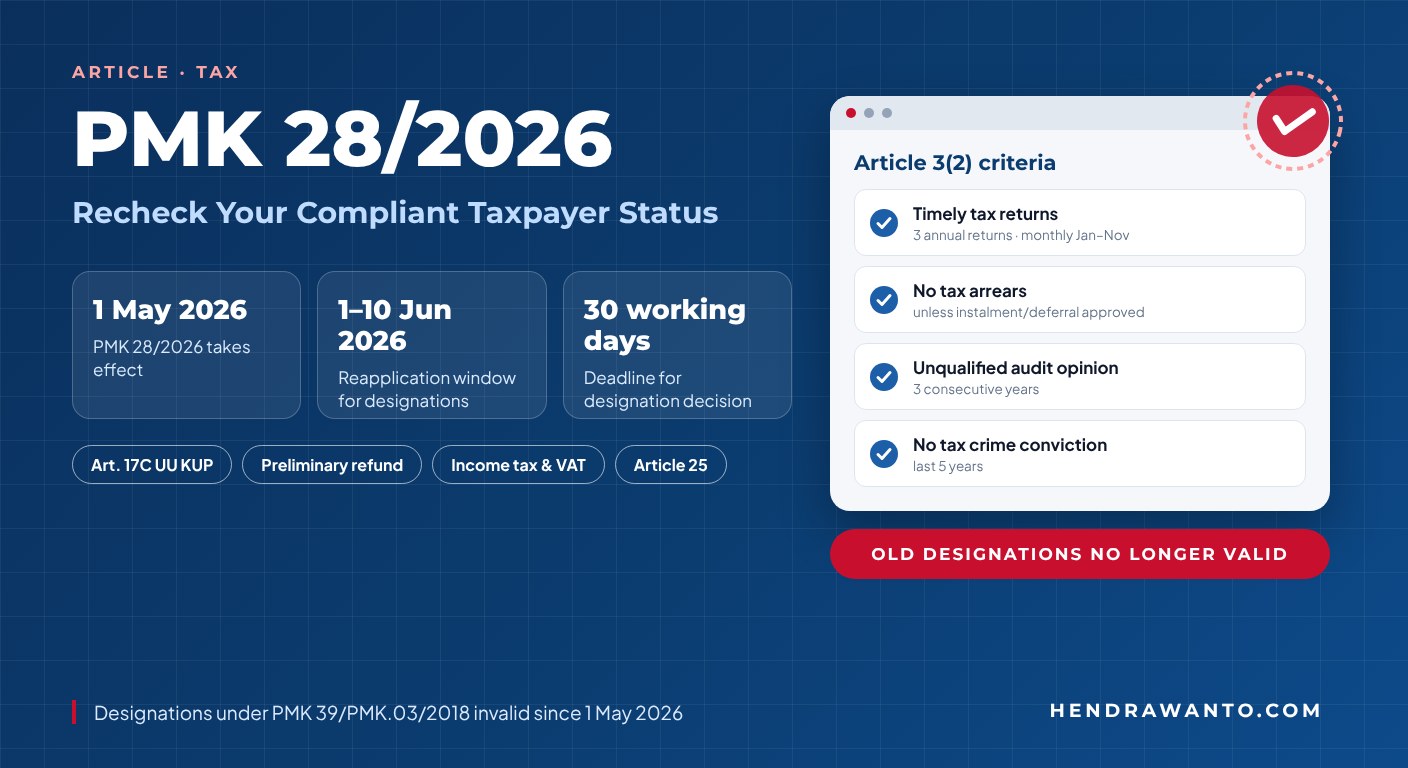
Having once been designated a taxpayer meeting certain criteria does not mean the status can still be relied on without checking it again. Minister of Finance Regulation Number 28 of 2026 (PMK 28/2026) restates the procedure for preliminary refunds of tax overpayments and took effect on 1 May 2026. Its transitional provision declares designation decisions issued under the old rules no longer valid. The first step before relying on this route is to confirm the status that applies today, not merely to find an old designation letter in the files.
Preliminary refunds are often called accelerated refunds. According to the Directorate General of Taxes (DGT) press release SP-11/2026 dated 4 May 2026, these refunds are granted through research (penelitian) of the application, not a tax audit. However, "accelerated" does not mean automatic approval: the applicant group, the requirements and the outcome of the research still decide the result.
Key Dates and Transitional Provisions
PMK 28/2026 was enacted on 29 April 2026 and, under Article 27, took effect on 1 May 2026. Article 26 revokes PMK 39/PMK.03/2018 together with its three amendments, namely PMK 117/PMK.03/2019, PMK 209/PMK.03/2021 and PMK 119 of 2024.
Article 25 covers four matters. First, designation decisions for taxpayers meeting certain criteria issued under PMK 39/PMK.03/2018 and its amendments are declared no longer valid. Second, taxpayers whose designation lapsed could reapply from 1 June to 10 June 2026, or by the date in Article 4(1), to be designated within 30 working days of filing provided they meet Article 3. Third, preliminary refund applications by taxpayers meeting certain criteria that were filed before 1 May 2026 and for which no refund payment order had been issued are settled under PMK 28/2026. Fourth, similar applications by taxpayers meeting certain requirements and by low-risk VAT-registered businesses (PKP) are settled under the old PMK.
- 29 Apr 2026PMK 28/2026 enacted
- 1 May 2026In force; old designation decisions declared invalid (Article 25(a))
- 1–10 Jun 2026Special reapplication window for lapsed designations (Article 25(b))
- 10 JanuaryApplication deadline under Article 4(1); decision within 30 working days
Because that special window has passed, applicants preparing their files now need to follow the general rule in Article 4. A copy of an old designation letter remains useful as history, but it must not be treated as proof that the status is still valid. Match the available decision against the data on the DGT portal and the latest correspondence from the tax office; if they do not match, seek clarification through official channels before filling in a refund application.
Three Routes, Three Sets of Requirements
Article 2 of PMK 28/2026 distinguishes applications from taxpayers meeting certain criteria, taxpayers meeting certain requirements, and low-risk PKP. The DGT press release links them to Article 17C of the General Tax Provisions Law (UU KUP), Article 17D of UU KUP and Article 9(4c) of the VAT Law. This article focuses on the first route.
This separation matters for finance teams. The certain-criteria checklist is no substitute for the specific rules for low-risk PKP. Conversely, having export sales or a VAT overpayment does not prove that a certain-criteria designation exists. Read the part of the PMK that matches the type of application before building cash projections.
Core Requirements for a New Designation
Article 3(2) sets four criteria: timely filing of tax returns (SPT); no tax arrears for any type of tax, except arrears with approved instalment or deferral; financial statements audited by a public accountant or a government financial supervisory body with an unqualified opinion for three consecutive years; and no conviction for a tax crime by a final and binding court decision in the last five years. The following paragraphs detail each criterion:
- Timely returns. Annual returns for the last three tax years filed on time; monthly returns for January–November of the last tax year filed, with any late filing limited to no more than three tax periods for each type of tax, not consecutive, and not beyond the filing deadline of the following period.
- No arrears. No tax debt past its due date as at 31 December of the last year before designation (except debts with approved deferral or instalment, or past the collection limitation period), and no payment made after the settlement deadline, including instalments or deferrals, in the last five years.
- Financial statements. Attached to the annual income tax return; an unqualified opinion, excluding an unqualified opinion with an explanatory paragraph; not restated due to error correction or data manipulation; any request for explanation of data and/or information issued at least three months before designation has been answered; audit corrections to fiscal profit/loss of no more than 5% for the last three tax years; and the public accountant within the five-year limit on audit services. The restatement and public-accountant items are each accompanied by the taxpayer's statement of compliance with the financial statement criteria.
- No tax crime. Registered and never convicted of a tax crime in the last five years.
An audit opinion is not a tax compliance certificate; it is one element alongside the return and arrears tests. Opinion types are discussed in Understanding Audit Opinions, while responding to requests for explanation is covered in SP2DK di Era PMK 111 Tahun 2025 (in Indonesian). Tax teams and financial statement preparers need to read the same file, especially where there are restatements, return corrections or fiscal adjustments.
Valid Until Revoked
Under Article 4, the application is filed electronically through the taxpayer portal no later than 10 January; if electronic filing is not possible, it may be filed in person or by post, expedition service or courier. The DGT examines compliance with Article 3 and issues a designation decision or a rejection notice within 30 working days of receiving the application. If the period passes without a response, the application is deemed granted.
Article 5 states that a designation is valid from the date it is issued until it is revoked. Grounds for revocation include late annual returns, late monthly returns for two consecutive periods or three periods in one calendar year, tax debt unpaid at its due date, late payment of instalments or deferrals, post-designation financial statements that fail the requirements (for example unaudited, with an opinion other than unqualified, or restated), and an open preliminary investigation or criminal tax investigation. A taxpayer whose designation is revoked may reapply under Article 4. Compliance after designation is therefore as important as compliance before it.
From Designation to Cash
Designation and refund are two separate steps. Article 6 states that a refund application may be filed for tax periods after the designation decision is issued, by filling in the preliminary refund column in the tax return. The DGT first examines formal obligations, including whether the designation is still valid, and then examines the overpayment. Under Article 7, the preliminary refund decision or notice is issued within three months for income tax or one month for VAT from receipt of the application.
- 1Self-test against Article 3returns, arrears, audit, crime
- 2Designation applicationportal, by 10 January
- 3Designation decision≤30 working days; valid until revoked
- 4Refund application in the returnperiods after designation
- 5Refund decision≤3 months income tax · ≤1 month VAT
Filling in the refund column does not guarantee that the whole overpayment will be refunded. Article 8 deals with cases where the amount in the decision differs from the amount requested. Cash forecasts should therefore use scenarios and separate the filing date, the decision and the actual payment.
Practical Checklist
- Check the legal basis of the designation. Letters issued under PMK 39/PMK.03/2018 and its amendments have been invalid since 1 May 2026.
- Test return and payment history against Article 3(3) and (4), not against a recollection that the entity is "usually compliant".
- Review three years of audit reports: opinion type, restatements, the public accountant's five-year limit and fiscal corrections.
- Make sure DGT requests for explanation have been answered in accordance with the rules.
- Monitor compliance after designation, because late filing or arrears can be grounds for revocation.
- Separate the status timeline from the cash timeline in internal communication.
Conclusion
PMK 28/2026 restates the preliminary refund of tax overpayments. Old designation decisions have been invalid since 1 May 2026, the 1–10 June 2026 reapplication window has passed, and a new designation demands detailed requirements and continuing compliance. Care over status, documents and route selection is more useful than assuming every overpayment automatically qualifies for an accelerated refund.
Need help assessing eligibility or a tax refund application? See the Tax Advisory service.
Official References
- DGT: Text of PMK Number 28 of 2026 on Procedures for Preliminary Refunds of Tax Overpayments (PDF, Indonesian)
- Ministry of Finance JDIH: PMK 28 of 2026 (status and revoked regulations)
- DGT: Press Release SP-11/2026 on the issuance of PMK Number 28 of 2026 (4 May 2026, Indonesian)
This article is general information, not tax advice for any particular situation. Application of the PMK depends on the type of taxpayer, the tax period or year, designation status and application documents. Check the full regulation and official DGT information before acting. The Indonesian version is the original text.