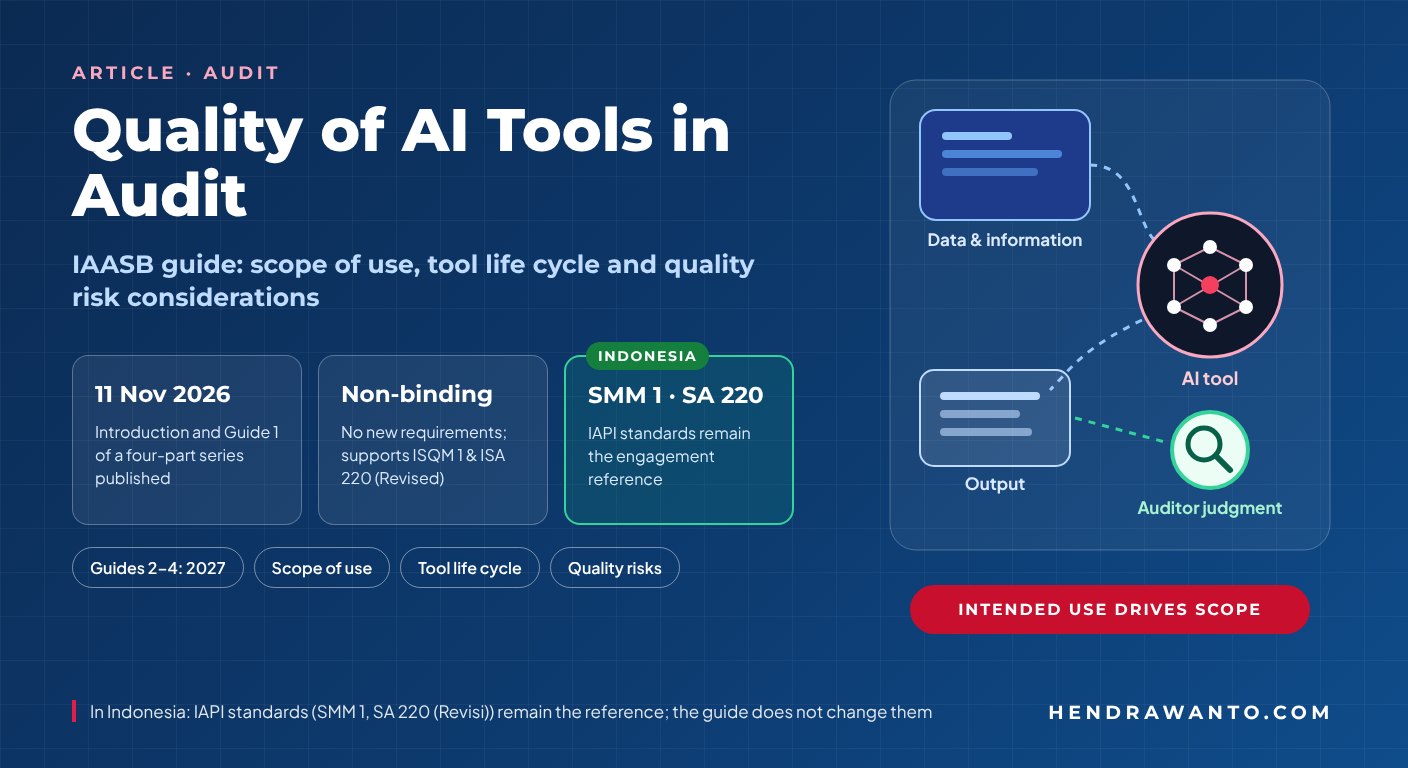
Artificial intelligence tools can help auditors read documents, design procedures and analyse information. Yet those benefits depend on the purpose of use, the quality of the data and people's ability to evaluate the results. The question often raised in public accounting firms is therefore shifting: no longer "may we use AI or not", but "how do we make sure its use stays consistent with quality management standards".
On 11 November 2026, the International Auditing and Assurance Standards Board (IAASB) published the first part of a four-part guide series on applying the IAASB's quality management standards to AI-enabled technological tools. What is available now is the series introduction and Guide 1: Common Conceptual Foundation. The IAASB states that the guides are non-authoritative and introduce no new requirements; their purpose is to support the consistent application of ISQM 1 and ISA 220 (Revised).
What Does the First Guide Cover?
Guide 1 lays the foundation for a series being developed in stages. It explains what an AI-enabled tool is and its life cycle, quality management responsibilities at the firm and engagement levels, and considerations in assessing quality risks. According to the IAASB announcement, the remaining parts are scheduled in stages through 2027, subject to IAASB approval: Guide 2 on firm-level quality management before deployment, Guide 3 on engagement-level use and oversight, and then an integrated edition that includes Guide 4 on monitoring and remediation after deployment. The IAASB also says Guide 1 may be revised to keep it coherent with the whole series. It is therefore more accurate to call it the IAASB guidance currently available, not a new standard or a finished guidance package.
The key point is use, not product name. Under Guide 1, the use of an AI-enabled tool is within the scope of the series when it facilitates the design or performance of an engagement procedure to obtain evidence. One general-purpose application can be in scope for one purpose and outside the scope of the series for another. For example, when an application helps extract information from source documents and analyse it for audit procedures, that use is in scope. If the application only records, organises or expresses work the auditor has already performed, that use falls outside the specific scope of this series.
Outside the series scope does not mean outside quality responsibilities. Guide 1 notes that an administrative use processing confidential information can still give rise to confidentiality risks, and that drafting documentation from completed work can give rise to risks relating to the accuracy of that documentation. So the firm's first question is not "is this product AI?", but "what work will this tool be used for, and what risks arise from that use?".
From Firm Policy to Engagement Performance
Guide 1 links AI tools to the firm's system of quality management and to engagement-level responsibilities. The firm determines the intended use or category of use before the tool is deployed, then applies its risk assessment process to identify quality risks and design responses. Engagement teams apply those firm responses in the circumstances of their engagement. The guide states that engagement teams do not repeat the firm's risk assessment process, but new or expanded uses may require further application of the firm's risk assessment process.
Guide 1 divides the tool life cycle into three phases, each of which will be covered in more detail by a later guide:
- 1Before deploymentDesign, evaluation and enablement of the tool by the firm, ending with the deployment decision.Guide 2 · scheduled Jan–Feb 2027
- 2Use in engagementsEngagement teams use the tool and oversee its outputs in line with firm policies.Guide 3 · scheduled Apr–May 2027
- 3After deploymentMonitoring, change and, eventually, decommissioning of the tool.Guide 4 · integrated edition, scheduled Jul–Aug 2027
As an illustration, a tool approved for grouping documents is not necessarily approved for proposing audit conclusions or accessing a new data set. A change in purpose can change the type of information fed into the tool, the impact of errors in its output and the need for review by the auditor. This illustration is an analytical application of the IAASB framework, not a list of uses specifically permitted or prohibited by the guide.
In the Indonesian context, the professional standards page of the Indonesian Institute of Certified Public Accountants (IAPI) lists SMM 1, which governs quality management for public accounting firms performing audits or reviews of financial statements, and SA 220 (Revisi) on quality management for an audit of financial statements. The IAASB's references to ISQM 1 and ISA 220 (Revised) should be read together with these Indonesian professional standards. Publication of the IAASB guide does not in itself change IAPI's standards or create new obligations for auditors in Indonesia. For the audit evidence side of AI, see also Audit Evidence in the AI Era: Reading Proposed ISA 330, 500 and 520.
Risk Questions Worth Asking
Guide 1 invites firms to assess a tool on the basis of its intended use. The first consideration concerns information: where the data comes from, who can access it, where it is processed or stored, and whether outputs may rest on information that is incomplete, outdated or unsuitable. In an audit, an error in data provenance can travel from a neat-looking summary into a flawed judgment. Confidentiality arrangements also need to be understood before engagement information is given to a service provider or a system outside the firm.
The next consideration is user discretion. When team members can write their own prompts, change settings, add knowledge sources or build agents and automated workflows, results may depend on each person's choices and skills. The firm needs to understand whether its original assessment still covers those variations in use. The guide does not say that every prompt needs separate approval; it discusses how the firm can set categories of use and appropriate conditions of use.
Finally, consider the influence of outputs and the ability to test them. A summary that is easy to trace back to source documents carries a different risk profile from an output that strongly influences professional judgment but is hard to trace. Good access security alone does not solve the problem of incorrect output. Conversely, outputs that are easy to check do not remove the risk when confidential information is sent without arrangements the firm understands. Guide 1 stresses that these considerations are interrelated; it also describes them as not a separate risk framework, not an exhaustive list and not a mandatory checklist.
How to Read the Guide Properly
Readers can start by describing the purpose of a tool's use in one sentence, then mapping the information used, who the users are and how much the tool's results affect procedures and conclusions. Next, match that use against firm policy and the applicable professional standards. When the use changes, check whether the earlier risk assessment and responses are still adequate. Guide 1 also reminds readers that falling outside the series scope does not make engagement documentation less important; the documentation requirements applicable to the engagement still apply.
Conclusion
The IAASB's new guide helps firms and auditors ask sharper questions before and while using AI tools: what is the tool used for, what data goes in, how far do its results affect the work, and how can those results be tested? Its value lies in applying existing quality management standards consistently. For practice in Indonesia, the final answer still rests on IAPI standards and the requirements applicable to the engagement, with the IAASB guide used as non-authoritative explanatory material. The later parts of the series scheduled for 2027 are worth watching.
Need to discuss applying auditing and quality management standards? See our Financial Statement Audit service.
Official References
- IAASB: IAASB Publishes First Guide on Quality Management for AI-Enabled Technological Tools (11 November 2026)
- IAASB: Applying the IAASB's Quality Management Standards to AI-Enabled Technological Tools — Guide 1: Common Conceptual Foundation (PDF)
- IAASB: Technology and the Future of Audit and Assurance
- IAPI: Standar Profesional Akuntan Publik (SMM 1, SA 220 (Revisi))
This article is general information, not a firm quality policy or an assessment of any particular engagement. Check the text of the professional standards and the latest official guidance before using AI tools in audit work. The Indonesian version is the original text.