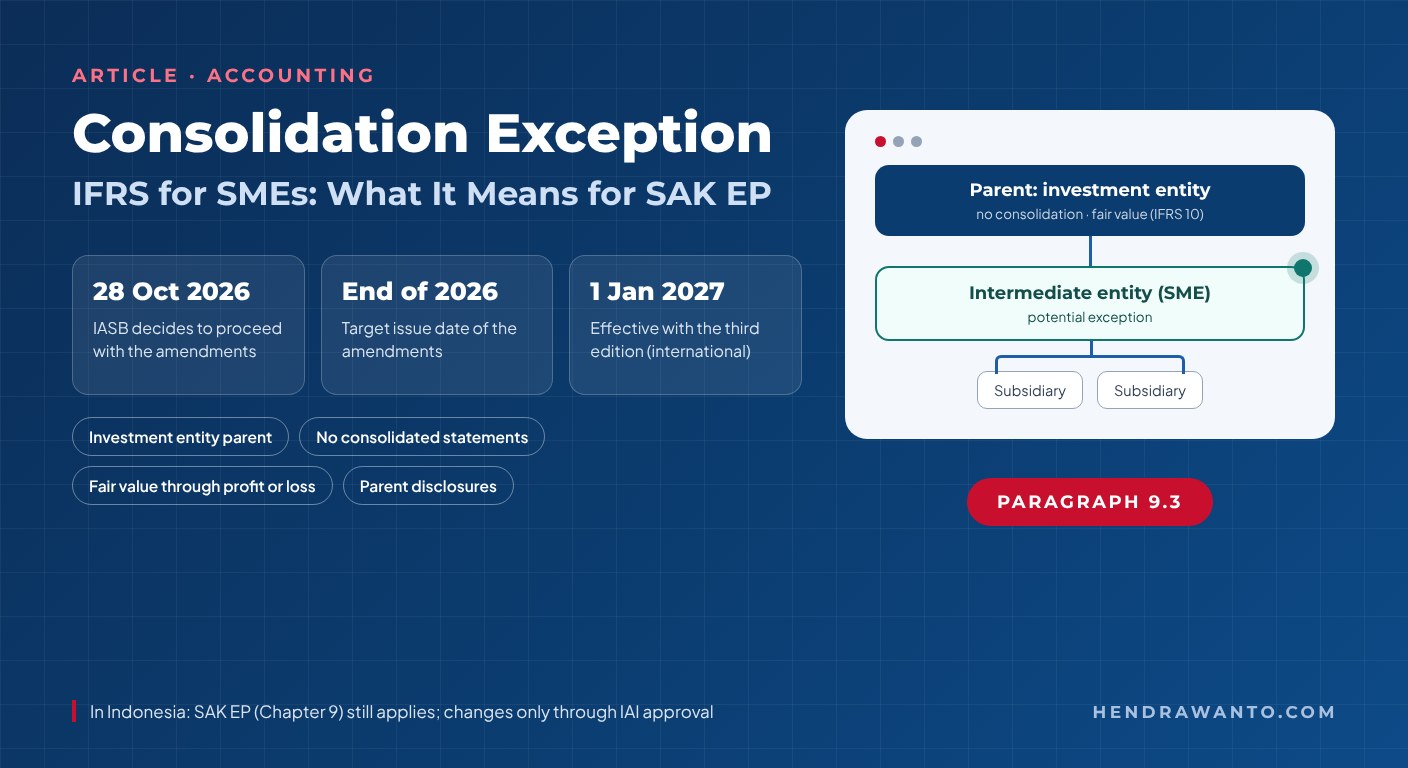
The International Accounting Standards Board (IASB) has decided to proceed with targeted amendments to the IFRS for SMEs Accounting Standard concerning an exception from the requirement to present consolidated financial statements. The decision was announced on 28 October 2026 following the IASB's October meeting. Its target is very specific: small and medium-sized entities (SMEs) whose parent is an investment entity, in structures where that parent does not present consolidated financial statements.
According to the IASB announcement, entities using the exception will also be required to disclose that they have applied it and to provide information about their parent. However, the announcement states that the amendments will be issued. A meeting decision is not the same as the final text of an amendment.
For Indonesian readers, this news matters because SAK Entitas Privat (SAK EP, the Indonesian Financial Accounting Standards for Private Entities) is closely related to IFRS for SMEs. That relationship does not mean every international change automatically becomes a SAK EP requirement. Monitoring IASB developments must be kept separate from determining the accounting treatment under the Indonesian standard in force.
The Consolidation Issue Under Discussion
Consolidated financial statements present the financial information of a group as a single economic entity. According to the IASB project page, the project responds to an application question about paragraph 9.3 of IFRS for SMEs concerning intermediate parents whose parent, or ultimate parent, is an investment entity.
In such a structure, the investment entity parent does not produce consolidated financial statements. Instead, it measures its investments in subsidiaries at fair value through profit or loss in accordance with IFRS 10. As a result, the intermediate entity below it has difficulty using a consolidation exception that depends on consolidated statements being available at a higher level. Similar relief already exists under full IFRS Accounting Standards; the IASB says the amendments aim to give eligible SMEs comparable cost savings.
- 1The entity is an SME whose parent (ultimate or intermediate) is an investment entity.
- 2That investment entity parent does not present consolidated financial statements.
- 3The parent measures its subsidiaries at fair value through profit or loss under IFRS 10.
In May 2026, the IASB published the Exposure Draft Consolidation Exception. The IFRS Foundation consultation document places the exception on entities whose ultimate or intermediate parent is an investment entity that does not present consolidated financial statements. The comment period was 120 days and closed on 9 September 2026. This is not a general exception for every private entity, every group with many subsidiaries, or every company that finds consolidation costly. The identity of the parent and how it reports its investments are at the heart of the analysis.
After receiving feedback, the IASB reported broad stakeholder support and decided to proceed with the amendments, adding disclosures about the use of the exception and information about the parent. The precise wording of the requirements must still be checked in the final amendments. It would be wrong to turn a meeting decision into a detailed list of obligations that is not yet available in an official text.
Decision Stages and Dates to Distinguish
The IASB states that it will issue the amendments before the end of 2026. According to its announcement, the amendments will take effect together with the third edition of IFRS for SMEs for reporting periods beginning on or after 1 January 2027. The IFRS for SMEs page refers to that edition as the 2025 edition, issued in February 2025, with the same effective date. The project page adds that early application is proposed to be permitted for entities that early adopt the third edition.
- 25 Mar 2026IASB decides to add the project and publish an exposure draft immediately.
- May 2026Exposure Draft Consolidation Exception published; 120-day comment period.
- 9 Sep 2026Comment period closes.
- 28 Oct 2026IASB decides to proceed with the amendments and add disclosures.
- End of 2026Target issue date of the amendments.
- 1 Jan 2027Effective with the third edition of IFRS for SMEs (international).
Indonesia: the dates above are the timetable for the standard maintained by the IASB. SAK EP changes only through formal approval by IAI.
There is a difference between an exposure draft, an IASB decision to proceed, a published amendment, and its adoption in a jurisdiction. At the time of writing, official sources show a decision to proceed and a target issue date, not the final text of the amendments. Those setting accounting policies should recheck the project status before relying on any particular wording.
The distinction also matters when communicating with group owners and managers. A summary that only says "consolidation exception effective 2027" may lead readers to believe that every small entity may stop preparing consolidated statements. An accurate summary names who may meet the conditions, the stage of the international amendment, and the reporting framework the entity actually applies.
Where Does SAK Entitas Privat Stand?
According to IAI, SAK EP has been effective since 1 January 2025, with early application permitted. It is intended for entities without public accountability that publish general purpose financial statements for external users; entities with public accountability may use it only if the relevant authority permits. IAI also notes that the illustrative financial statements in SAK EP are adopted from the 2015 version of IFRS for SMEs, and that their use requires consideration of consistency with Indonesian practice.
The IFRS Foundation's jurisdiction profile for Indonesia records SAK EP as converged with the 2015 version of IFRS for SMEs, with few modifications. The baseline reference is therefore the 2015 edition, not the 2025 edition to which the new amendments attach. The IASB's 2026 amendments do not automatically become part of the SAK EP text.
- Standard-setter
- IASB
- Status
- Decision to proceed with amendments (28 Oct 2026); target issue end of 2026
- Effective
- With the third edition, periods beginning 1 Jan 2027
- Check
- Final amendment text when issued
- Standard-setter
- IAI
- Status
- Effective since 1 Jan 2025; converged with the 2015 version of IFRS for SMEs
- Consolidation
- Chapter 9 Consolidated and Separate Financial Statements
- Check
- Effective SAK EP text and amendments approved by IAI
IAI's list of effective SAK EP chapters includes Chapter 9 on consolidated and separate financial statements. For preparers in Indonesia, the chapter in force and any amendments approved by IAI are the starting point. If Indonesia later decides to adopt or adapt the change, compare its effective date, scope, and transition provisions with IAI's official text. Do not infer a change from an international headline alone. For an overview of SAK EP, see SAK Entitas Privat: a transition map from SAK ETAP.
Entities reporting under another framework should not rely on this article directly either. A consolidation conclusion must follow the framework stated in the financial statements, the actual ownership structure, and the requirements of the applicable standard. An investment entity analysis has consequences that differ from a mere administrative choice to simplify group reporting.
Practical Steps Before Making a Decision
- Identify the reporting framework. Are the financial statements prepared under SAK EP or another framework? Document the basis for that choice, including regulatory requirements where relevant. Without this step, a comparison with the IFRS for SMEs amendments can easily lead to the wrong conclusion.
- Map the group structure. Who is the immediate parent, who is the ultimate parent, is there an investment entity parent, and does that parent present consolidated statements? These are analytical questions derived from the scope of the IASB project, not a statement that any entity already qualifies for the exception.
- Check the applicable standard text. SAK EP users refer to Chapter 9 and IAI's official updates. Entities that actually report under IFRS for SMEs need to wait for the final amendment text and check its conditions and disclosures.
- Document the assessment. Record the sources, document versions, reasoning, and assessment date so the decision can be revisited when the standard changes. This documentation also helps auditors reviewing group reporting; see SA 600 (Revised): audits of group financial statements.
Conclusion
The IASB's decision on the consolidation exception is a recent accounting development with a narrow scope: SMEs whose parent is an investment entity that does not present consolidated statements. The direction of the amendments has been announced, but the final text is still awaited. For Indonesian readers, the key message is to separate changes to the international IFRS for SMEs from the SAK EP requirements in force. Mapping the group structure and checking official sources is a safer basis than relying on news summaries.
Need support assessing consolidation requirements or applying SAK EP? See our Accounting & SAK Implementation service.
Official References
- IFRS Foundation: IASB decision, October 2026 meeting (28 October 2026)
- IFRS Foundation: IFRS for SMEs — Consolidation Exception project
- IFRS Foundation: Exposure Draft Consolidation Exception and comment letters
- IFRS Foundation: IFRS for SMEs Accounting Standard (2025 edition)
- IFRS Foundation: Indonesia jurisdiction profile
- IAI: About SAK Entitas Privat (in Indonesian)
- IAI: SAK Entitas Privat effective as at 1 January 2025 (in Indonesian)
This article is general information and education, not an accounting opinion on any particular entity. Eligibility for the exception, presentation, and disclosure must be assessed against the applicable standard text and each entity's facts. The Indonesian version is the original text.