The statement of cash flows shows how much cash was received from borrowings and how much was repaid. Yet the closing balance of liabilities arising from financing activities can also change because of transactions that do not involve cash. Without a bridging explanation, readers struggle to trace why the figure in the statement of financial position differs from the impression given by financing cash flows.
That issue is discussed in Implementation Bulletin Volume 12 issued by DSAK IAI (May 2026), specifically the section on PSAK 207 Statement of Cash Flows and the disclosure of changes in liabilities arising from financing activities. The bulletin discusses an IFRS Interpretations Committee agenda decision first issued in September 2019 and updated in January 2026. Its focus is not to introduce a table format every entity must copy, but to explain how the disclosure objective can be met with meaningful information.
What Is the Status of This Bulletin?
The bulletin's introduction states that the Implementation Bulletin is a SAK-related product (a non-SAK product). It explains how the requirements of a standard apply to particular fact patterns and derives its authority from the standard itself; it does not add to, remove, or change any SAK requirement. Readers should therefore return to the applicable text of the standard and use the bulletin to understand its application.
According to the bulletin, the January 2026 update replaced references to PSAK 201 Presentation of Financial Statements with references to PSAK 118 Presentation and Disclosure in Financial Statements. Internationally, the same update replaced references to IAS 1 with IFRS 18, as shown in the IAS 7 supporting materials on the IFRS Foundation website. Timing matters here. According to IAI's announcement, DSAK IAI approved PSAK 118 on 28 May 2025; it replaces PSAK 201 and becomes effective on 1 January 2027. The reference to PSAK 118 in the bulletin therefore does not mean all of its requirements are already effective for financial statements now being prepared; entities need to check their reporting period and the standards they apply.
- Sep 2019The IFRS Interpretations Committee issues an agenda decision on disclosing changes in financing liabilities.
- 28 May 2025DSAK IAI approves PSAK 118, which replaces PSAK 201.
- Jan 2026Agenda decision updated: references to PSAK 201 (IAS 1) replaced by PSAK 118 (IFRS 18).
- May 2026DSAK IAI issues Implementation Bulletin Volume 12.
- 1 Jan 2027PSAK 118 becomes effective.
Start with the Objective, Not the Table Format
PSAK 207 requires information about historical changes in cash and cash equivalents through a statement of cash flows that classifies cash flows into operating, investing, and financing activities. As described in the bulletin, paragraph 44A of PSAK 207 sets the disclosure objective: to enable users of financial statements to evaluate changes in liabilities arising from financing activities, including both changes arising from cash flows and non-cash changes. That objective explains why simply showing opening and closing balances may not be enough.
The question addressed by the agenda decision was whether paragraphs 44B–44E of PSAK 207 are sufficient to require disclosures that meet the objective in paragraph 44A. The conclusion: paragraphs 44B–44E, together with PSAK 118, are adequate. Citing the Basis for Conclusions on IAS 7, the bulletin notes investors' needs to check their understanding of the entity's cash flows, to obtain information about the entity's sources of finance, and to understand the entity's exposure to risks associated with financing. If a significant change is buried in an "other" line without explanation, the numbers may still add up, but the economic story becomes blurred.
Which Liabilities Are in Scope?
According to the bulletin's explanation of paragraph 44C of PSAK 207, liabilities arising from financing activities are liabilities for which cash flows were, or future cash flows will be, classified in the statement of cash flows as cash flows from financing activities. This definition is more precise than selecting accounts merely because their name contains the word "debt". Preparers need to look at the nature of the related cash flows.
The bulletin also confirms that an entity may define and reconcile another measure, such as "net debt", but doing so does not remove its obligation to identify the liabilities defined in paragraph 44C. A management-defined measure and the scope required by the standard must not be quietly treated as the same thing. The net debt concept also appears in transaction practice; see, for example, the article on due diligence before an acquisition or investment.
Separate Cash Changes from Non-Cash Changes
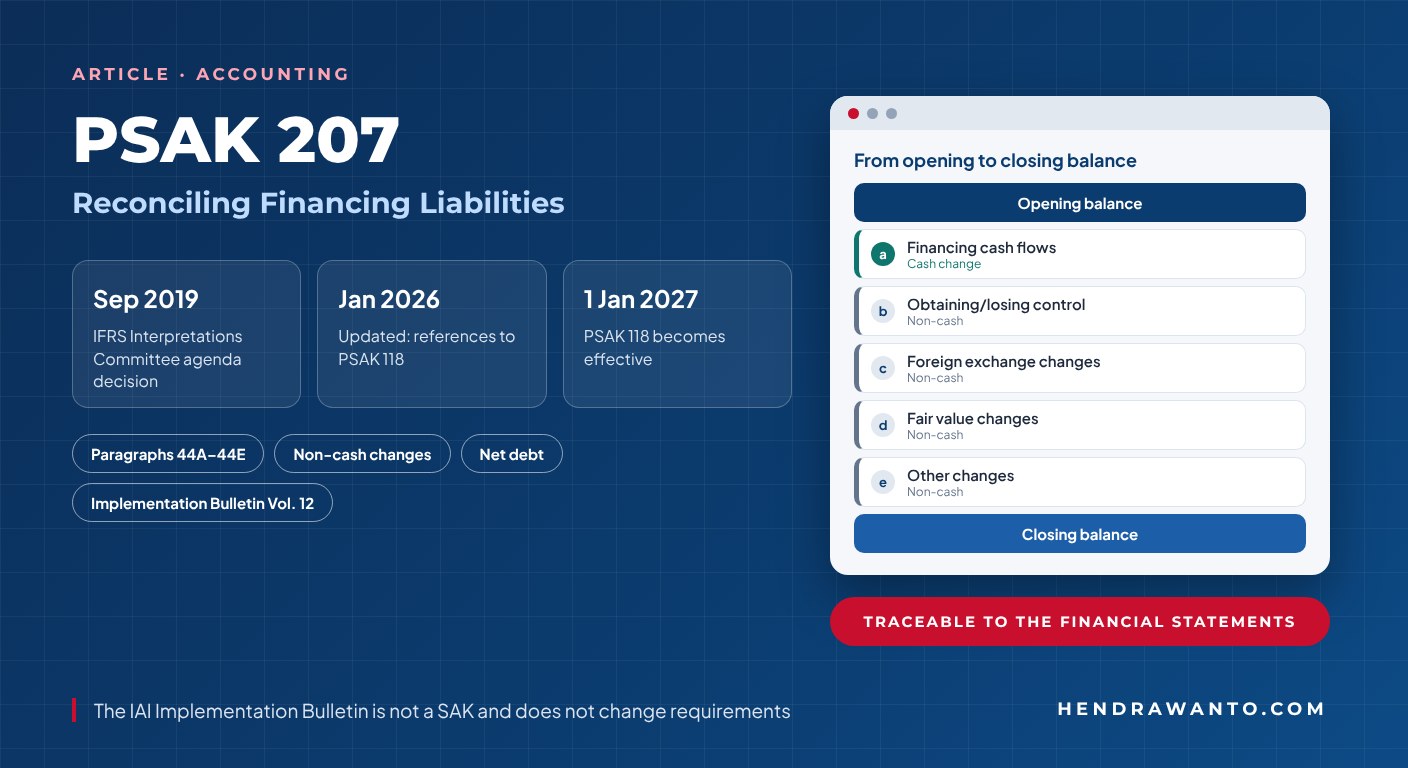
Paragraph 44B of PSAK 207, as described in the bulletin, requires an entity to disclose the following changes to the extent necessary to meet the objective in paragraph 44A:
- changes from financing cash flows;
- changes arising from obtaining or losing control of subsidiaries or other businesses;
- the effect of changes in foreign exchange rates;
- changes in fair values; and
- other changes.
The words "to the extent necessary" matter: the list is not a reason to show irrelevant empty rows, but a tool to test whether movements in the balance have been sufficiently explained.
- aFinancing cash flows linked to the statement of cash flows
- bObtaining/losing control of subsidiaries or businesses
- cForeign exchange changes
- dFair value changes
- eOther changes
According to the bulletin, paragraph 44D states that providing a reconciliation between opening and closing balances is one way to meet the disclosure objective, not the only prescribed form. If that approach is chosen, the information must enable users to link reconciling items to the statement of financial position and the statement of cash flows, or related notes. Paragraph 44E requires changes in financing liabilities to be disclosed separately from changes in other assets and liabilities. Readers then do not have to guess whether a difference in the balance came from cash payments, exchange rate movements, business transactions, or other events.
Aggregation, Disaggregation, and Additional Explanation
The level of detail is a matter of judgement. The bulletin links paragraph 44B of PSAK 207 with paragraphs 41–42 of PSAK 118, including paragraph 41(e), which requires ensuring that aggregation and disaggregation do not obscure material information. According to the bulletin, each material class of liabilities and each material reconciling item—whether a cash or a non-cash change—is disclosed separately. Referring to paragraph 113(c) of PSAK 118, additional explanation may be needed so that each class and item shows sources of finance, helps users understand cash flows, and links to the financial statements.
For example, if a group of liabilities changes significantly because of a non-cash event, a short label without explanation may obscure the source of the change. Conversely, excessive detail on unimportant items can hide material information. The bulletin sets no quantitative threshold or standard format; materiality is still assessed in the entity's context.
How to Review the Note Before Issue
The following questions are a practical review tool based on the objective and principles in the bulletin, not a list of new requirements:
- Has every material class of financing liabilities been identified based on its cash-flow classification?
- Are material cash and non-cash changes shown separately?
- Can the opening balance, closing balance, and cash movements be traced to the statement of financial position and the statement of cash flows?
- Are changes in financing liabilities separated from changes in other assets and liabilities?
- Is there an "other" line or internal term (such as net debt) that needs explanation?
- Is the structure of the note consistent between periods, or is any change explained so comparative information remains understandable?
If an entity is preparing to apply PSAK 118, the review should also consider how its aggregation and disaggregation requirements affect the financing note. See also the article on PSAK 118 and the new income statement from 2027. The final decision must still rest on the text of the standard applicable to the relevant period, not merely on this summary.
Conclusion
The key message of IAI Implementation Bulletin Vol. 12 is that paragraphs 44B–44E of PSAK 207, together with PSAK 118, already provide an adequate basis for explaining changes in financing liabilities. A good reconciliation is not just a table that balances arithmetically: it helps users understand sources of finance, separate cash flows from non-cash changes, and trace figures to the primary financial statements. The bulletin helps readers interpret those requirements, but it does not create a new standard.
Need help preparing notes to the financial statements? See the Accounting & SAK Implementation service.
Official References
- IAI: Implementation Bulletin Volume 12 (May 2026, Indonesian)
- IAI: PSAK 207 Statement of Cash Flows (Indonesian)
- IAI: Approval of PSAK 118 Presentation and Disclosure in Financial Statements (Indonesian)
- IFRS Foundation: Supporting materials for IAS 7
- IFRS Interpretations Committee: Disclosure of Changes in Liabilities Arising from Financing Activities (IAS 7), updated January 2026
This article is general information and does not replace reading the full PSAK or professional judgement on specific facts and reporting periods. Check the applicable SAK text and IAI's official announcements before setting accounting policies or disclosures. The Indonesian version is the original text.