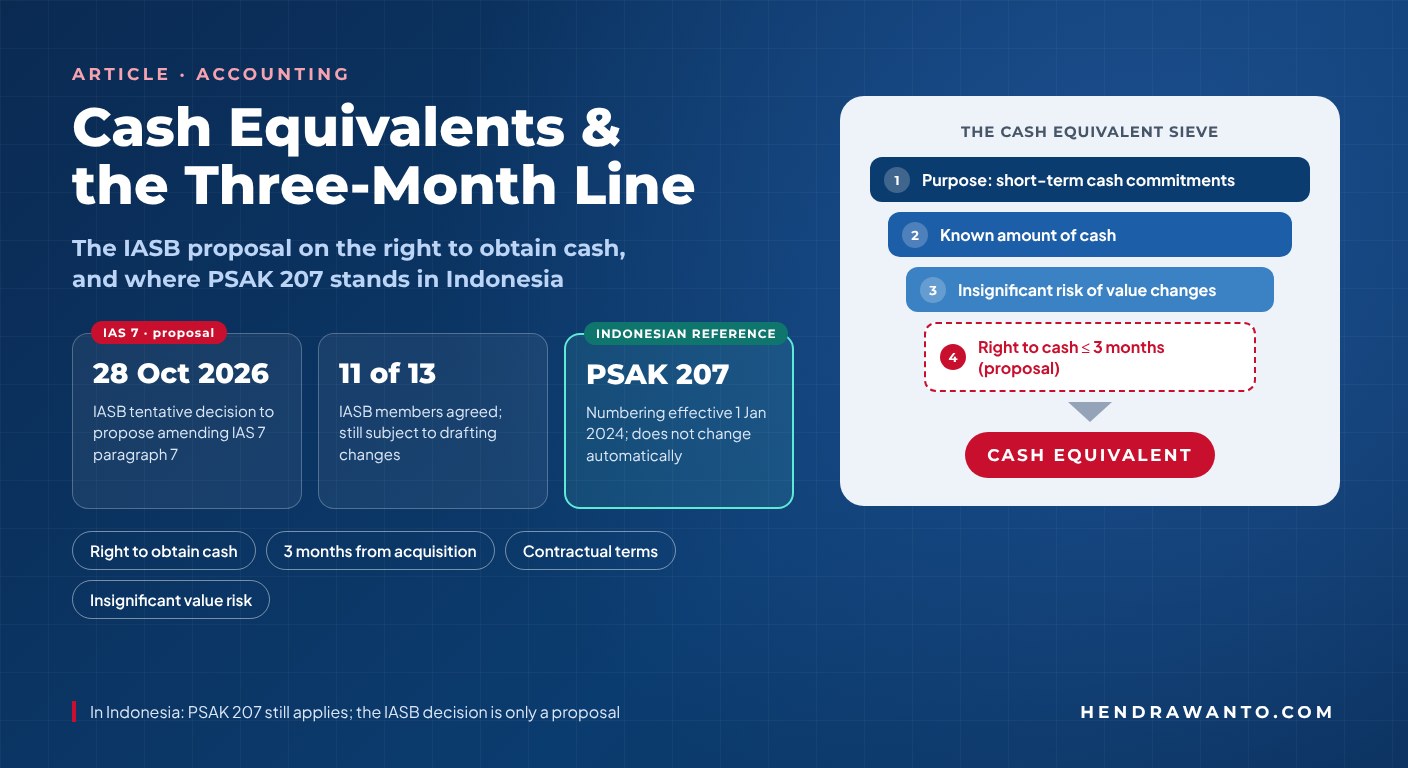
The term cash equivalent sounds simple: an investment that is almost the same as cash. In practice, classification requires more than looking at when an instrument can be sold or redeemed. The purpose for holding it, the certainty of the amount of cash to be received, the risk of changes in value and the contractual terms are all relevant. A debate about one part of that assessment surfaced again at the International Accounting Standards Board (IASB) meeting at the end of October 2026.
According to the IASB Update for October 2026, at its meeting on 28 October 2026 the Board tentatively decided — with eleven of thirteen members agreeing and subject to drafting changes — to propose amending paragraph 7 of IAS 7 Statement of Cash Flows. The direction of the proposal: an investment normally qualifies as a cash equivalent only if the entity has a right to obtain the cash flow from that investment within three months of the acquisition date, and in assessing that condition the entity considers all relevant contractual terms and conditions. The words "tentative" and "propose" matter: the meeting decision is not a final amendment to IAS 7, let alone an automatic change to Indonesian accounting standards.
What Applies Today?
IAS 7 defines cash equivalents as short-term, highly liquid investments that are readily convertible to known amounts of cash and are subject to an insignificant risk of changes in value. Paragraph 7 of IAS 7 — as quoted in an IASB staff paper for the April 2026 meeting — adds that cash equivalents are held for the purpose of meeting short-term cash commitments rather than for investment or other purposes, and that an investment normally qualifies only when it has a short maturity of, say, three months or less from the date of acquisition. How quickly an instrument can be sold in the market is therefore not, by itself, enough to call it a cash equivalent.
In Indonesia, IAI lists PSAK 207 Laporan Arus Kas (Statement of Cash Flows) as the standard requiring information about historical changes in cash and cash equivalents through a statement of cash flows. The IAI page explains that the renumbering from PSAK 2 to PSAK 207 was approved on 12 December 2022 and became effective on 1 January 2024. That numbering is the Indonesian reference; the IASB discussion in this article concerns IAS 7 at the international level. Preparers must still check the text and status of the PSAK applicable to their reporting period. For another disclosure topic under the same standard, see also PSAK 207: Reconciling Financing Liabilities.
PSAK 207 Statement of Cash Flows
- PSAK 207 numbering effective 1 January 2024
- Cash equivalent definition: liquid, known amount of cash, insignificant risk of value changes
- The basis for preparing financial statements today
IASB tentative decision
- Meeting of 28 October 2026; 11 of 13 members agreed
- Proposes amending IAS 7 paragraph 7: right to obtain cash within three months of acquisition
- Not a final amendment; no effective date stated
An IAI Implementation Bulletin Volume 2 (June 2023) on investments in shares or money market fund units that can be redeemed at any time stresses two elements of the cash equivalent definition in PSAK 207: the amount of cash to be received must be known at the time of the initial investment, and the risk of changes in value must be insignificant. The bulletin also notes that being convertible into cash at any time is not enough to make such units cash equivalents. This shows why a product label or a quick-withdrawal feature should not replace an analysis of substance.
What Exactly Is the IASB Proposing?
In its discussion of the statement of cash flows project on 28 October 2026, the IASB tentatively decided to propose amending paragraph 7 of IAS 7. The planned clarification focuses on the entity's right to obtain the cash flow within three months of the acquisition date and on assessing all relevant contractual terms. The word "right" directs attention to the entity's contractual position, not merely to an expectation that the instrument can usually be turned into cash quickly.
Practical questions might include: is a withdrawal right actually available to the holder of the investment; are there notice periods, restrictions or other conditions that affect when cash can be obtained; and can the amount of cash to be obtained be determined reliably? These questions are a general analytical tool, not a conclusion that a particular type of instrument is always in or always out of cash equivalents. The contractual terms and the applicable accounting framework still need to be read case by case.
- 1PurposeHeld to meet short-term cash commitments, not for investment.
- 2Known amount of cashReadily convertible to a known amount of cash.
- 3Value riskInsignificant risk of changes in value.
- 4Time frameToday: short maturity of, say, three months or less from acquisition.IASB proposal: right to obtain cash within three months of acquisition, considering all contractual terms.
The IASB also noted a request from some members that, when the drafting is finalised, it be made clear that the decision does not change the requirement for an investment to meet all aspects of the cash equivalent definition. Passing the time-frame test alone is therefore not automatically enough. The investment must still be liquid, convertible to a known amount of cash, subject to an insignificant risk of changes in value, and held for meeting short-term cash commitments. The IASB summary states no effective date or specific next step for this topic; the Board says only that it will continue to consider each topic in the statement of cash flows project plan.
Why "Can Be Sold" Differs from "Has a Right to Obtain Cash"
An available market price may indicate liquidity. However, the ability to sell an asset to another party is conceptually different from a contractual right to receive a cash payment from the investment itself. If sale proceeds move with market prices, the certainty of the amount of cash also needs to be reviewed. Likewise, an instrument with a near maturity does not automatically meet the whole definition if the purpose of holding it or its value risk does not fit.
The distinction helps preparers avoid shortcuts such as "every product that can be redeemed immediately is a cash equivalent". The IAI bulletin gives the money market fund context: redeemability at any time must still be tested for whether the amount of cash is known from the start of the investment and whether the risk of changes in value is insignificant. The bulletin does not say that all money market fund units always qualify or never qualify. The conclusion depends on the facts of the product.
- IAI Implementation Bulletin Vol. 2Redeemable at any time is not enough; the amount of cash must be known from the start.
- PSAK 207 numbering effectivePSAK 2 becomes PSAK 207 Statement of Cash Flows.
- IASB staff paperDiscusses consistent application of the cash equivalent definition.
- IASB tentative decisionProposes amending IAS 7 paragraph 7; 11 of 13 members agreed.
- Discussion continuesNo final amendment and no effective date yet.
What Should Preparers in Indonesia Do?
First, map the instruments currently included in cash and cash equivalents. For each instrument that requires judgement, keep the contract, redemption terms, purpose of holding, and the basis for assessing the amount of cash and its value risk. That documentation makes the accounting policy easier to explain and keeps classification consistent across reporting periods.
Second, separate monitoring of international developments from applying PSAK today. The IASB tentative decision is a useful signal of where the discussion is heading, but it is no basis for saying PSAK 207 has changed. If the IASB later issues a final amendment, it will still be necessary to check whether and when the change is adopted into Indonesian standards by the competent standard setter. Until there is an official basis, financial reporting policies need not be changed merely because of an international meeting summary.
Third, test the consistency of classification with the investment purpose and contractual information. Similar instruments may require different analyses if their redemption rights, value risk or intended use differ. When material doubt arises, record the judgement explicitly and evaluate the disclosure needed under the applicable PSAK. This is more useful than setting one mechanical rule for every product.
Conclusion
The IASB's October 2026 meeting clarified the direction of a proposal: assessing the right to obtain cash within three months of acquisition, together with all contractual terms, when considering the time-frame element of cash equivalents. The proposal has not yet amended IAS 7 in final form and does not automatically change PSAK 207. For preparers in Indonesia, the most useful step now is to test each instrument against the current definition, the purpose of holding, the certainty of the amount of cash, the risk of changes in value and its contractual documents.
Need a discussion of applying SAK to the classification of cash and cash equivalents? See the Accounting & SAK Implementation service.
Official References
- IFRS Foundation: IASB Update October 2026 — Statement of Cash Flows and Related Matters (cash equivalents)
- IASB: Agenda Paper 20A (April 2026) — Improving consistent application of the definition of cash equivalents
- IFRS Foundation: IAS 7 Statement of Cash Flows
- IAI: PSAK 207 Laporan Arus Kas (Statement of Cash Flows)
- DSAK IAI: Implementation Bulletin Volume 2 (June 2023)
This article is general information, not accounting advice for any specific transaction. Classification decisions must follow the applicable PSAK and requirements together with the facts and documents of the instrument concerned. Check official IAI and IFRS Foundation publications before making decisions. The Indonesian version is the original text.