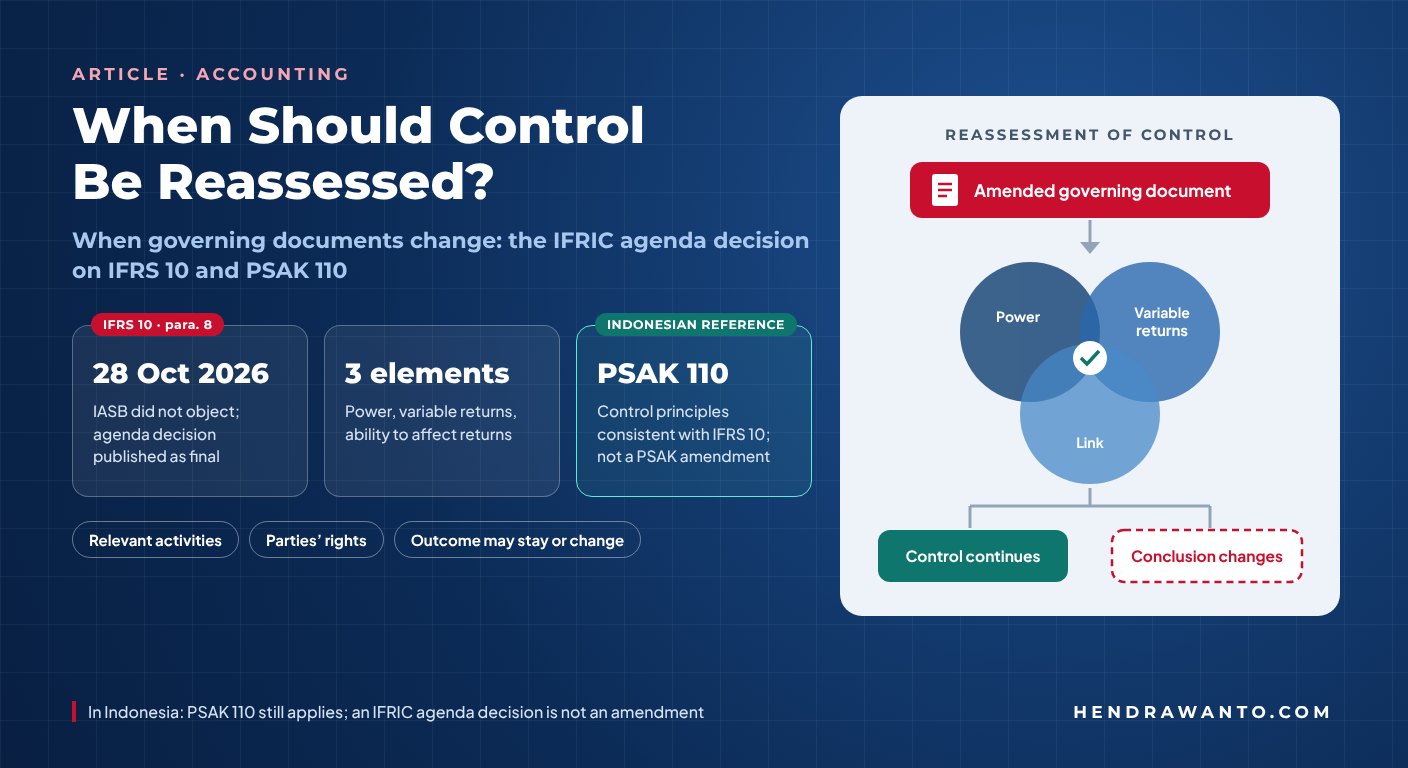
An entity’s founding or governing documents can change while it operates. Changes to decision-making rights, to how key activities are directed, or to the powers of other parties can affect the assessment of who controls that entity. The accounting question is not only whether the investor still holds the same number of shares, but whether new facts require the investor to reassess the elements of control on which consolidation is based.
In October 2026, the IFRS Foundation published the final agenda decision of the IFRS Interpretations Committee on reassessing control under IFRS 10 Consolidated Financial Statements. The decision appears as an addendum to the IFRIC Update of September 2026 and deals with amendments to an investee’s governing document that could change the relevant activities and the rights of the investor and others over those activities. For the fact pattern submitted, feedback indicated that the entity reassesses whether it still has control. The outcome of that reassessment may stay the same or change.
The Fact Pattern in Question
In the fact pattern described by the Committee, the investor was involved when the purpose and design of the investee were set and, at that time, concluded that it controlled the investee. Later, the investee’s governing document was amended in a way that could change the relevant activities and the parties’ rights over them. The question was whether, in accordance with paragraph 8 of IFRS 10, the amendment requires the investor to reassess whether it still controls the investee. That paragraph requires an investor to reassess control when facts and circumstances indicate changes to one or more of the elements of control.
According to the IASB staff paper for the October 2026 meeting (AP12A), the tentative agenda decision was published after the Committee’s March 2026 meeting and received 15 comment letters. The evidence gathered by the Committee indicated no diversity in practice on the question, so the matter was judged not to have widespread effect and the Committee decided that no standard-setting project was needed. At its 15–16 September 2026 meeting, the Committee decided to finalise the agenda decision.
The decision is not a rule that every document change causes the investor to lose control. Its focus is the need to retest an earlier conclusion when a change could alter the relevant facts.
- IAI Bulletin Vol. 7Discusses control under PSAK 110; its principles are consistent with IFRS 10.
- Tentative agenda decisionPublished for comment; 15 comment letters received.
- Committee finalisesNo diversity in practice; no standard-setting project needed.
- IASB does not objectAgenda decision published as final in an IFRIC Update addendum.
- PSAK 110 still appliesAn agenda decision is not an amendment to PSAK.
The IFRS Foundation project page records that the IASB, at its October 2026 meeting, did not object to the agenda decision in accordance with paragraph 8.7 of the Due Process Handbook. The IASB Update for October 2026 states that at the 28 October 2026 meeting no IASB member objected. However, an agenda decision is not an amendment to IFRS 10. It does not add or change requirements in the standard; it explains how existing principles apply to a particular fact pattern.
What Is Assessed When Control Is Re-examined?
Assessing control is not simply a matter of ownership percentage. The DSAK IAI Implementation Bulletin Volume 7 (PSAK 110 section dated August 2025) summarises that an investor controls an investee if and only if it has all of the following: power over the investee, exposure or rights to variable returns from its involvement, and the ability to use its power to affect the amount of those returns. The bulletin stresses that PSAK 110 sets no quantitative threshold for the size of exposure to variable returns; the investor must assess all its rights and involvement with the investee.
When governing documents change, preparers need to determine which part of the relationship may have changed. Relevant activities are the activities of the investee that significantly affect its returns. If an amendment changes who has the right to direct those activities, the earlier assessment of power may no longer reflect the current position. Other parties’ rights must also be re-read, because changes to their rights can alter the investor’s ability to carry out decisions.
- 1TriggerAn amendment to governing documents that could change relevant activities or the parties’ rights.
- 2Relevant activitiesWhich activities now most significantly affect the investee’s returns?
- 3Rights mapCompare the rights of the investor and others before and after the amendment, and its effective date.
- 4Three elementsPower · exposure to variable returns · link between power and returns.
- 5Conclusion & memoDocument the reasons and the effect on consolidation and disclosure.
Signed documents provide an important basis, but the assessment does not end with reading the title or summary of an amendment. Preparers need to compare rights before and after the change, determine when the change takes effect, and look at how decisions about relevant activities are now made. If a change is merely administrative and does not alter the relevant control facts, the assessment may end with the same conclusion. If substantive rights change, the conclusion may differ. Either way, it must be supported by traceable analysis.
Reassessing Does Not Mean Automatically Deconsolidating
The difference between process and outcome matters. A requirement to reassess means the earlier conclusion must be tested against new facts; it does not yet answer who controls the investee after the change. The agenda decision itself states that the entity’s conclusion on control may or may not change as a result of the reassessment. The outcome depends on the rights, the relevant activities, and the link between power and returns after the amendment.
Control continues
- All three elements are still met after the amendment
- Consolidation continues
- Keep a memo explaining why the conclusion did not change
Conclusion changes
- One or more elements are no longer met (or are newly met)
- Identify the date the facts changed
- Assess accounting and disclosure consequences under the applicable PSAK
No shortcuts: a document change does not automatically remove control, and consolidation should not be kept without reading substantive changes.
An immediate reaction of removing an investee from the consolidated financial statements merely because a document changed can therefore be misleading. Conversely, continuing to consolidate without reading substantive changes is also risky. Preparers should document the analysis and the date the facts changed, then determine the reporting effect under the applicable standards. If the conclusion changes, the accounting consequences must be examined separately; this agenda decision does not set out the treatment for every form of change in control.
Nor does the agenda decision remove the need for judgement in more complex fact patterns, for example when changes in the parties’ rights occur through several documents or actions at different times.
The Position for Preparers in Indonesia
In Indonesia, the primary reference for consolidated financial statements is PSAK 110. DSAK IAI Implementation Bulletin Volume 7 states that the control principles in PSAK 110 are consistent with those in IFRS 10. That link makes the IFRIC agenda decision relevant analytical material, but it must not be presented as if IFRIC had issued an amendment to PSAK. The applicable PSAK and the facts of the transaction still determine conclusions in domestic financial statements. Entities applying SAK EP follow different consolidation requirements; see IFRS for SMEs Consolidation Exception and SAK EP.
Practical steps:
- Keep the versions of the governing documents before and after the amendment, with the approval minutes and effective date.
- Map decision-making rights over the activities that most affect returns, including the rights of other parties.
- Test each of the three elements of control and record which ones changed.
- Summarise in a short memo: the reasons for keeping or changing the conclusion and the effect on consolidation and disclosure.
This documentation also helps auditors understand the basis for management’s judgement. For subsidiaries considering reduced disclosures, see also PSAK 119: Reduced Disclosures for Subsidiaries. For structures with layered rights or special arrangements, the analysis may require a full reading of the legal documents; this article does not determine the conclusion for any particular structure.
Conclusion
The IFRIC agenda decision finalised in October 2026 confirms that, in the fact pattern described, an amendment to governing documents that could change relevant activities and the parties’ rights triggers a reassessment of control under paragraph 8 of IFRS 10. The reassessment may lead to the same conclusion or a different one. For preparers in Indonesia, the main task is to test the three elements of control under PSAK 110 against current rights and facts, and to document the effects clearly.
Need help applying PSAK 110 to your investment structure? See our Accounting & SAK Implementation service.
Official References
- IFRS Foundation: IFRIC Update September 2026 and October 2026 addendum — Reassessment of Control (IFRS 10)
- IFRS Foundation: Completed project — Reassessment of Control (IFRS 10)
- IASB: Agenda Paper 12A (October 2026) — finalisation of the agenda decision
- IFRS Foundation: IASB Update October 2026
- DSAK IAI: Implementation Bulletin Volume 7 (PSAK 110, August 2025) — in Indonesian
This article is general information and not a determination of control for any entity. Analysis and accounting treatment must follow the applicable PSAK, the legal documents, and the facts of each investment relationship. Check official IAI and IFRS Foundation publications before making decisions. The Indonesian version is the original text.