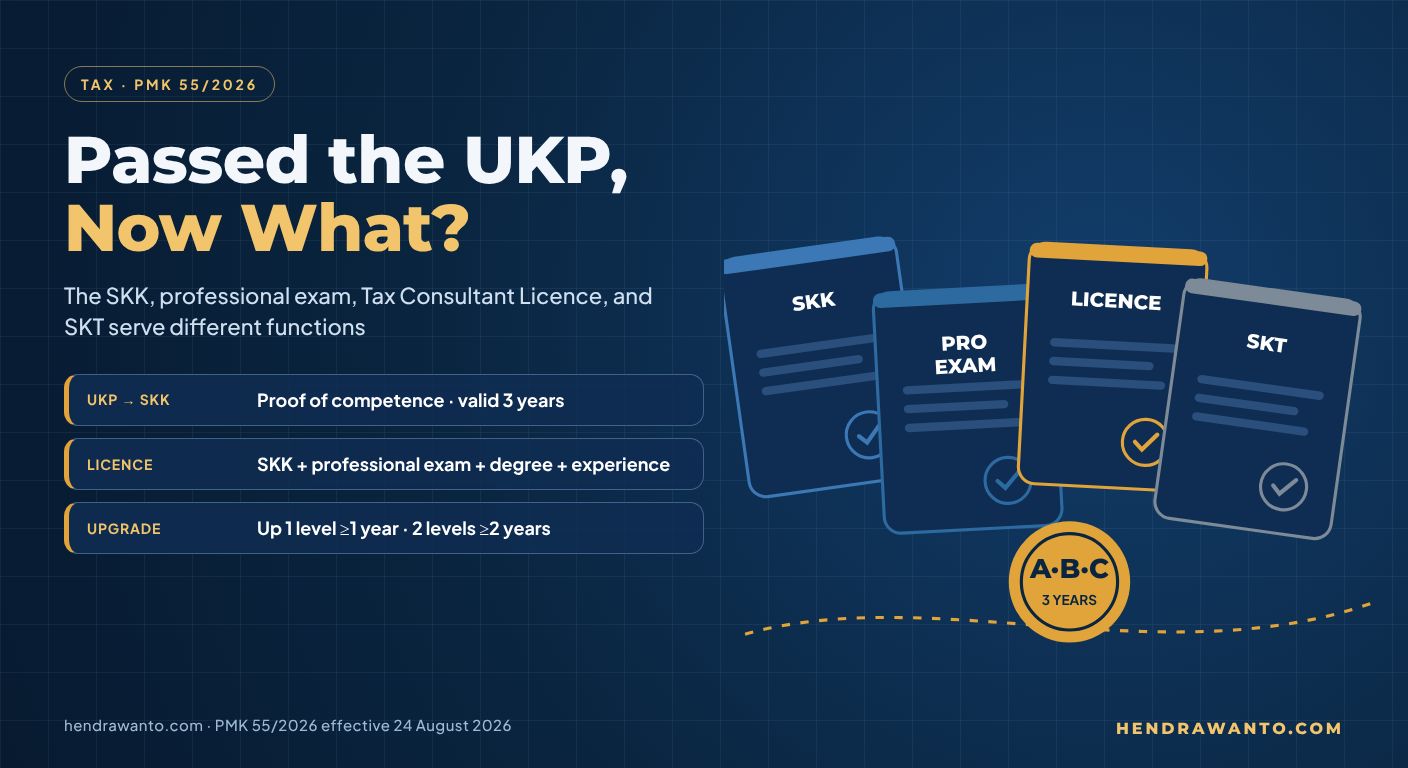
Picture a corporate tax officer who has just passed Indonesia's Tax Competency Test (Uji Kompetensi Perpajakan, UKP) at Level C. She knows the material, holds proof of competence, and wants to start advising clients. Can she immediately call herself a licensed Tax Consultant? The answer is not yet. That is why Minister of Finance Regulation (PMK) No. 55 of 2026 has to be read as a whole.
The regulation's official title is Tax Consultants and Other Parties Acting as Taxpayer Representatives. Its scope is far wider than exam procedures: it links proof of competence with licensing, institutions, professional conduct, and supervision. According to the Ministry of Finance legal database (JDIH), it was enacted on 22 July 2026 and promulgated and effective on 24 August 2026 (State Gazette 2026 No. 589).
The UKP Tests Competence; the Licence Grants Professional Status
Article 7 makes the tax competency test the route to an SKK: candidates must sit the test and pass. The Managing Unit runs the test and issues the SKK. In practice, UKP announcements are published on the Kemenkeu Learning Center certification portal (BPPK).
Article 5, however, sets broader requirements for a Tax Consultant Licence. Besides competence, applicants must pass the tax consultant professional exam run by a Tax Consultant Association, hold at least a bachelor's degree (S1) or equivalent, and meet other requirements.
Why does the separation matter? The ability to solve tax problems, readiness to practise a profession, and legal authorisation are three things that must each be proven. The claim "I passed the exam, so I may practise as a licensed consultant" skips the requirement checks and the licence itself. This reading of Article 5(2)–(3), Article 7, and Article 10 is the author's analysis.
Who May Register for the UKP?
Article 8 sets two requirements to sit the competency test: Indonesian citizenship and a tax ID in the form of a population ID number (NIK) activated as an NPWP. It does not require a bachelor's degree to sit the UKP. The S1 requirement appears only for the Tax Consultant Licence (Article 5).
| Aspect | Sitting the UKP (Art. 8) | Applying for a licence (Art. 5) |
|---|---|---|
| Citizenship | Indonesian | Indonesian |
| Tax identity | NIK activated as NPWP | Document showing NIK activated as NPWP |
| Bachelor's degree | Not mentioned | Required |
| Proof of competence | Obtained after passing | SKK matching the licence classification |
| Association professional exam | Not mentioned | Required; see transitional provisions |
| Work experience | Not mentioned | Regulated; documents for B and C differ |
Under Article 9, registration is filed electronically with the Managing Unit through the Ministry of Finance information system. If that system cannot yet be used, other media coordinated by the Managing Unit are available. Candidates follow the channel announced by the organiser rather than picking an alternative themselves.
Example. Rani, an Indonesian university student with an active NIK-NPWP, meets the two basic Article 8 requirements. Being eligible for the UKP does not mean she qualifies to apply for a consultant licence. For actual registration she still goes through the organiser's verification and operational rules. The table summarises selected aspects, not the full list of licence requirements.
A, B, C: Different Scope, Not Just Difficulty
The PMK distinguishes SKK classifications (Article 10) from licence classifications (Article 4). Both define the scope of competence and services, not academic rank.
A common misjudgement. A foreign-investment (PMA) company operates in Indonesia and all its documents are in Indonesian. Can a consultant with a B licence serve it because its transactions are domestic? That cannot be concluded. PMA companies are expressly excluded from the B licence scope; document language and transaction location do not change the company's classification. For individual clients, the test also goes beyond citizenship: check domicile in a treaty partner country. Identify the client category before accepting an engagement.
Exam content for each level is covered in our Indonesian-language guides: UKP Level A, Level B, and Level C.
SKK Validity and Experience Requirements
An SKK is valid for three years from its issue date. Renewal may be filed no earlier than one month before it expires and requires passing a refresher exam. Passing once does not make the proof of competence permanent.
Note the words no earlier than. They set when renewal may start, not a deadline. Do not rewrite them as "no later than one month before expiry"; the meaning differs. Registration mechanics and refresher schedules follow official announcements.
For B and C licences, Article 5(3)(e) details the experience documents: at least one year in aggregate within the last three years for a B licence, and at least two years in aggregate within the last three years for a C licence. Experience covers involvement in tax services provided by consultants to individuals and entities and/or handling a company's tax affairs. Article 5(2)(e) also requires an experience letter signed by the authorised head of the office or company and by a Tax Consultant acting as supervisor. Experience is more than a line on a CV.
Example. Dimas passed UKP C but has only eight months of relevant experience. His SKK C does not waive the experience requirement for a C licence. He should map the gaps before applying.
Other licence requirements include integrity, certain employment-status rules, disclosure of family relationships, and specific rules for former Ministry of Finance employees; the full list is in Article 5. False UKP registration data can invalidate an SKK, and false licence application data can lead to revocation (Article 6 and Article 10(7)–(10)).
Other Taxpayer Representatives and the 2026 Transition
The PMK also regulates other parties acting as taxpayer representatives, meaning parties other than Tax Consultants and family members as defined in Article 1. Article 50 applies the SKK provisions to them mutatis mutandis. Article 51 provides for an SKT signed by the Director General and issued together with the SKK, with a classification matching the SKK. The SKT is valid for three years and lapses if the holder dies or the SKK ceases to be valid.
The implication: an SKT must not be presented as a Tax Consultant Licence. The professional exam requirement in Article 5 applies to licence applicants; do not transfer it automatically to the other-representative route just because both use an SKK. For how representation works in practice, also read PMK 44 of 2026.
- EnactedPMK 55/2026 is signed.
- Promulgated & effectiveEffective on promulgation (Article 62). Existing Practice Permits remain valid as Tax Consultant Licences (Article 60(a)).
- Old certificationCertification under the old rules may still be held (Article 60(e)).
- Association examDeadline for associations to hold the professional exam (Article 61 point 1).
31 December 2026 is not the date on which every licence or certificate expires. Old Tax Consultant Certificates are recognised as an SKK for up to two years from their issue date and may be used to apply for a licence until the association holds the professional exam. Once that exam is held, holders of old certificates must take it as a licence requirement (Article 60(f)–(g)). Applications already in process before the new rules have their own transitional treatment. Do not lump together existing licence holders, old certificate holders, and new UKP candidates. Check actual exam dates with the association. The role of associations, the membership deadline, and CPD duties are covered in Tax Consultant Associations After PMK 55/2026.
Practical Steps Before and After the UKP
In the author's experience, good preparation links the exam target to the work you intend to do. Chasing a higher classification without checking licence and experience requirements can leave you with a certificate you cannot yet use as planned.
- Set the goalProof of competence, a consultant licence, a licence upgrade, or the other-representative route? The goal decides the documents.
- Map your clientsIndividuals, entities, PMA companies, permanent establishments, domicile and treaty status. Choose the level that covers them.
- Audit your documentsCheck your NIK-NPWP, degree, experience, supervisor, and certificate validity.
- Use official noticesSchedules, fees, format, syllabus, equipment, and pass criteria are announced per period.
- Practise the reasoningSpot the issue, find the legal basis, and explain why the other options are wrong. Try the UKP simulation game.
- Plan beyond passingPrepare the licence or registration step and an SKK renewal calendar. Avoid using titles or statuses you have not obtained.
PMK 55/2026 is not a technical notice for any UKP period. This article does not set the number of questions, duration, pass mark, fees, venues, or registration dates; use the official notice for your period. UKP rules and sample questions are also covered in UKP Replaces USKP in 2026.
Three Common Questions
Must candidates pass Level A before sitting Level C?
Article 8 does not set a mandatory A, B, then C sequence. Do not conclude either that order is free or that it is mandatory without reading the organiser's technical rules. Licence upgrades have their own rules in Articles 12–13.
Are old certificates immediately invalid?
That conclusion is not accurate. Article 60 distinguishes existing licences, pending applications, old certificates, and old-style certification. Check your certificate's issue date and when the association holds its professional exam.
Is the three-year validity the same for every document?
The SKK and SKT are each valid for three years under Articles 10 and 51. That rule does not automatically apply to the Tax Consultant Licence or to old certificates governed by the transitional provisions.
Closing: Competence Is the Foundation
Passing the UKP is an important achievement. Its value grows when followed by an understanding of the limits of authority, meeting licence requirements, and responsibility in serving taxpayers. In the author's view, PMK 55/2026 aims to draw a clearer line between people who are competent, parties authorised to provide services, and the supervision mechanism. The right question is not only "how do I pass?" but also "which documents do I need for the work I plan to do?"
For fellow accountants and auditors: other professional certifications do not automatically replace an SKK or the full Tax Consultant Licence requirements. Check your basis of authority before offering or accepting a tax engagement.
Article Map of PMK 55/2026
| Topic | Reference |
|---|---|
| Licence status and classification | Articles 1, 3–4 |
| Licence application requirements | Articles 5–6 |
| UKP, registration, SKK, refresher | Articles 7–11 |
| Licence upgrades | Articles 12–13 |
| Other representatives and SKT | Articles 50–55 |
| Transition, revocation of old rules, effectiveness | Articles 60–62 |
References
- JDIH Ministry of Finance: PMK 55 of 2026 (enacted 22 July 2026; promulgated and effective 24 August 2026; State Gazette 2026 No. 589).
- Directorate General of Taxes: PMK 55/2026 publication.
- PMK 44 of 2026 on taxpayer representatives.
- Kemenkeu Learning Center: certification portal and FAQ for UKP services and notices.
This educational article separates a summary of the rules from the author's analysis; it is not legal advice for any specific case. Check technical rules for each period and developments on the professional exam through official channels when registering. Visuals are editorial illustrations; animations do not depict exam duration or document processing.